
400-year-old temple hidden behind weeds

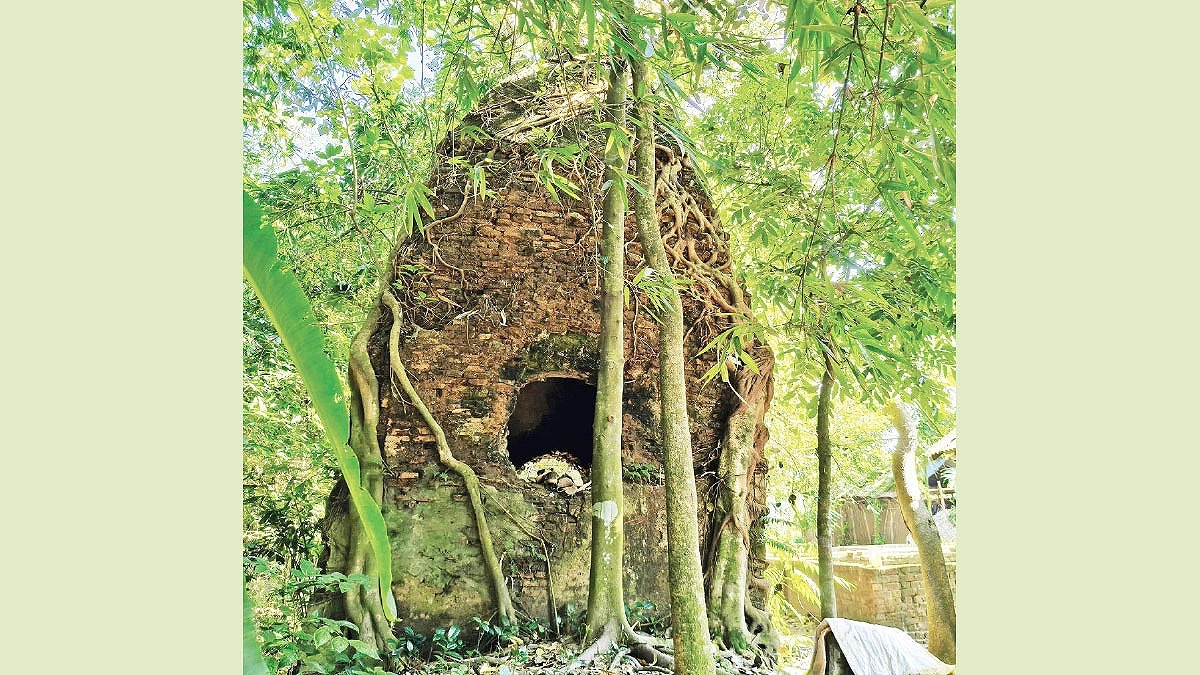
Photo: Agamir Somoy
The Jor Mandir or the Twin Temple in Thakuradah village under Gangachara Upazila of Rangpur was once vibrant with the beating of dhak (drums), the sounding of conch shells, and the bustle of crowds.
People gathered from far and wide for worshipping, attending Raas Leela, and local fairs. Today, the grounds of this 400-year-old temple complex stand in silence, shrouded in weeds, bamboo groves, and overgrown jungle. Portions of the walls have collapsed, rooms have caved in, and the exposed brickwork bears the scars of time. What remains of the structure seems to silently tell the story of a forgotten community.
Located in Barabil Union of the upazila, the site is locally known as Jor Mandir. Residents claim the temple is around 400 years old, though they acknowledge that further research is needed to confirm its exact age, construction period, and origin story. In the local history book Gangachara Upazilar Itihas O Oitijhya (History and Heritage of Gangachara Upazila), the temple is noted as having been built in the 18th century or earlier.
The ruins themselves offer subtle clues to that past. According to locals, the temple once featured two two-story spires alongside four smaller ones, with lion statues flanking the entrance. Only a single spire survives today. Terracotta motifs remain visible on the walls, and the architecture and brick style suggest it was an 18th-century (or earlier) Navaratna (nine-spired) style temple.
Other historical structures were once connected to the site. Nearby stood the "Sheikh Kuya" (Sheikh's Well), where locals claim several touchstone statues were once kept. To the south was a three-story monastery from the same era, which was destroyed during the Pakistan period. While these details are intertwined with local folklore, distinguishing hard history from oral tradition remains a challenge.
Despite these uncertainties, the temple's past lives on in the memories of village elders. Local resident Babu Jamini Chandra recalled, "The temple was once two stories high, its bricks adorned with intricate craftsmanship and animal figures. The grounds were always lively with regular worship, Raas Leela, and traditional fairs."
Kumod Roy similarly recalled crowds traveling from distant places for joining the fairs. Over time, however, those vibrant days came to a halt.
Abu Sayeed Inam Tanvirul, Field Officer at the Department of Archaeology in Rangpur, said that preliminary information is being gathered to assess the site's historical and archaeological importance. A report will be submitted to higher authorities following an official inspection.
Regional Director Dr. Ahmed Abdullah added that if adequate evidence is uncovered, a proposal for the temple's conservation will be forwarded to the head office.
