Cattle Markets, Poor Vendors Targetted
'Mini-Mint' Found in Flat; Target Cattle Markets
- Criminals active on social media
- Fake notes are being made in two ways
- They are often get out bail and involve in the same crime
- BBA students are members of the gang

Gangsters Mint Counterfeit Notes Ahead of Eid Ul Adha Celebration. Agamir Somoy.
A residential flat in the Bashon area of Gazipur appeared to be an ordinary home from the outside, but inside, a dangerous criminal operation was discovered. In a small room, three advanced color printers and a laptop were found alongside specialized paper and cutting equipment. Racketeers were printing 1,000-taka counterfeit notes via the laptop and the printers.
One after another, sheets of paper were fed into the machines, rapidly producing copies that looked like genuine currency. With three printers running simultaneously, the entire setup functioned like a small printing press—a veritable "mini-mint" for counterfeit money.
Acting on a tip-off, the Dhaka Metropolitan Police’s Detective Branch (DB) raided the flat on Wednesday. On the same night, RAB-3 raided a photocopy shop named "Cyber Net Cafe" in the capital’s Kamalapur area, arresting two individuals, including a specialist in making counterfeit notes. These groups in Gazipur and Kamalapur are not alone; several organized gangsters have launched missions to flood the market with fake currency ahead of Eid-ul-Adha.
Members of these syndicates are using social media platforms like Facebook, TikTok, Telegram, Instagram, and WhatsApp to advertise counterfeit notes with special offers. They lure buyers with attractive deals and establish contact through "secret groups." In many cases, they take advance orders and provide home delivery through agents in the capital and across the country.
Law enforcement officials stated that since new banknotes are not yet sufficiently available in the market, these syndicates were counterfeiting them for distribution. This group had been operating secretly for a long time, supplying fake currency to Dhaka, Gazipur, Narayanganj, and other regions. They planned to spread the counterfeit money specifically in cattle markets and shopping malls for the upcoming Eid-ul-Adha.
Investigators noted that the use of technology in producing counterfeit notes has increased. Organized groups are now operating on a smaller scale from within residential homes. Their activities typically peak during religious festivals and major shopping seasons.
Reportedly, counterfeiters use two main methods. One involves using high-quality paper, glue, and security threads. These are then processed using scanners and printing machines to create fake notes of any denomination. The second method is the "wash" technique, where genuine low-denomination notes are washed and dried. The original ink is removed, and a higher denomination is printed over the blank authentic paper—for instance, turning a washed 100-taka note into a 500-taka note.
According to DB sources, a man named Mujibur Rahman was arrested in Uttara on Wednesday. During the arrest, 400,000 taka in counterfeit notes and 40,000 taka in genuine cash from sales proceeds were recovered.
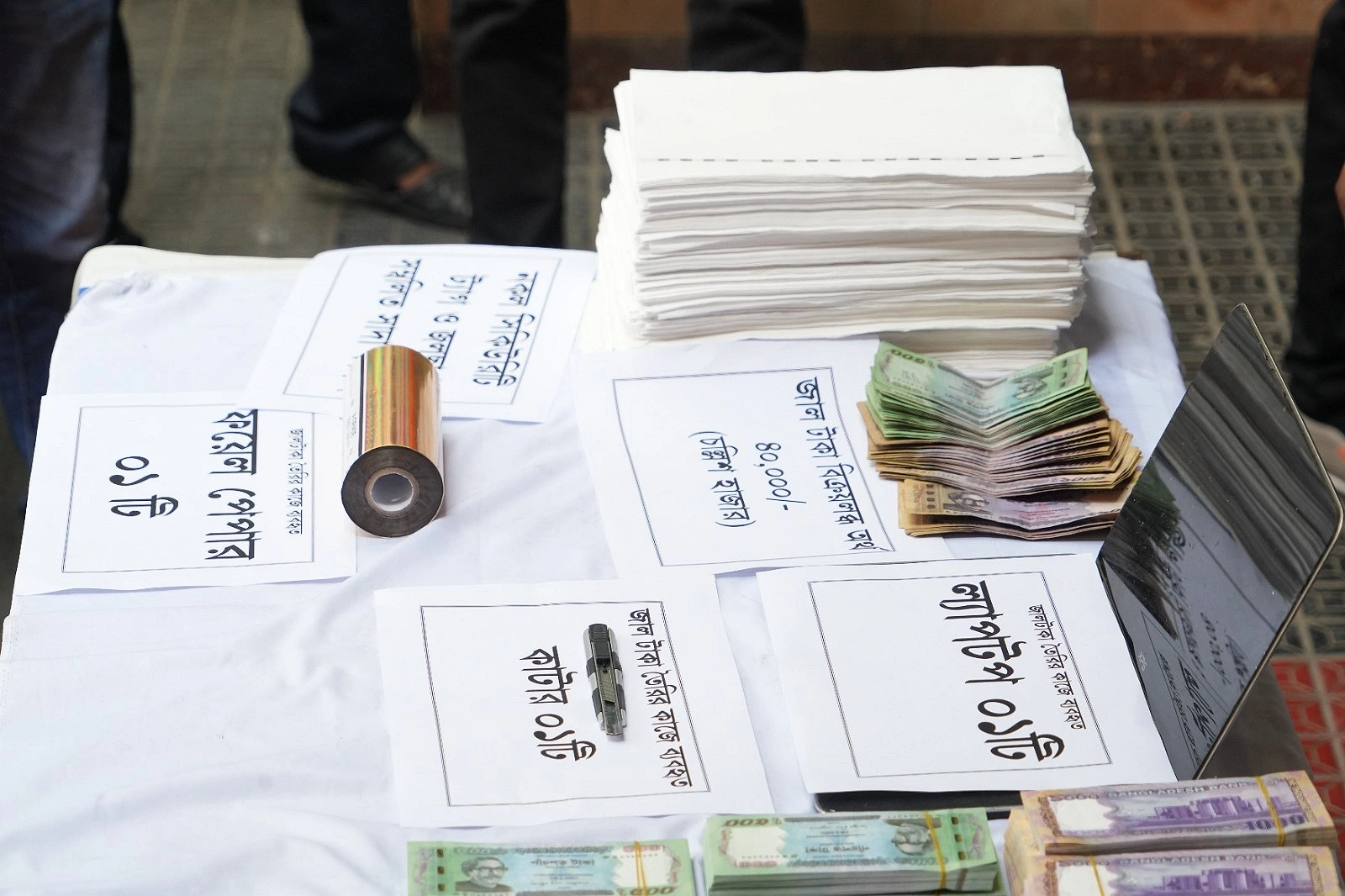
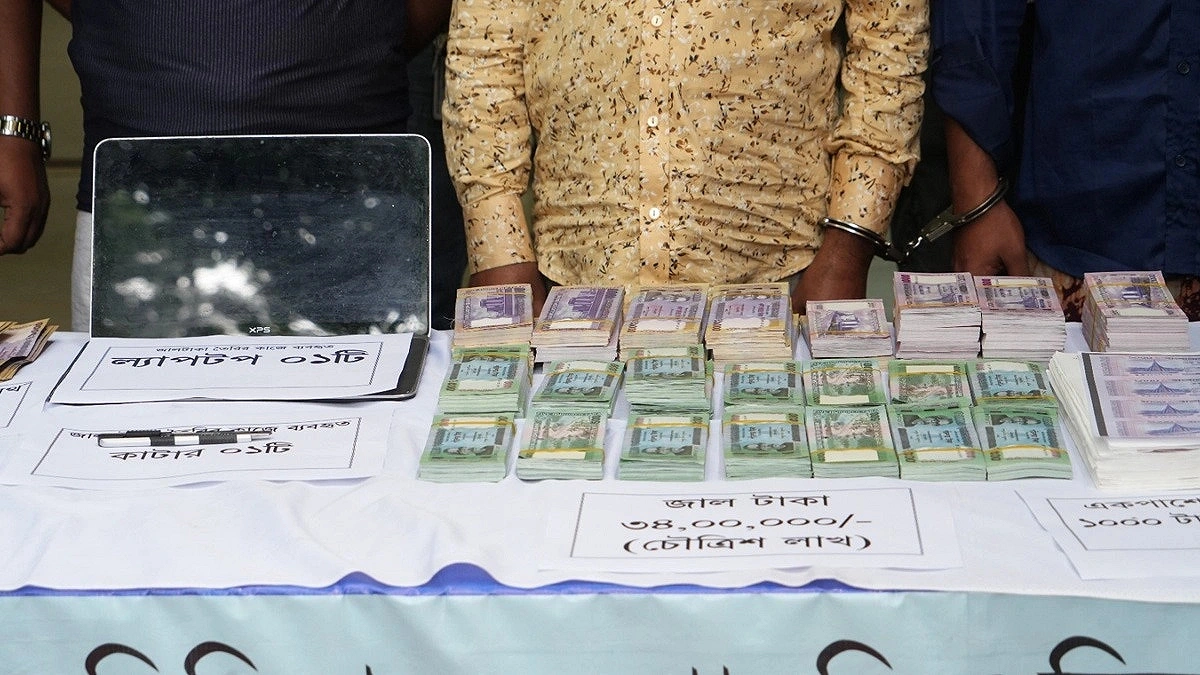
Based on information provided by him, detectives raided the flat in Gazipur’s Bashon later that afternoon, arresting Dulal Mridha and Mamun. The counterfeiting process was active at the time of the raid. Authorities seized 3 million taka in counterfeit notes, one laptop, three color printers, a roll of golden foil paper, and a large quantity of other forgery equipment. A case regarding the incident has been filed at the Uttara East Police Station.
Shafiqul Islam, Additional Commissioner (Intelligence) of the Dhaka Metropolitan Police, stated that the suspects confessed to supplying counterfeit notes not only in the capital but also across various districts. He said, "They have been producing and supplying fake currency to various areas including Dhaka, Gazipur, and Narayanganj for a long time. They also planned to flood cattle markets and shopping malls with counterfeit money for the upcoming Eid-ul-Adha. Members of this syndicate are named in multiple cases filed in Dhaka and other parts of the country."
He added, "Counterfeiters are frequently arrested, yet they often return to the same crimes after being released on bail. The syndicate members are active again this Eid, but the police remain on high alert. To flood the market before the festival, the group was continuously printing money using three machines. They even recruited a professional printing press worker to assist in the operation."
A DB official noted that during initial interrogation, the arrestees admitted to using technology to create counterfeit notes that closely resemble genuine ones, which were then distributed through various markets and traders.
Meanwhile, at midnight on the same day, RAB conducted a raid on a photocopy shop named "Cyber Net Cafe" on Kamalapur Bazar Road. A young man named Kamrul Islam, a member of the counterfeit ring, was detained. Following his lead, RAB-3 members raided a house in South Kamalapur and detained another individual named Nishad Hossain.
Authorities seized 40 counterfeit notes of 500-taka denomination from them, along with computers, printers, and other forgery equipment.
"One member of this ring is a first-year BBA student at Notre Dame University, who primarily served as a supplier. The shop operator handled the technical aspect of the forgery. Kamrul was arrested based on intelligence, and the other suspect was apprehended based on his information," said Saidur Rahman, Deputy Commander of RAB-3.
Saidur added that while counterfeit money has always existed, the most alarming aspect of this operation is that the group is forging brand-new banknotes that have not even reached the general public yet. He further noted that the syndicate is utilizing AI technology to produce these counterfeit notes.
According to relevant sources, counterfeiters are using various social media platforms to advertise the sale of fake currency. They establish contact with potential buyers by creating secret groups.
Some of these advertisements offer 100,000 taka in counterfeit notes for as little as 15,000 to 18,000 taka. To gain the trust of buyers, they even provide false promises such as "money-back guarantees" or quality assurance. The syndicates use coded language to avoid detection by the general public and authorities, using phrases like "new model color prints," "special offers for the Eid market," or "great opportunities" to promote counterfeit money as legitimate products.
It has been revealed that the more accurate the counterfeit note, the higher its price and demand. It costs approximately 7,000 to 8,000 taka to produce 100,000 taka worth of 1,000-taka fake notes. Syndicate members sell these to wholesalers for 12,000 to 18,000 taka. The wholesalers then sell them to the first level of retailers for 25,000 to 30,000 taka. These retailers, in turn, sell to a second tier for 40,000 to 50,000 taka. Finally, the second-tier retailers sell the notes at face value—100,000 taka—at the field level. In this manner, counterfeit notes gradually spread from rural villages to major shopping malls.
RAB stated that the fake money is released into the market in three stages. In the first stage, a bundle of 100,000 taka is sold wholesale for 25,000 to 30,000 taka. In the second stage, wholesalers sell these to retail traffickers for 40,000 to 45,000 taka. In the third and final stage, the retail traffickers use their own networks to strategically distribute the money across different areas. The primary targets of these counterfeiters are often the uneducated, elderly, poor, and low-income individuals.