

Kolkata’s Rooftops Turn Saffron: Is Psychology Shifting?

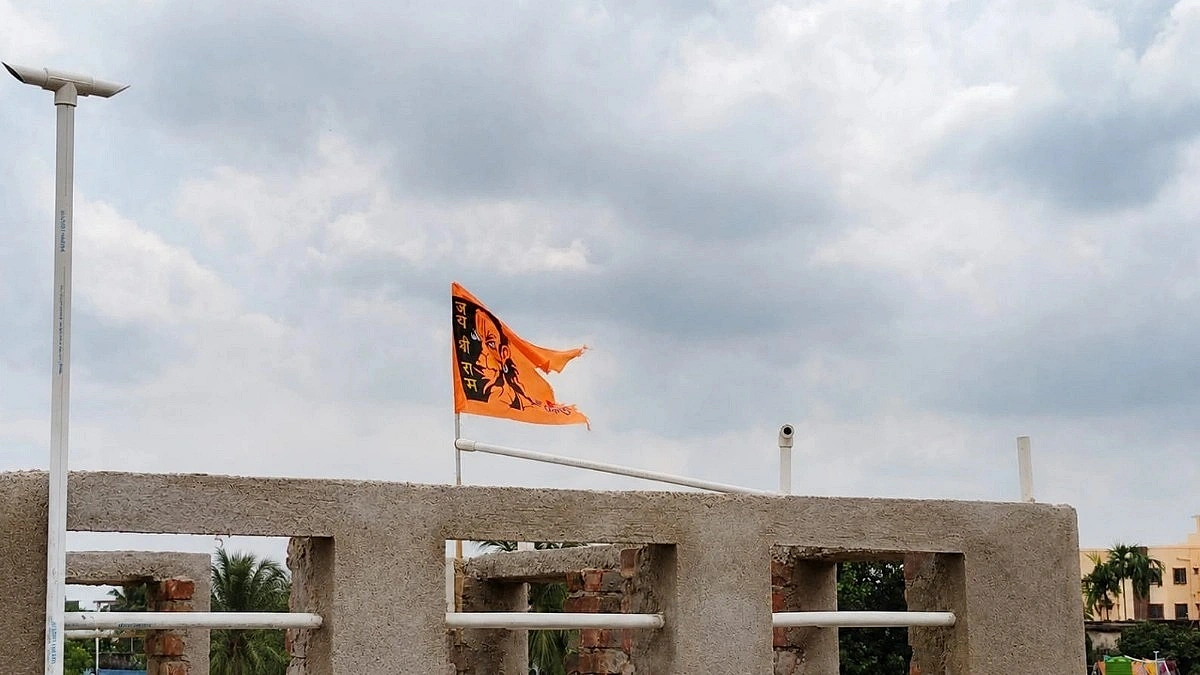
Not just in one or two places, saffron flags can be seen on rooftops across various neighborhoods.
As the monsoon approaches West Bengal, nature is also dressing up in full bloom. Buds of jarul, radhachura, and krishnachura have begun to blossom. Yet beyond these natural scenes, a different newcomer has been quietly appearing across Kolkata for several months. Not just in one or two places, but across neighborhoods, rooftops are increasingly seen flying saffron flags inscribed with ‘Jai Shri Ram’ in bold Hindi letters. Earlier, such a sight was rare, certainly not in this volume. The sharp rise in the sale of these flags, often featuring a faint image of Lord Hanuman, is evident. But what explains this change?
From South Kolkata to North Kolkata, and across many suburban areas, the sight is now common. In some places, one or two houses display them, while in others, entire rows of rooftops carry saffron flags. Naturally, this has drawn attention.
Arindam Mukherjee, a resident of Narendrapur in South Kolkata, said, “We have put up the saffron flag out of devotion.” He described it as a matter of personal religious belief. However, he avoided answering why the slogan was not written in Bengali.
At the same time, other questions are being raised. Bengali Hindus have traditionally worshipped Durga, Kali, and Krishna. Kolkata has long been known as the city of Durga Puja, a center of creativity and inclusiveness where festivals transcend religious boundaries.
In that sense, Rama worship is relatively new in the everyday religious practice of Bengalis. Moreover, the sudden visibility of “Jai Shri Ram” written in Hindi across so many places has led many to view the trend differently.
Nusrat Hasan, a social worker from Park Circus, said, “We have no issue with religion. But when you suddenly see the same thing everywhere, it feels a bit uncomfortable. We have not seen this before.”
Atiqul Islam, a teacher from South 24 Parganas, echoed similar sentiments. “Everyone should live in their own way, that is what we want. But the pace of this change is very fast—it is noticeable,” he said.
However, politician Amit Ghosh from Howrah offered a different perspective. “This is not just religion; it is becoming part of a larger identity. People now want to display that identity. When religion mixes with politics, it inevitably takes a dangerous form,” he said.
Many observers believe that over the past few years, subtle and direct attempts have been made to shift the psychological landscape of West Bengal society. In particular, the influence of Hindutva ideology associated with the BJP is gradually taking root. Although few openly acknowledge it, the issue repeatedly emerges in public discussions. Others point to the rapid spread of these trends through social media, where imitation plays a strong role. There are also claims that in some parts of the country, Muslims are being forced to chant “Jai Shri Ram,” with refusal sometimes leading to mob violence.
Kolkata has historically been a city that has embraced people beyond race, religion, caste, and language for generations. It is perhaps why poet Mirza Ghalib once said with affection that Kolkata had “pierced his heart like an arrow.”
Against this backdrop, the sudden presence of clusters of “Jai Shri Ram” flags on rooftops is not merely symbolic. It signals a quiet transformation unfolding within the city. While some accept it as normal, others quietly raise questions whether Kolkata’s familiar cultural fabric is gradually changing, little by little.