


Hong Kong activist Wong admits national security charge

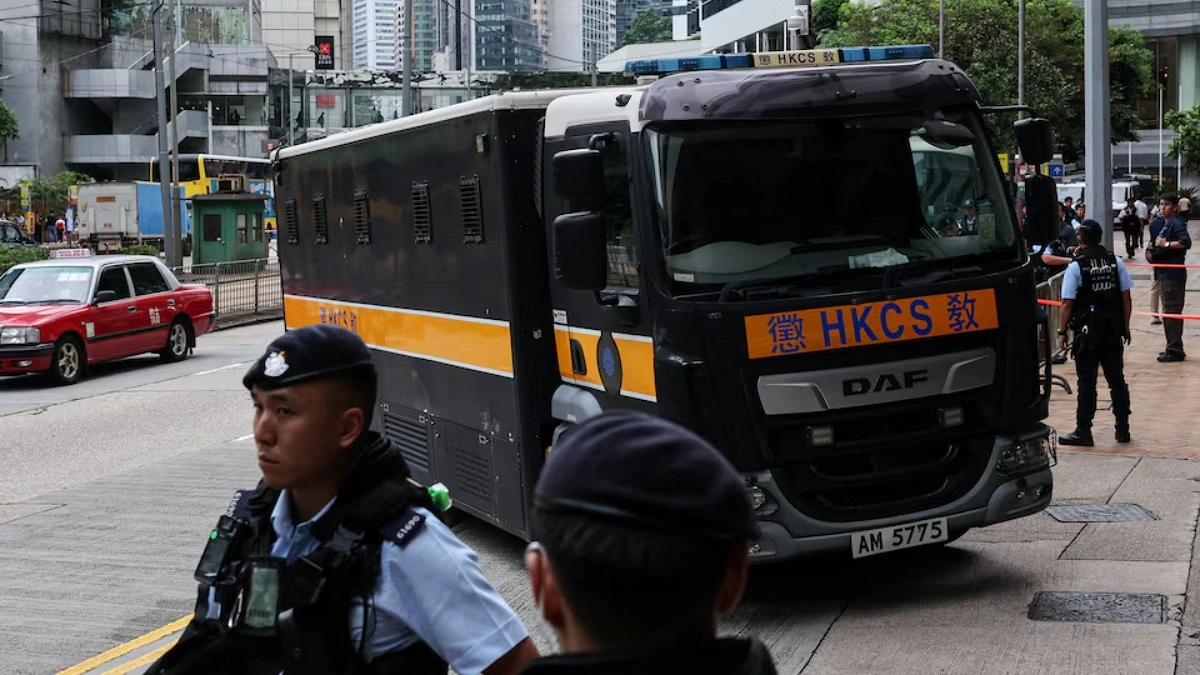
Photo: REUTERS
Hong Kong democracy activist Joshua Wong, 29, pleaded guilty in court on Wednesday to collusion with foreign entities.
The national security crime carries a maximum sentence of life in prison. Wong first gained international recognition as a teenage activist in Hong Kong. He belonged to a group of youth leaders whose protest activities became illegal after Beijing imposed a sweeping National Security Law on the Asian financial hub in 2020.
Dressed in a dark blue shirt and black-rimmed glasses, Wong waved and nodded to the gallery from the court’s dock and inhaled deeply at intervals. He then entered his guilty plea before a government-approved national security judge at the High Court of Hong Kong, located in the Admiralty district.
Several Western diplomats attended the court hearing. During the proceedings, the prosecution focused on an international media and political campaign run by Demosisto. Wong previously served as a leader of this now-disbanded political party, which had supported a referendum on Hong Kong’s sovereignty.
The prosecution alleged that this campaign aimed to trigger sanctions against Hong Kong and China during 2019 and 2020.
Wong is serving a prison sentence for a prior national security conviction of conspiracy to commit subversion. Authorities had arrested him alongside other democratic activists who participated in an unofficial primary election in 2020.
His prison term will conclude next year. A charge sheet that Reuters previously reviewed accused Wong of conspiracy with exiled activist Nathan Law and other individuals.
The document alleged that they petitioned foreign nations, institutions, organizations, or individuals outside China to enforce blockades or sanctions. The charge sheet stated that these hostile actions against Hong Kong or China occurred in 2020, specifically between 1 July and 23 November.
International human rights organizations and multiple Western nations are closely monitoring Wong’s prosecution and other similar cases to evaluate how authorities enforce the National Security Law.
His plea follows the conviction of two other activists last month for inciting subversion after they utilized the phrase “end one-party dictatorship” during their political campaigns.
Those individuals, Lee Cheuk-yan, 69, and Chow Hang-tung, 41, belonged to an association that organized annual vigils to commemorate the 1989 Tiananmen Square crackdown on pro-democracy demonstrators in Beijing.
Chinese government enacted Hong Kong’s National Security Law on June 30, 2020, following months of turbulent and occasionally violent pro-democracy protests that disrupted the city throughout 2019.
Western countries and global human rights groups have criticized the legislation, calling it excessive because it undermines the high degree of autonomy that Beijing guaranteed to Hong Kong after the British handed over control of the territory in 1997.
On the other hand, Chinese and Hong Kong officials argue that the law remains absolutely essential to re-establish public stability.
Source: Reuters (adapted)


