
What Mamata’s Defeat Means for Bangladesh

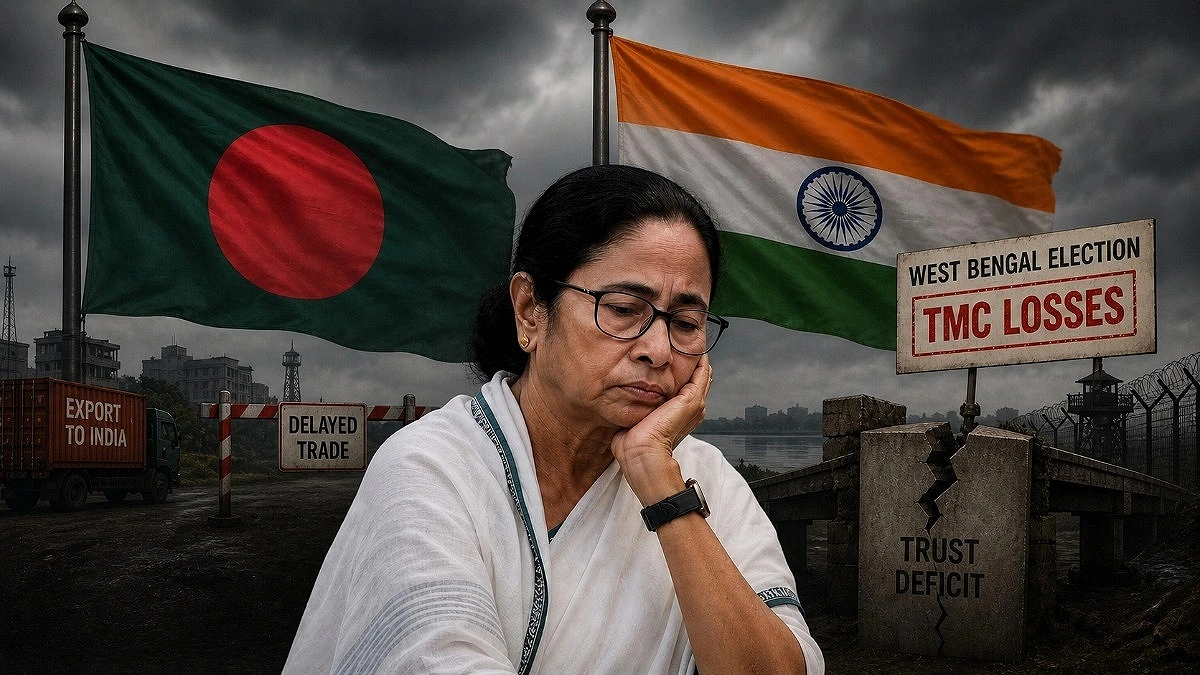
Graphics: Agamir Somoy
In the West Bengal Assembly election, the Bharatiya Janata Party (BJP) is set to form the government with a landslide victory. Unofficial results indicate that the BJP has won 208 seats. On the other hand, the Trinamool Congress (TMC) led by three-time Chief Minister Mamata Banerjee has secured 79 seats. In addition, the Communist Party of India (Marxist) has won 1 seat, the Congress 2 seats, and others have won 3 seats. Earlier, voting for 293 seats was held in two phases on 23 April and 29 April, with the results scheduled for 4 May.
An analysis of speeches delivered at election rallies shows that the BJP’s campaign prominently focused on the Bangladesh issue, particularly targeting the Hindu community. At the same time, a political narrative was constructed around Muslims. A significant section of Muslims in West Bengal was labelled as illegal Bangladeshi infiltrators, and as a result, many were reportedly deprived of voting rights in this election. Beyond campaign rhetoric, BJP leaders have also made controversial remarks about Bangladesh and Muslims on various occasions.
BJP leader Mithun Chakraborty had strongly alleged that the TMC was attempting to turn West Bengal into West Bangladesh. He also called upon Hindus to unite in order to resist this situation.
BJP leaders have consistently alleged that, during the TMC rule, unchecked infiltration from Bangladesh has taken place, which they claim is altering the demographic structure of the state and creating security risks.
Leaders including Suvendu Adhikari have claimed that Hindu votes have consolidated in this election and that they voted for the BJP in opposition to what they describe as the appeasement politics of the TMC. According to BJP leaders, they seek to protect the authentic Bengali cultural identity, which they argue is under threat due to illegal infiltration.
The BJP’s statements regarding Bangladesh have largely been used as part of its strategy to prevent illegal infiltration, preserve the cultural identity of the state, and consolidate Hindu voters. It remains to be seen whether, after coming to power in ‘Nabanna’, the BJP will incorporate this political narrative into governance.
On the other hand, TMC leader Mamata Banerjee has consistently enjoyed support from Muslim voters in West Bengal. According to analysts, Muslim voters have played a key determining role in her becoming Chief Minister of West Bengal for three consecutive terms.
Mamata has also, at various times, openly expressed her sympathy towards Muslims. Even though she is herself a Hindu, her perceived inclination towards Muslims has long been used by the BJP as a political tool.
Moreover, there is hardly any measure that the ruling BJP at the Centre has not taken in its bid to consolidate control over Bengal. One such initiative is the Special Intensive Revision (SIR), a special process of voter list revision. Through SIR, nearly 9 million voters have been removed from the electoral roll, which is around 12 percent of the total electorate. More than 6 million voters have been marked as absent or deceased. The fate of another 2.7 million voters remains pending, awaiting tribunal decisions.
Among those under review, around 65 percent are Muslim voters and voters from the Matua community, while Dalit Hindus have also been affected. According to data from the Behanbox and the SABAR Institute, 61.8 percent of the voters excluded or under review are women. Poor and marginalised women are in the most vulnerable position.
According to many analysts, voters in West Bengal have been influenced by the BJP’s anti-Muslim and anti-Bangladesh campaign rhetoric. In particular, many believe that large-scale illegal Muslim migration from Bangladesh, which allegedly affects their livelihoods, has shaped voter perceptions under the BJP’s narrative. As a result, there will be pressure on the BJP to demonstrate visible action on this issue. Consequently, anti-Muslim and anti-Bangladesh sentiment may take on a new dimension in West Bengal.
Some foreign policy experts also believe that there could be a significant rise in incidents where Muslim citizens of West Bengal are labelled as Bangladeshis and pushed across the border into Bangladesh. In addition, a section of observers sees a strong possibility of escalating border tensions.
International Crisis Group analyst Thomas Kean has said that if the BJP comes to power in West Bengal, border securitization is likely to increase further. He also warned that new tensions could emerge in communal relations.
Beyond that, there is concern within sections of the Muslim community that if the BJP assumes power in West Bengal, the Citizenship Amendment Act (CAA) could be implemented more effectively. If the CAA is enforced, those whose citizenship is questioned could potentially be identified as Bangladeshis and pushed across the border into Bangladesh.
This is not merely a perception; such incidents are already reported to have begun in practice. According to available figures, Indian authorities pushed back 2,479 individuals into Bangladesh between May 2025 and January 2026. Many international analysts believe that the BJP’s strengthened political position in West Bengal could further intensify this issue.
South Asia Senior Research Fellow at the Bangladesh Institute of International and Strategic Studies (BIISS), M Ashik Rahman, has said that a change of state government does not alter India’s foreign policy. Relations with Bangladesh are managed by the central government of India, not the West Bengal state government.
He said that during election campaigns, political leaders often make many statements, similar to what was seen in Assam when the BJP first came to power. However, once in government, those promises or statements do not necessarily translate into policy outcomes.
The researcher believes that since the central government of India is seeking to improve relations with Bangladesh, the West Bengal government is unlikely to take any actions that could undermine such efforts.
In a prompt reaction to the West Bengal elections, Bangladesh’s State Minister for Foreign Affairs Shama Obaed Islam described the election as an internal matter of India. Responding to a question, she said, “First of all, the BNP should have no stance on this issue. This is India’s election, it is an internal matter of India, a matter of their democracy.”
“We have always said that we want democracy to be established in our own country, and similarly we also want democracy to be established and prevail in all neighboring countries, including India,” she added.
In response to another question, Shama Obaed said, “A country’s foreign policy is driven by its national interests. We have said it many times before, and I am saying it again today that we will follow the Prime Minister’s ‘Bangladesh First’ foreign policy. Regardless of which government comes to power in other countries, our foreign policy will remain the same.”
