


Mecca defense pact signals new regional security architecture

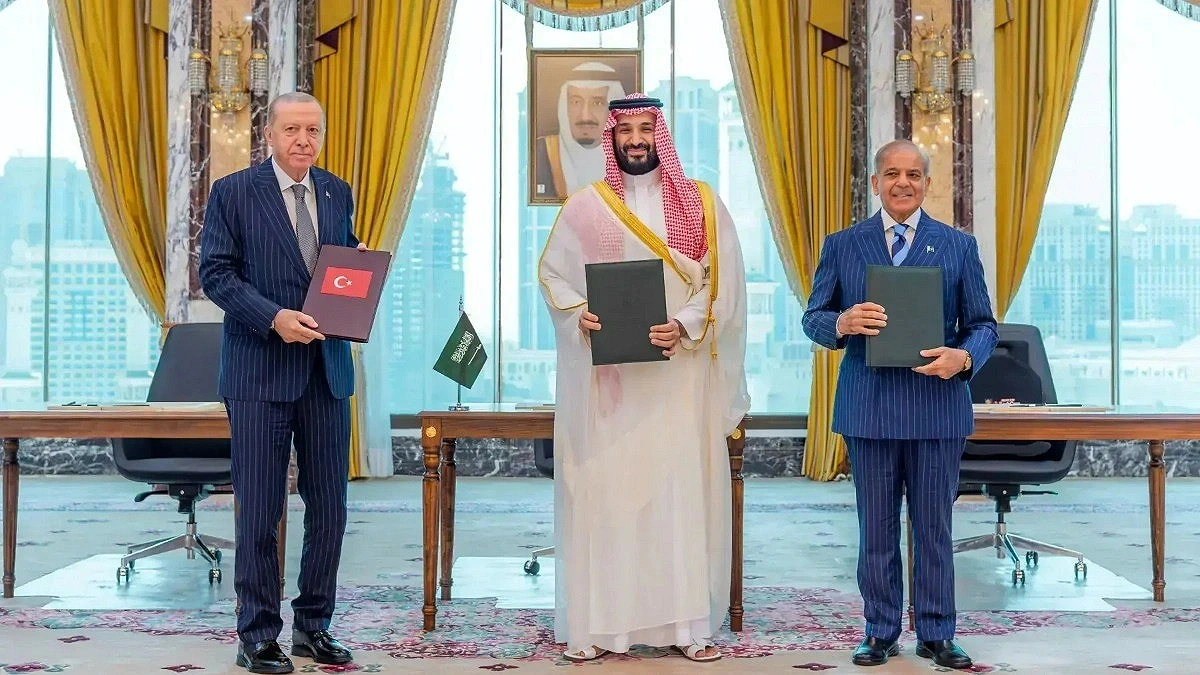
Photo: REUTERS
Turkiye, Saudi Arabia, and Pakistan officially signed the Mecca Joint Deterrence Agreement on Friday, establishing a new security architecture for the region.
Following the signing, Turkish Foreign Minister Hakan Fidan, citing the vision of President Recep Tayyip Erdogan, signaled an ambitious plan to expand this defense pact beyond its founding members.
“Under our president’s vision, we should not remain limited to three countries. We should grow and, if necessary, bring [other] countries under this umbrella,” Fidan told the state news agency Anadolu.
Mecca defense pact, which builds upon a year-old agreement between Riyadh and Islamabad, features a NATO-like stipulation where an attack on one member state is treated as an attack on all.
While specific details are still being finalized, Fidan clarified that the allies would consult to determine the “degree, form and format of support” required during an attack.
Turkish and Saudi officials emphasized that the alliance is not intended to replace existing strategic relationships, nor does it target any specific nation, including Iran. The most prominent candidate for expansion is Egypt, whom Fidan described as a “natural partner”.
He expressed high expectations for Cairo to join once certain “technical issues” are resolved, saying, “I believe that at the next stage, Egypt will also be among us in the alliance. We already act towards one another as if we were alliance members.”
Ali Bakir, a professor at Qatar University, noted that Egypt’s inclusion would “significantly increase the pact’s political weight, regional influence and operational effectiveness”.
However, Egypt’s path to membership is complicated by its existing military ties and diplomatic obligations. While Cairo maintains a solid relationship with the founding trio through the R4 group, analysts like Karim Elgendy of Chatham House suggest Egypt may be wary of binding military obligations that could drag its forces into external conflicts.
Elgendy remarked, “Egypt may join only if the language protects its aid relationship with Washington, doesn’t undermine existing alliances and peace treaties, and maintains its own freedom to decide when and where it fights”.
He added that if the pact remains a flexible political framework, Cairo may sign, but “if it hardens into an obligation that could pull Egyptian forces into someone else’s war, the answer is likely to be negative.”
Ahmed Aboudouh, also of Chatham House, observed that while Egypt shares certain security concerns, it may resist “security commitments,” preferring “overlapping regional security arrangements that are narrow in scope and are issue-related … rather than being entangled in defence commitments with elevated risks/cost.”
Beyond Egypt, interest in the pact is growing among Gulf nations. Former Qatari Prime Minister Sheikh Hamad bin Jassim Al Thani expressed hope on X that all members of the Gulf Cooperation Council (GCC) - including Qatar, Bahrain, Kuwait, Oman, and the United Arab Emirates - would “take the initiative to join”.
Elgendy identified Qatar and Kuwait as the primary “names to watch,” noting they have the “strongest motive to buy extra insurance” following recent regional tensions. Ali Bakir agreed that Qatar is the “most natural” candidate and suggested that Azerbaijan, Syria, and Jordan could also join the alliance “relatively quickly”.
As the alliance considers future growth, Elgendy characterized it as a “coalition of the willing” that will likely expand on a case-by-case basis, driven by the individual risk calculations of each regional capital.
Source: Al Jazeera (adapted)

