
I Try to Go Beyond the Moment — Raghu Rai

Graphics: Agamir Somoy
The year was 2012. That was likely the last time he visited Dhaka. "He" refers to Raghu Rai—the only photographer from the Indian subcontinent to be a member of Magnum, the world’s most prestigious and elite photo agency. He is also the first photographer in India to be honored with the 'Padma Shri,' the country's high-ranking civilian award.
I found myself at the Bengal Gallery, having spent a scorching afternoon under the sun. I saw that he was there in the gallery, but the visitors were few and far between. Introducing myself professionally, I began a conversation in front of the camera. Before me stood a living legend of photography, a man who captured thousands of moments of our Great Liberation War, turning them into frozen pieces of history frame by frame.
Since there was no one around to disturb us, I started the conversation from the very beginning. "How did your journey into photography start?" I asked.
In the quiet, melancholic afternoon of the gallery, he spoke from the heart. Our conversation flowed between my broken phrasing and Rai-ji’s professional, fluent English. Raghu Rai believed there was no prior plan behind him becoming a photographer. He had graduated in Civil Engineering simply because his father wanted him to. After working a government job for a year and a half, he became utterly frustrated and bored, having no idea what to do next. Consequently, he went to stay with his elder brother, S. Paul, who was himself a famous Indian photographer. Paul was eleven years older than Raghu. "Unfortunately, he has passed away, but he lived a good life," Raghu Rai remarked. When Raghu first went to stay with him, he still had no inkling of what he truly wanted to do.
During his stay with S. Paul, many photographers would come to visit. They discussed photos, lenses, and creative ideas. Raghu used to think of them as a bunch of madmen. One day, he heard that a very good friend of Paul’s was going to his village to take photos. Raghu liked the man very much, so he said, "Brother, I want to go with him. May I?"
Raghu thought of it as a sort of holiday. He didn't know what came over him, but as he was leaving, he asked Paul for a camera so he could take some pictures himself. S. Paul loaded film into a small camera and gave him a brief explanation of exposure. The first photo Raghu took in the village was of a baby donkey. Raghu recounted, "I saw a baby donkey in a field. When I tried to get close, it started to run. After a few minutes, it got tired and just stood there. So, I went close and took some shots. The photos were taken in soft light, and the background was completely blurred."
With a smile, Raghu said, "In those days, it was trending to photograph sweet village kids or rural children. Many photographers did that. But that didn't particularly interest me. When I saw that baby donkey, I thought it was something very sweet and funny. I responded to it instinctively. From 1965 to 1971/72, The Times in London used to publish a half-page photo every weekend. These photos had to be funny, strange, or interesting—there had to be something unique about them. My brother used to send his photos there. When S. Paul sent the photo I snapped, they published it. I must have been around 24 then. They published it with my name, and the money they paid for it was enough to cover my expenses for an entire month. Everyone said it was a huge deal that my photo got published. And I thought, ‘Why not, let me try my hand at this.’"
And so, it happened by accident, and Raghu thought, "Alright, let’s see what I can do with photography." When he started taking photos on a daily basis, he wanted to do something different and better—something distinct from what everyone else was doing. He was searching for the kind of images that had already been stored in his mind through others' work. Consequently, he would return from shoots and feel truly unhappy with the results. He said, "It took me some time to realize that it was my instinctive reaction to the subject, like that baby donkey, that made it unique. That is where the miracle began."
Raghu Rai had no formal training. He learned composition, lighting, and the art of developing by watching his elder brother. His brother, Paul, was an excellent printmaker and a great photographer. He made his own prints, which were beautiful—"dazzling," as Raghu described them. He learned everything from him. At that time, he used an Agfa Super, a small camera; a simple one for amateurs. Later, his brother gave him an old Nikon camera to use. Eventually, he moved on to the Nikon Radius and others. Now, he also uses Fuji medium format cameras.
Raghu Rai believes that most people are like programmed, mechanical beings. Just as they say "garbage in, garbage out," he views creativity as an internal process that must function before something meaningful emerges. Most people produce second-rate imitations of things without realizing they aren't exploring anything new or different. It wasn't that he consciously knew he had to find something new; rather, the baby donkey simply looked sweet and funny to him. That’s why he took that shot.
Reflecting on those early days, Raghu told me that photography in this part of the world was in a very dull phase back then: the trend was all about beautiful landscapes, elderly people with wrinkled faces, beautiful girls, and close-ups of small children. Then, because they were in photojournalism, Paul and Kishore Parekh were forced to work with daily realities. That turned into a completely different game. They immersed themselves in the kind of photography that was popular then. They captured unique and rare moments from everyday life or political situations.
Kishore and Paul were ten or eleven years older than Raghu Rai. By then, they had already made a name for themselves. Kishore Parekh was the chief photographer for The Hindustan Times, while Paul held the same position at The Express. Raghu Rai joined The Statesman, and within a year, he became the chief photographer. The three of them were very close friends. When he saw their assignments, he would think "I won't let it go," meaning he wouldn't let them outdo him easily. Surrounded by these two giants, he worked incredibly hard. In such a situation, you either get crushed between the giants or you rise above. He feels that, in his case, the latter happened.
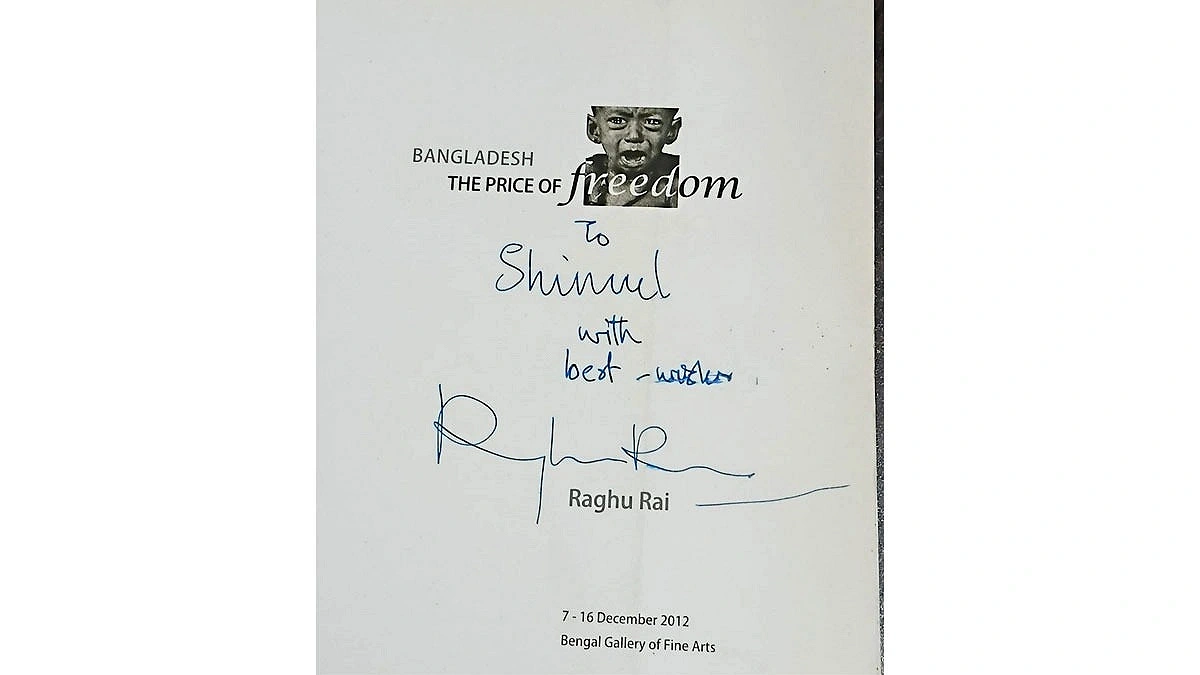
Inevitably, the conversation turned to the photographs taken during the Bangladesh Liberation War. This was, after all, the focus of the exhibition at the Bengal Gallery, titled ‘Bangladesh: The Price of Freedom.’ He shared, "I was the chief photographer at The Statesman when the assignment to cover the 1971 Bangladesh Liberation War came up. I was based in Delhi, but the headquarters was in Kolkata. When the refugees started pouring in, they summoned me to Kolkata and sent a reporter with me to the border areas. We even went to Jashore after the Pakistani army had retreated. I took photos of the Mukti Bahini—but what freedom fighters! I saw ordinary people standing there, rifles in hand. To be honest, no one was prepared for this—the Pakistanis had left the Bangladeshis with nothing to fight with. I photographed the refugees coming toward us. I captured Bangladeshis arriving on buses and rickshaws, clutching their children to their chests. While photographing broken bridges and these scenes, I remember my eyes welling up. When they began entering India, I moved from camp to camp to document them."
Raghu Rai continued, "Most of my photos from the war are of either women or children. The suffering of women is far greater than that of men. Women try to take care of everything. Children suffer the most because they are tender and soft. The men were devastated; yes, tired and devastated. But somehow, the women evoked much more emotion and pain in me. You must have seen," he said to me, "the photo of the child from the Bhopal gas tragedy that became an iconic photograph. You see, children can touch everyone's heart."
I wanted to stay on the subject of the 1971 photographs. I mentioned to Raghu Rai that the world saw those images much later. He explained that he had lost all his negatives from 1971. When he left The Statesman in 1977, he took the negatives with him. A newspaper only prints one or two photos a day, maybe three at most; the vast majority of his work had never been published. So, when he left, he bundled the negatives and kept them in his office. A few years later, he moved his office to a new location. These boxes were filled with packets of negatives and other materials. Somehow, for over thirty-five years, he simply couldn't find them. They were hidden away in a box. It was only when he began digitizing his work that he started emptying everything out. After thirty-five years, he discovered a large bundle of negatives, including those taken during Lieutenant-General Niazi’s surrender. Historic photographs, all of them.
1971 was a milestone in Raghu Rai's career; it was those photographs that earned him extraordinary global fame. One of the great inspirations in his life was Henri Cartier-Bresson. His meeting with Bresson happened almost miraculously during an exhibition in Paris. In 1971, Rai had taken some intense photos of Bangladeshi refugees. Twenty photos of refugees and fifty of his creative works were exhibited in 1972 at a gallery in Delpire. The exhibition was set to open at 6:00 PM. Around 5:45 PM, he noticed someone with a Leica camera slung over their shoulder, examining every photograph with great concentration. He looked at the man and thought, "This must be Bresson." He watched him, eventually approached him, and finally asked. The man replied that he was indeed Bresson. He asked Raghu Rai if he was the photographer. When Rai said yes, Bresson said, "Let me look, then I will come to you." Later, he found Rai and said, "Very good." Then, with a very serious expression, he called his wife, Martine Franck, and said he had met a very good Indian photographer and wanted to invite him home. Raghu Rai recalled with a laugh, "I was invited to their house for dinner—it was an extraordinary experience for me."
After returning to India, Raghu Rai received a letter from Magnum Paris stating that Bresson had nominated him as a member. He was stunned; he thought, "My God, Bresson! These people! I don't think I can work with them. How can I, a young boy, work alongside them?" He did not respond in 1972. At the time, he was still working for The Statesman, which was a very influential newspaper back then. In 1977, he decided to leave the paper. While packing his belongings and negatives, he came across the letter again. Since he was leaving his job, he sent a telex to Jimmy Fox, the director of Magnum in Paris, informing him that he was leaving the newspaper and asking if the offer was still open. Fox replied that it was. That is how he joined Magnum. While many people go to great lengths to become a Magnum photographer, he never had to do any of that.
Once, he and his wife were attending the Arles Festival (Rencontres d'Arles). Learning of this, Bresson invited them to his nearby farmhouse and sent his car to pick them up from the festival. The farm had acre after acre of land. Raghu Rai asked why he wasn't growing anything, as the entire area looked like empty fields. Bresson replied, "You know, that’s the difference between your part of the world and here. There, you don't have enough food; but here, my government pays me not to grow anything because they cannot manage such a surplus of food."
Speaking of influences, he says no. He respected Bresson as a person and as a photographer, but when he takes a photo, no one else's existence remains with him. It is his direct connection with the situation. He believes that someone's creativity can spark something within you, but if you follow a specific person, you become a second-rate imitation of them. He knew this truth well. So, when he speaks of instinctive reaction, he means a reaction free from the mind, from ideas, and from the traps of the intellect. If you have seen a great photo by Bresson, your brother, or anyone else, it remains in your head. But your instinct lies outside your head. If you photograph the world using your instinct, no influence can stand in your way. He says, "I admire the work of several photographers, but when I take a picture, no one else exists for me. My religion is related to my quest, not to the world."
When asked about his favorite subject for portrait photography, he considers Satyajit Ray to be one of his favorites. He says Satyajit Ray was one of the greatest filmmakers of modern times. There were many, but he was the only one who truly knew the language of cinema. Dialogue alone does not make a film; it is the visual language of cinema, and Satyajit Ray knew that best.
I finally asked Raghu Rai about the role of the mind in the creative process. He believes, "The human mind is the greatest computer provided by nature, installed within all of us. The mind has an immense capacity to store sights, sounds, images, and ideas. But when it comes to creativity, that reservoir becomes an extra burden that tries to drive you. You start with hard work. From hard work come moments of deep concentration, and with deep concentration come moments of silence, much like meditation." If asked if he could meditate, he would say no. However, when he interacts with the world and reacts instinctively, he experiences a moment of the soul, a meditative state he recognizes. And, that creates silence within him. Silence is when you are free from your head. The head is noisy; it talks to you, saying, "Look, that’s a good photo, that’s not, this is like this, that is like that." When you tell your head to be quiet, when you disconnect your eyes from your head and connect them to your soul and your heart, the head ceases to exist. Then, nature begins to provide that meditative silence. This is where the miracle starts to happen. Most photographers do not understand this, and that is the problem.
The process of connecting with every inch of space within the frame is also vital to Raghu Rai. With great conviction, he said, "When you are truly in the 'here and now,' you connect with every inch of the space. In that moment of connection, the noise in your mind stops. It ceases to exist. Each space has its own expression and its own miracle that appears and then vanishes. It is all deeply interconnected. Every situation emits an interrelated miraculous energy."
He believes a photographer should capture or unveil the mystery of things; everything else is just information. Photography, in its origin, was a documentation of people, individuals, and places—a mechanical process. Yet, every situation carries its own spiritual atmosphere, its own charm, and its own silence.
When I asked him about the "decisive moment" for pressing the shutter, he noted that the expression belongs to Bresson. "But I believe," he said, "that there are decisive moments before the 'decisive moment' occurs, and moments after it as well. The Indian experience is multi-layered; many moments are alive at the same time. Therefore, I try to go even beyond the decisive moment."
Raghu Rai is globally acclaimed for his photographs of the Bangladesh Liberation War and the Bhopal gas tragedy. He explained that when facing tragedy or disaster, he does not indulge his own emotions. While that photo of the Bhopal tragedy still haunts the human soul, he insists that as a creative person, the center of your heart must be clear and pure to reflect the truth of the situation. You reflect it; you capture it; you mirror it exactly as it is. If you become colored by emotion, your mind and soul become biased. Therefore, whether the situation is good, bad, or indifferent, one must remain a serene, honest observer. He remarked, "If you want to share a tragedy with the rest of the world with the same intensity and truth, you cannot smear it with the colors of your own emotions."
Looking at Raghu Rai's photographs of Indira Gandhi, one often sees a fierce woman surrounded by many men. In contrast, he presented Mother Teresa with extreme tenderness and peace. When questioned about these portrayals, he said he never did it intentionally. He has no agenda. He does not believe in agendas; he believes in capturing the truth and the deeper vibrations of a situation. Whether the reflection of that situation turns out to be good, bad, peaceful, angry, or something else is a different matter.
Raghu Rai concluded, "Every individual has some kind of spiritual aura—good, bad, or indifferent. In moments of exploration and expression, there are times when that aura suddenly begins to manifest itself, and it comes with an instinct. It is through an instinctive reaction to people and situations that you can capture the spiritual atmosphere of things." In response to a final question, he noted that life is full of contradictions. India is one of those civilizations where different eras have learned to coexist side-by-side for centuries. Naturally, all kinds of paradoxes exist—fascinating, strange, contradictory, and parallel situations occurring in the same place. That, he believes, is the miracle of India.
Evaluating his own photos or identifying a particular image as his "best" is simply not in his nature. He says, "I am merely the harvest of all experiences, big and small, after nearly 55 years." Every moment and every interaction—regardless of scale—has its own miracle, and he considers himself a product of all those moments. When asked about his favorite photo, he explains, "When you look at a magnificent building, you cannot point to a single brick and say it is the most important one. Every brick has equal status. They are all equally important."
Regarding portraits of famous individuals, he mentions that very few people, such as Mother Teresa, the Dalai Lama, or his Guru-ji, have touched him deeply. He feels he has been blessed by these divine sources, which is why the miracle of his quest continues even at this age.
Explaining why most of his work is in black and white, he notes, "The color films of the past used to exaggerate certain colors. Now, digital technology makes images so bright and vivid that everyone thinks they are a great photographer because the 'noise' of color is so loud. A painter can paint the sky green without being questioned. But in my field, all kinds of colors exist in a scene, and they might not harmonize. It’s a funny situation; I cannot change the colors, yet they often clash. Every color has an emotional value and its own visual presence. You cannot control them beyond a certain limit. So, when you convert it to black and white, it silences the noise of the colors."
When asked what it takes to become a great photographer like him, Raghu Rai says one must have "fire in the belly." Most people are professionals because that is how they earn a living. "But for the one who is on fire, who is hungry and thirsty—that hunger cannot be satisfied unless you become an explorer." He adds, "One who has a hunger for life, a hunger to understand nature, a hunger to witness and see—they develop a devotion like Mirabai’s love for God. Our devotion spans from the earth to the sky and from within me to beyond this world—a hunger to know and understand every single thing, a hunger for exploration. This hunger creates the necessity for the quest. That is the essence. You must have a hunger to learn. Without it, you are just a news worker or a documentarian, merely reproducing things over and over again."
When asked for advice for photographers, he remarks that most young photographers lack self-awareness. "That is the problem. Self-awareness in every moment. The world stays alive and awake for the one who is self-aware." Rai shares that even now at 80, when he has a camera in his hand, he remains alert and vibrant every minute; that is how he lives. If he shoots for eight hours a day, he might be physically tired, but he is spiritually energized. After a few hours of sleep, he is refreshed and strong again because he lives every moment of this life. He says, "One who desires a vision of God—when that vision keeps happening, imagine the 'mad' energy they possess. I am that person. My vision of life and nature keeps happening at every new turn. I am that man—the Deewana, the Mastana (the crazed, the intoxicated)."
Raghu Rai believes divine blessings are with him, allowing him to take photos with the same passion, addiction, and energy as before. He concludes, "Photography is my religion. It has taught me so much about life, nature, God, and reality. My journey has been very fulfilling. I am a seeker. And by divine grace, I am still growing."
We thanked each other. Rarely does a mutual conversation end with such a sense of enchantment.
Shimul Salahuddin
Head of Creative Research and Events, Agamir Shomoy
