

Rescue Gets Difficult If Accident Occurs
Limited to paper, hazardous pipes still remain in buses

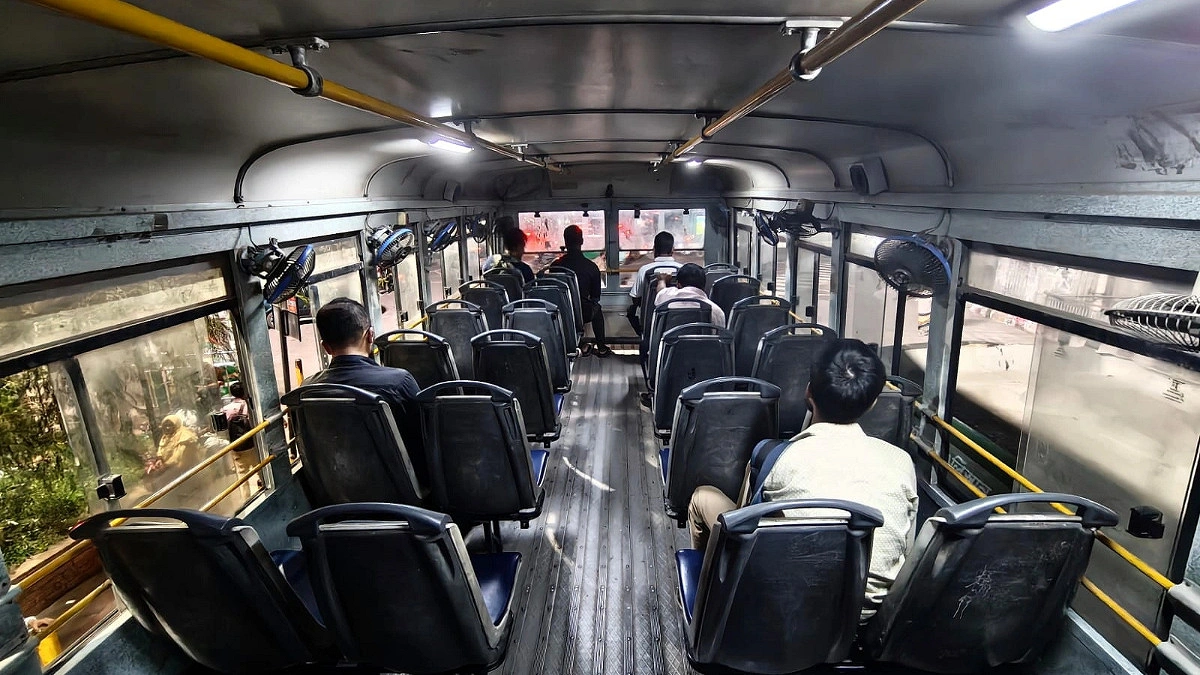
BRTC bus operators also keep the steel parallel pipes hooked to windows. Agamir Somoy photo.
The Bangladesh Road Transport Authority (BRTA) had directed the removal of stainless steel pipes installed horizontally across the windows of non-AC buses to ensure the rapid rescue of passengers in road accidents.
However, several months after the directive was issued, most buses operating on various routes across the country, including the capital, still have those pipes in place. As a result, the risk for passengers trying to exit quickly during accidents and for rescue workers remains significant.
On April 27 last, the BRTA issued a public notice stating that during accidents on roads, highways, ferry ghats, or railway crossings, passengers often cannot exit quickly through doors or windows, leading to fatalities. Therefore, it directed that emergency exits be clearly marked in visible places on AC buses, tools for breaking window glass be kept, and the stainless steel pipes in the middle of windows on non-AC buses be removed.
But observations of buses on various roads in the capital show that most non-AC buses still have those pipes on their windows. In some cases, the pipes are kept as an excuse to hang curtains, while in many buses, even without curtains, the pipes have not been removed. Even BRTC buses have not removed these pipes.
Mazharul, a private sector employee who travels by bus, said, "I saw the BRTA directive on social media. But I haven't seen any visible monitoring or drives at the field level to enforce it."
According to him, the directive remains confined to paper.
Shamsunnahar, a university student who regularly travels by bus, pointed out that during accidents – if a bus overturns or catches fire – windows become the only escape route for passengers. But the stainless steel rods in the middle of the windows obstruct quick exits and also obstruct rescue efforts.
Several passengers expressed the view that issuing directives alone is not enough to ensure road safety. Regular monitoring, holding transport owners accountable, and taking action against violators are essential for effective implementation.
Directive Issued, but Why No Implementation? – Officials Respond
When contacted regarding why the directive has not been enforced in practice despite the public notice, Rubaiyat-e-Ashik, Director of the Audit and Legal Branch of the BRTA, said that his branch primarily handles court and litigation-related matters. Therefore, he could not comment on this issue. He suggested contacting the Engineering Branch.
Mohammad Ibrahim Khalil, Deputy Director (Engineering) of the BRTA, was asked about the matter. He said that the issue does not fall under his branch's purview.
On the other hand, Subir Kumar Saha, Deputy Director of the Road Safety Department of the BRTA, said that he was not aware of which branch had issued the directive to remove the stainless steel pipes used for hanging curtains.
Dhalu Barman, a driver of a VIP bus in the capital, mentioned that the pipes are used to hang curtains to protect passengers from the sun. He said they had not received any directive that curtain rods cannot be kept, and he was hearing about it for the first time. He added that he would inform the bus owner.
Saiful Islam, Secretary General of the Bangladesh Road Transport Owners' Association, also claimed that no such written directive from the BRTA had reached them. He stated that if the matter is true, necessary action would be taken, and it would be raised for discussion in the association's upcoming meeting.

