
A robot defeats humans in table tennis

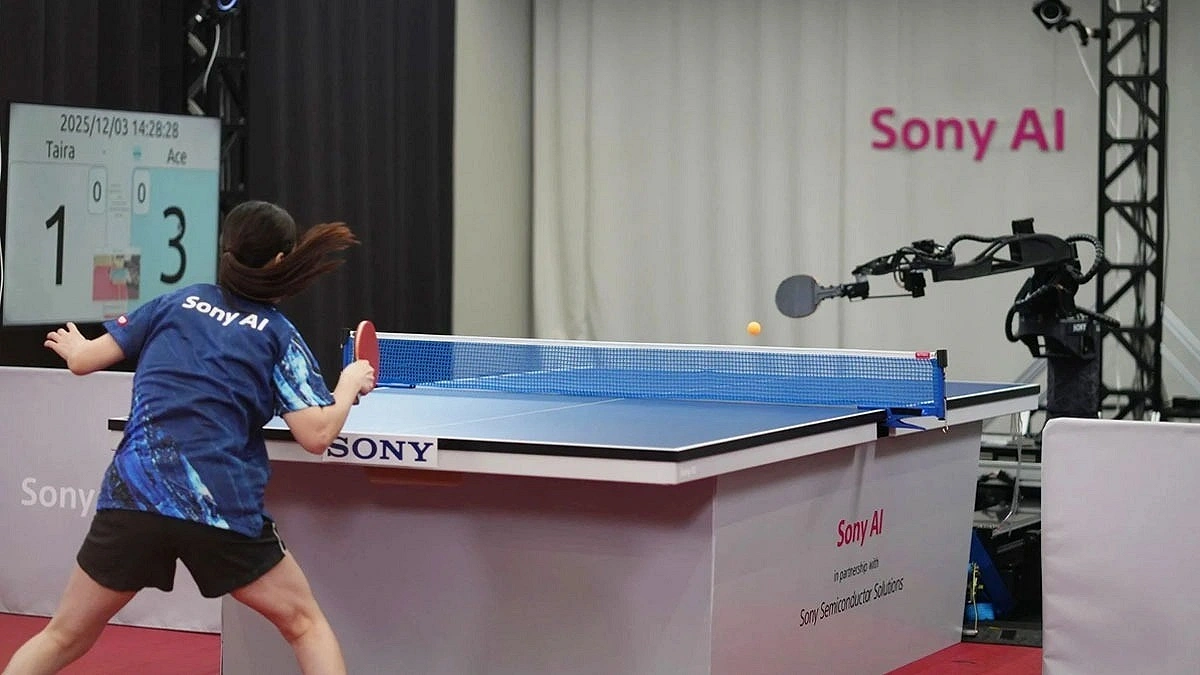
Mayuka Taira is a Japanese professional table tennis player. She gained recognition after reaching the women’s singles final at the 2019 US Open Table Tennis Championships. She played a competitive match against ‘S.’ Photo: Collected
Artificial intelligence (AI) is advancing everywhere. It is no longer confined to black-and-white chessboards or computer screens. Moving beyond the complex web of mathematical equations and algorithms, AI has now stepped onto the playing field—where every shot, every spin, and every moment determines superiority. In that real arena, this new contender is challenging human skill.
A robotic arm named ‘S,’ developed by the Japanese technology company Sony, is not merely a machine but a highly responsive player. Even world-class table tennis stars are struggling against it. The game is no longer limited to human versus human; it has evolved into an exciting duel between humans and machines.
By defeating top human players in table tennis, the ‘S’ robot has set a new milestone in competitive sports.
The robot won three out of five matches against elite players. However, it lost two matches against professional players. Overall, it secured victory in one out of seven competitions.
Experts said the results demonstrate the rapid advancement of AI technology. For a long time, researchers have considered table tennis a difficult benchmark for robotics, as it requires instant reactions, precise observation, and fine motor control.
In matches held under official rules, ‘S’ demonstrated exceptional skill in controlling spin. It returned shots that were difficult to anticipate and even generated rapid backspin—something a former Olympic player had considered impossible.
Unlike humanoid robots, ‘S’ uses an automated robotic arm with eight joints, mounted on a mobile base. Engineers specifically designed it for performance in high-speed competitive play.
While researchers praised the achievement, some experts cautioned that mastering table tennis does not solve the broader challenges of robotics.
Jan Peters, Professor of Intelligent Autonomous Systems at the Technical University of Darmstadt, described the project as highly impressive.
Jan Peters said such progress will not resolve the fundamental problems of robotics. Significant traditional engineering advancements remain necessary for robots to become useful in everyday life.
He also said a moment comparable to ChatGPT—which transformed the world—will arrive within the next decade. That moment, he suggested, may come sooner than 2036.
