
Prices of Essentials Rise, Income Stagnates

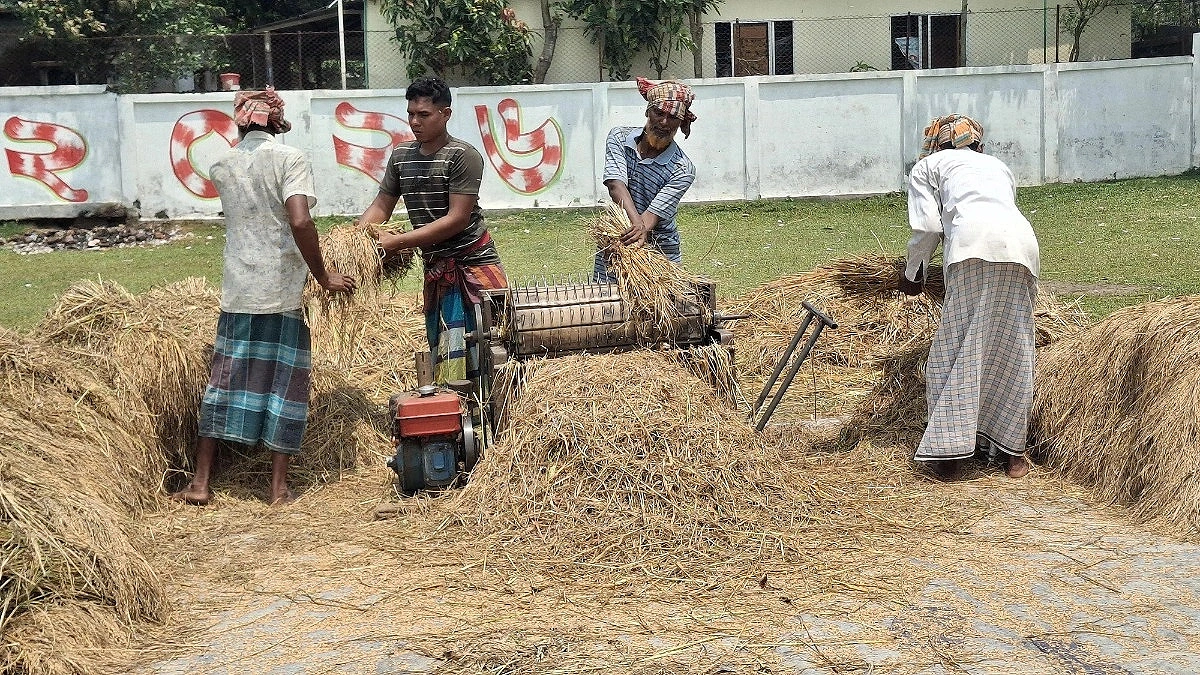
Photo: Agamir Somoy
The prices of daily essentials are rising steadily with each passing day. However, people's incomes are not increasing proportionally. As a result, a significant imbalance has emerged between the income and expenditure of lower and middle-class residents in rural areas. This reality becomes even clearer when analyzing local market prices, agricultural production costs, and the wages of day laborers.
In the village markets of Chandpur, the prices of almost all daily commodities—from rice, lentils, and oil to vegetables—have increased by 20% to 40% over the last year. Depending on the season, vegetable prices have even doubled. This has led to a substantial increase in the monthly food expenses of an average family.
According to farmers, production costs are much higher than before due to the rising prices of fertilizers, seeds, irrigation, and labor. Yet, because they do not receive fair prices for their crops in the market, their actual income is not growing.
Mintu Khan, a farmer from the Safarmali area of Chandpur Sadar Upazila, expressed his frustration. He said, "Costs per bigha have increased by about 30% to 40%. But when it’s time to sell, I don't get a price that matches that increase. Because of this, many have stopped cultivating paddy. If this continues, no one will farm anymore."
Abul Khayer, a farmer from the Shahtali area of Chandpur Sadar, noted, "We used to have a lot of agricultural land, but now it is difficult to even recover the costs through farming. The price of everything has gone up in the market, but the price for the farmer has not. When we sell to wholesalers, we see the price double at the retail market. So, who is actually profiting?"
Kamrul Islam, a farmer from the Char Bhairabi area of Haimchar Upazila in Chandpur, said, "All types of crops yield well in the char areas. However, due to a lack of facilities, farming is no longer appealing. The price of everything is rising day by day, but when I go to sell vegetables, I don't get the price. It is impossible to run a household like this."
Meanwhile, there is a stagnation in the wages of day laborers in both rural and urban areas. Although wages have increased, the rise is very low compared to market prices. In villages, a laborer receives a daily wage of 500 to 700 BDT, which was previously 400 to 500 BDT. In cities, laborers earn between 800 and 1,000 BDT, though the cost of living in urban areas is much tougher. Laborers report that it is becoming increasingly difficult to bear the cost of living with this income.
Nannu Mia, a resident of Kherudia village in the Bishnupur Union of Chandpur Sadar, is a day laborer. When there is no work, he makes a living by catching fish in the river. With a five-member family, his monthly income is around 14,000 to 15,000 BDT, but the math does not add up for him either. "I used to get by somehow with what I earned before. Now, when I go to the market, I can't balance the budget. I often have to take out loans. I can no longer afford my children's education with this income."
While there are slightly more income opportunities in cities, sources of income in villages remain limited. In an agriculture-dependent economy, there is a severe lack of alternative employment. As a result, the quality of life in rural areas is deteriorating faster than in the cities.
Mosharef Hossain, President of the Citizens for Good Governance (Sujan) Chandpur district unit and Principal of Baburhat School and College, expressed deep concern over the current economic situation. He said thiugh the impact of ongoing global crises is affecting Bangladesh, the government is not treating it as a valid crisis. In reality, the situation is becoming more complex and acute by the day, leading to a continuous decline in the country’s economic upliftment. Employment opportunities are shrinking, and ordinary people—especially the low-income groups—are facing severe challenges in earning a living.
According to him, to understand the disparity between rural and urban life, decision-makers cannot simply sit at the policy level; they must gain firsthand experience of the people's lifestyles. Inequality is evident in everything from the valuation of labor to the distribution of facilities. Low-income and working-class people often fall victim to deception and deprivation. However, if their labor were properly valued, the overall economy of the country would be much stronger. He emphasized that it is vital to analyze these problems minutely and adopt effective solutions to eliminate this inequality.
Subhash Chandra Roy, President of the Chandpur Chamber of Commerce and Industry, said the country's economic situation is becoming increasingly unstable. Price hikes in the market are so uncontrolled that prices change within short intervals. This impact is felt not only by businessmen but by all classes of society—from laborers to the wealthy.
However, he also shared words of hope. He mentioned that the current government has begun taking steps to revitalize the economy. Emphasizing the agricultural sector, he said, "If the farmer survives, the country survives." If agricultural production increases, the supply of goods in the market will naturally rise, stabilizing prices. Currently, due to insufficient production of many agricultural products, the country remains dependent on imports. Reducing this dependency will bring positive changes to the economy. Once that happens, people will not be as worried about expenses, regardless of their income. Therefore, it is essential to strengthen and expand the agricultural sector.
Regarding this, Mohammad Abu Taher, Deputy Director of the Chandpur Department of Agricultural Extension, stated that although the total cultivable land in the district is 87,063 hectares, about 1,500 hectares of land have been lost to cultivation over the last 2 to 3 years. The reasons behind this include farmers not receiving fair prices, labor shortages, the construction of houses on agricultural land, and the conversion of land into fish farming. He noted that while cultivable land is decreasing, the population is increasing, making it a major challenge to maintain food production.
He further added that when production decreases, consumers have to buy food at higher prices, which increases overall economic pressure on them. Therefore, to make the agricultural sector sustainable, more research, advanced technology, and the introduction of new crop varieties are essential. Special emphasis must be placed on preserving agricultural land in char areas and bringing them back under cultivation. If the government can ensure land ownership of these farmers, they will be more interested in preserving and cultivating the land.
Furthermore, farmers are deprived of fair prices because they produce on small, fragmented plots and sell locally on a limited scale. To solve this, it is crucial to implement government initiatives for effective marketing systems, storage facilities, and price guarantees. Stakeholders hope that if these steps are properly implemented, farmers, laborers, and businessmen will all benefit, providing the country's economy with a stable foundation.
