
The Leather Mystery

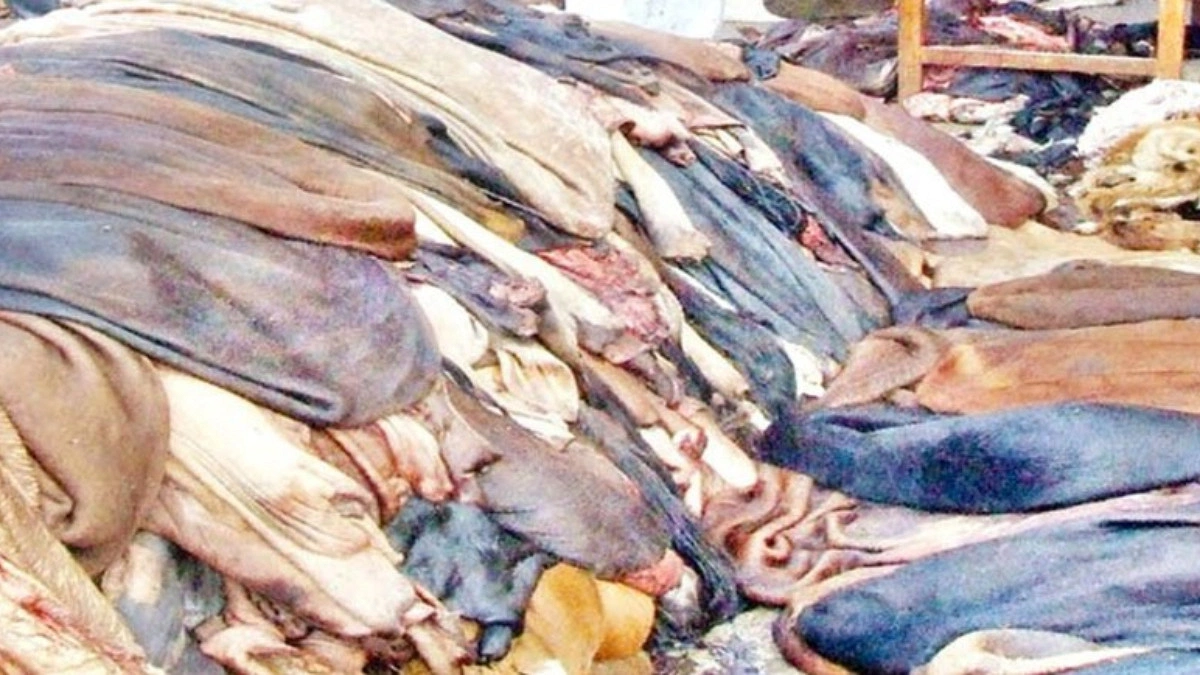
Representational image. BSS.
In 2013, the price of raw bull-hide per square foot from sacrificial animals was about 90 taka. In 2026, the government fixed its price at 65 taka. That means, far from increasing over 13 years, the price has actually dropped by 25 taka—approximately 28 percent. Yet during the same period, Bangladesh’s earnings from leather and leather goods exports have not fallen; rather, they have increased over the long term.
This raises a major question: why has the price of raw cowhide from sacrificial animals—the key raw material for a sector that earns foreign currency—been declining for 13 years? A long-term collapse, while millions of hides go to waste. Seasonal buyers, madrasas, and orphanages are being deprived of fair prices. What is the mystery behind this?
Investigations reveal that the reasons behind the annual crisis in the leather market are multiple. Artificially setting prices by the government, losing international markets, excessive dependence on China, tannery crises, failure to obtain environmental certifications, and a syndicate-based market structure. Due to these factors, the country’s leather industry is facing an existential crisis. The suppliers of raw hides are the weakest link in this sector, and the entire value chain’s profits are concentrated in the hands of tanneries and exporters. The same scenario has repeated itself this Eid-ul-Adha. Despite the government fixing prices as usual, market prices didn’t come close. In some cases, leather was dumped into rivers because fair prices weren’t obtained. In Chattogram, Feni, Satkhira, and other areas, seasonal traders who went door-to-door collecting hides were seen discarding them on roadsides, riverbanks, and open spaces due to not receiving fair prices.
‘Free Market’ Only on Paper: Bangladesh is a free-market economy, but every year the government fixes prices for sacrificial animal hides. In reality, those prices aren’t even enforced. Economists say that if the government fixes prices for a product in a market where the number of buyers is limited, that market is not competitive but rather becomes a “buyer-dependent controlled market.” That’s exactly what is happening with hides. As every year, this year the government fixed hide prices. In the capital, the fixed price for cowhide per square foot was 60-65 taka, and outside Dhaka it was 55-60 taka. But in reality, many areas saw prices no higher than 20-30 taka. In some places, hides weren’t sold at all.
When asked about fixing prices in a free-market economy, the Commerce Secretary (routine charge), Md. Abdur Rahim Khan, told Agamee Kal: “Around Eid-ul-Adha, over 10 million animal hides are traded across the country in a single day. This is abnormal in terms of regular supply and demand in the leather market. That’s why the government intervenes to manage it properly.” He added that to avoid future crises in the leather market, the government is planning a change. The Commerce Minister has also agreed with this change. There are plans to pilot the removal of animal hides and waste management in major collection areas such as Dhaka, Chattogram, and Natore.
How valid are the tannery owners' arguments?
Tannery owners have long claimed that Bangladeshi leather fails to meet international compliance standards. Specifically, due to not fulfilling environmental criteria, access to the European Union and other developed markets is limited. As a result, apart from China, there are no major buyers. However, sector insiders believe there are major inconsistencies within this statement. First, if the international market is so poor, then how is the export earnings from leather and leather goods increasing every year? Second, even though export earnings are rising, why are the benefits not reaching the raw hide producers? Third, if the market is indeed contracting, why are large entrepreneurs in the tannery sector continuing to make new investments? According to industry insiders, the real problem is not the international market, but the domestic market structure itself.
Commerce Minister Khondaker Abdul Muqtadir has stated that industries generating high levels of waste should be located where there are adequate waste treatment facilities or a Central Effluent Treatment Plant (CETP). From that perspective, the decision to shift the tannery industry from Hazaribagh to Savar was correct. However, the way this relocation was carried out was riddled with mismanagement. According to him, by next July, a comprehensive and long-term plan will be published to improve the leather sector's development, preservation, processing, and export capabilities.
Belal Hossain, director of Ayub Brothers Limited, a tannery business, told Agamee Kal last Friday that due to a decline in export orders in the international market, tannery owners are being forced to buy hides at low prices. In his view, the government must first get to the root of the problems surrounding this industry. If those issues are resolved, whether or not the government fixes the price of sacrificial hides will not have much impact. Currently, the entire leather sector is operating relying solely on the Chinese market. To emerge from this situation, factories need to achieve compliance, and government support is essential for that.
The syndicate's hand in the game
Field-level traders have alleged that the raw hide market has come under the control of a few large groups and tannery owners. During Eid, they form alliances to buy hides at low prices. As a result, seasonal traders in villages, madrasas, and orphanages do not get a competitive market. In many areas, wholesalers deliberately arrive late in the market to create a fear of the hides rotting, forcing collectors to sell at lower prices. During Eid, several large tanneries cite cash shortages and complications with bank loans as excuses. This forces middlemen to buy hides at reduced prices.
The international market picture
In India, Pakistan, and Vietnam, the raw hide market is more competitive compared to others. Besides local processing industries, these countries have diversified export markets. Experts say that Bangladesh's leather sector has long been stuck in a "low-value trap"—buying cheap raw materials, adding limited value, and then exporting. If this trend continues, there is a risk that the sacrificial hide economy may completely collapse in the future. Because the new generation is losing interest in hide collection. Madrasas are also reducing their dependence. Meanwhile, the international market is rapidly moving towards environmental compliance, transparency, and sustainable production. Bangladesh is lagging behind in this race.
