
Who Determines the Fare for AC Buses and Trucks?

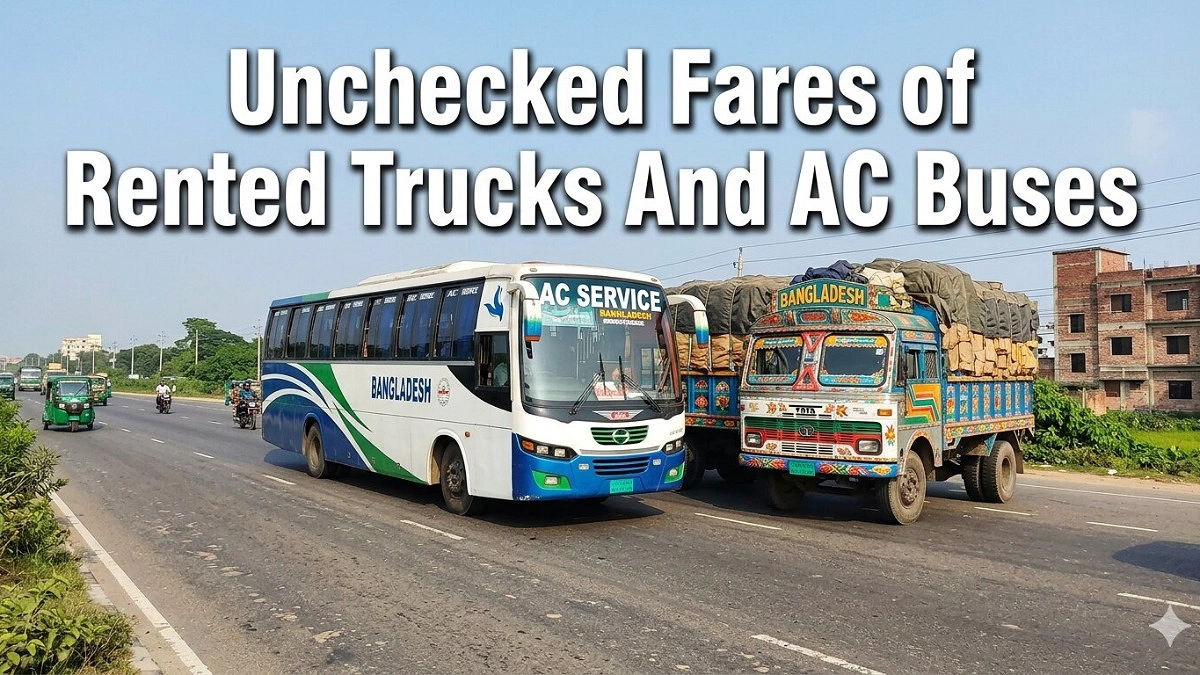
Photo Made by AI.
Public transport fares have increased following the rise in diesel prices. Last Thursday, the government issued a notification regarding fare hikes. On Saturday, the Bangladesh Road Transport Authority (BRTA) released the list of recalculated fares for inter-district and long-distance transport, as well as for the commuting buses of Dhaka and Chittagong metopolitan cities.
These new fares took effect on Sunday. However, this increase only applies to non-AC buses. This has raised questions about whether AC bus fares will increase and, if so, who actually determines them.
The BRTA does not set fares for AC buses or goods-carrying vehicles. Consequently, in both cases, owners' associations determine the fares at their own discretion. There are two primary reasons behind this. First, the type, structure, characteristics, and capacity of AC buses and trucks vary significantly from one another. Second, there are variations in the quality of service provided. As a result, fares for these vehicles fluctuate based on the "demand and supply" equation.
The owners themselves decide the fare for an AC bus based on its quality. Occasionally, transport owners' associations take on the role of fare-controlling authorities. Because of these variables, the government has never been able to fix fares for AC buses and goods-carrying vehicles in the history of the country.
Investigations reveal that AC buses costing anywhere from Tk8 million to Tk 25 million are currently operating on the roads. The quality of service varies from one bus to another, meaning fares cannot be uniform across all providers. Fares differ between companies even for the same distance, a reality that passengers have surprisingly accepted.
Kazi Md. Zubaier Masud, Joint General Secretary of the Bangladesh Road Transport Owners' Association, addressed these issues. He confirmed that owners determine the fares, though he noted they are usually not unrealistic.
Masud claimed that passengers are the ultimate judges of whether a fare is justified. If the service quality is high, passengers do not object. However, if quality is not maintained, passengers do not return, which negatively impacts the business. Therefore, owners generally do not increase fares irrationally.
When asked why the government does not set AC bus fares, Masud stated that the government has not taken the initiative. He mentioned that the association has submitted a proposal for a fare of Tk5 per kilometer, but he does not believe the government will fix a regulated fare anytime soon.
Similarly, the government does not determine the fares for vehicles used for transporting goods. To date, no per-kilometer rate has been fixed for freight vehicles such as trucks, pickups, and covered vans.
A large portion of these freight vehicles operates around industrial hubs. The demand is highest in areas like Dhaka, Gazipur, Ashulia, Savar, and Chittagong. Most vehicles in these regions operate under "syndicates," which officially set the rates. For instance, the fixed truck fare for garment goods from Dhaka and its surrounding areas to Chittagong is currently Tk18,500. Conversely, the return trip from Chittagong costs Tk22,500. Regardless of fluctuations in fuel prices or general transport costs, businessmen must pay these fixed rates throughout the year.
Other than apparel goods, the truck fare on the Dhaka-Chittagong route was Tk14,000 last week. As of this week, it has risen to between Tk16,500 and Tk17,000.
Explaining the reasoning behind this, Md. Tofazzal Hossain Majumder, President of the Bangladesh Truck and Covered Van Owners' Association, argued that the biggest factor is the mismatch between supply and demand. When there are more vehicles than required, fares drop; when the opposite occurs, fares rise.
Regarding why a per-kilometer fare hasn't been established, Majumder claimed, "We have the intention. We even submitted a proposal to the previous government, but it didn't yield results. If fares were fixed, there would be more discipline. Two different calculations have been submitted to the government: one requesting Tk269 per kilometer and another at Tk97.62 per kilometer."
