
Load Shedding Eats Up Workers' Income

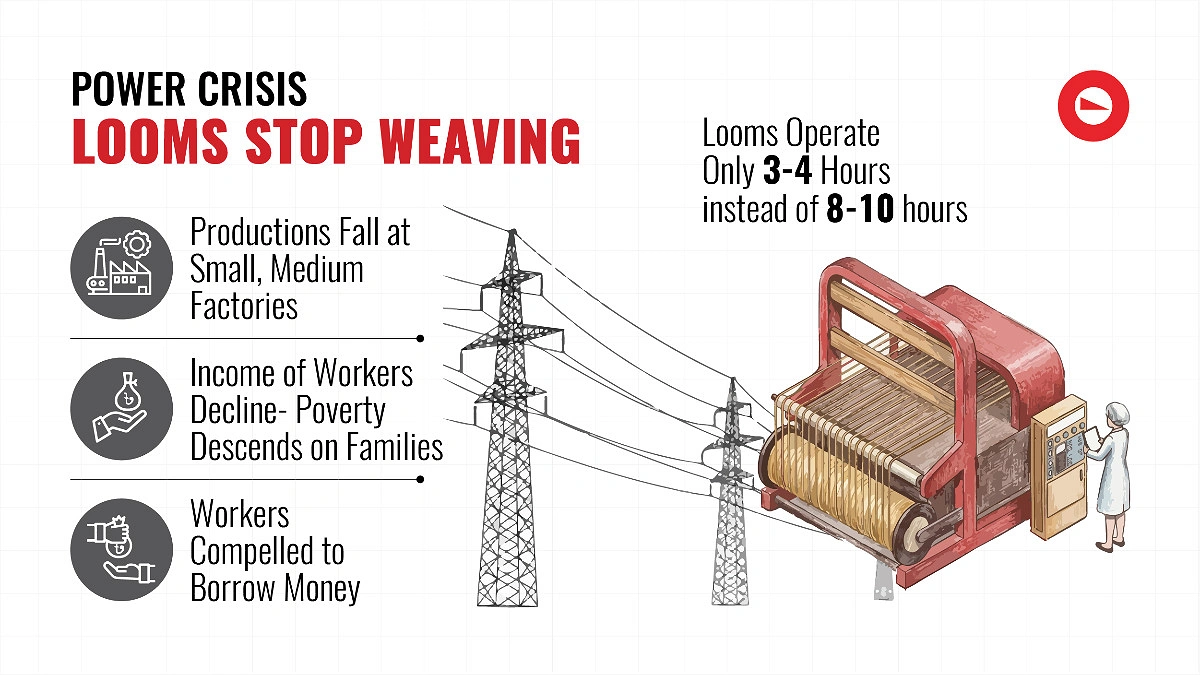
Graphics: Agamir Somoy
It is 5 PM. An unnatural silence hangs over a weaving factory in Koroitala village of Narayanganj’s Araihazar Upazila. This silence is described as "unnatural" because, typically, this is the busiest time for workers, with the rooms echoing the rhythmic "clack-clack" of the looms.
Standing beside a row of idle machines is Taijul Islam, a worker whose face bears the marks of exhaustion and whose eyes reflect deep uncertainty. When he speaks, his pent-up frustration pours out in a single breath.
"We haven't had proper electricity for three weeks. I’ve lost count of how many times it goes out in a day. If I can't work, there’s no income. With Eid ahead—how will we survive?"
This question isn't just Taijul’s; it is shared by thousands of weavers in Koroitala, Dairadi, and surrounding villages in Araihazar. Their work has ground to a halt due to the severe nationwide load-shedding. In this electricity-dependent industry, the reduction in working hours has slashed the incomes of approximately 10,000 workers. Instead of earning extra for the upcoming Eid holidays, their lives are now defined by uncertainty.
Taijul, who supports a five-member family, is in a dire situation. Last week, his total earnings were only Tk2,000. Meeting daily expenses with this amount is nearly impossible.
"If I buy rice, there’s no money left for vegetables," he says. "In the market, no vegetable costs less than Tk100. What are we supposed to eat?"
Another worker, Shahin Hasan, noted that electricity is unavailable for most of the day. "From morning until noon, the power went out five times. I couldn't work for even one hour straight. I operated 10 machines but could only weave 50 yards of cloth, earning just Tk150."
Typically, a worker can operate up to 10 machines simultaneously, earning 3 BDT per yard of woven cloth. Consequently, when the power goes out, their income drops to zero. Previously, they could work 8 to 10 hours a day; now, that has dwindled to 3 to 4 hours or less.
The crisis has also hit factory owners and managers. Rahat Hossain, a manager at a local weaving factory, said, "Before the load-shedding, we produced 50,000 yards of cloth a week. Now it has dropped to 35,000 yards. Even calculating a profit of Tk3 per yard, we are losing about Tk45,000 weekly."
For larger factories, the losses are even greater, potentially reaching several hundred thousand BDT by the end of the month. Owners say that with production down, it has become difficult to pay workers' regular wages, and they are struggling to figure out how to manage the coming days.
The surge in load-shedding is largely attributed to fuel shortages resulting from the conflict involving Iran, which has created a deficit in power generation. This has hit electricity-dependent small and medium enterprises the hardest.
According to data from the Power Grid Company of Bangladesh (PGCB), out of 136 power plants in the country, 13 are shut down due to gas shortages, 9 due to fuel oil shortages, and 8 for maintenance. Additionally, 17 solar plants are inactive at night. Against a capacity of 12,200 MW from gas-based plants, only 5,200 MW is currently being produced.
Looming Power Crisis: Demand Expected to Surpass 18,000 MW
The Power Development Board (PDB) has announced that electricity demand in the country could exceed 18,000 MW during the upcoming summer peak. Currently, daily production is hovering between 14,000 and 15,000 MW. If production cannot be increased by mid-summer, the deficit is expected to worsen significantly.
A Threat to the Rural Economy
Speaking with Agamir Somoy, stakeholders in the weaving industry expressed deep concern that a prolonged crisis will impact more than just individual workers. The weaving sector anchors a massive economic cycle involving yarn suppliers, transport workers, and wholesalers. A collapse in this industry could trigger a broader recession in the rural economy.
To cope with falling incomes, many workers are being forced to take high-interest loans or deplete their meager life savings.
Taijul Islam: "If this continues, we won't survive. Without electricity, there is no income. Load-shedding isn't just stopping the looms; it’s stopping our lives."
Sanaullah (Worker): Reported that his weekly income from night shifts has plummeted from Tk9,000 to Tk 4,000. His daily earnings have dropped from Tk 3,500 to just Tk 1,500.
Isadullah (Owner, Anik Textile Mill): Stated that production has been cut by more than half. His 14 machines used to produce 9,500 yards of cloth per week; that figure has now fallen to 4,000 yards.
The Looming Eid Crisis
Typically, the period leading up to Eid-ul-Adha is a "peak season" where increased demand allows workers to earn extra income. This year, the situation is the opposite. Owners and workers alike are demanding a specialized electricity management plan for weaving hubs to ensure that the looms can keep turning.
Expert Analysis
Professor Al Amin from the Department of Accounting & Information Systems at the University of Dhaka emphasized the need for a policy shift in power distribution.
"While much of the country's power generation is oil-dependent, coal and gas-based plants are currently not operating at full capacity. With demand rising, the deficit can only be mitigated through an integrated distribution plan between the industrial and residential sectors and a rigorous policy re-evaluation."
