


Draft of New Road Safety Law: Riders, pedestrians to face penalties

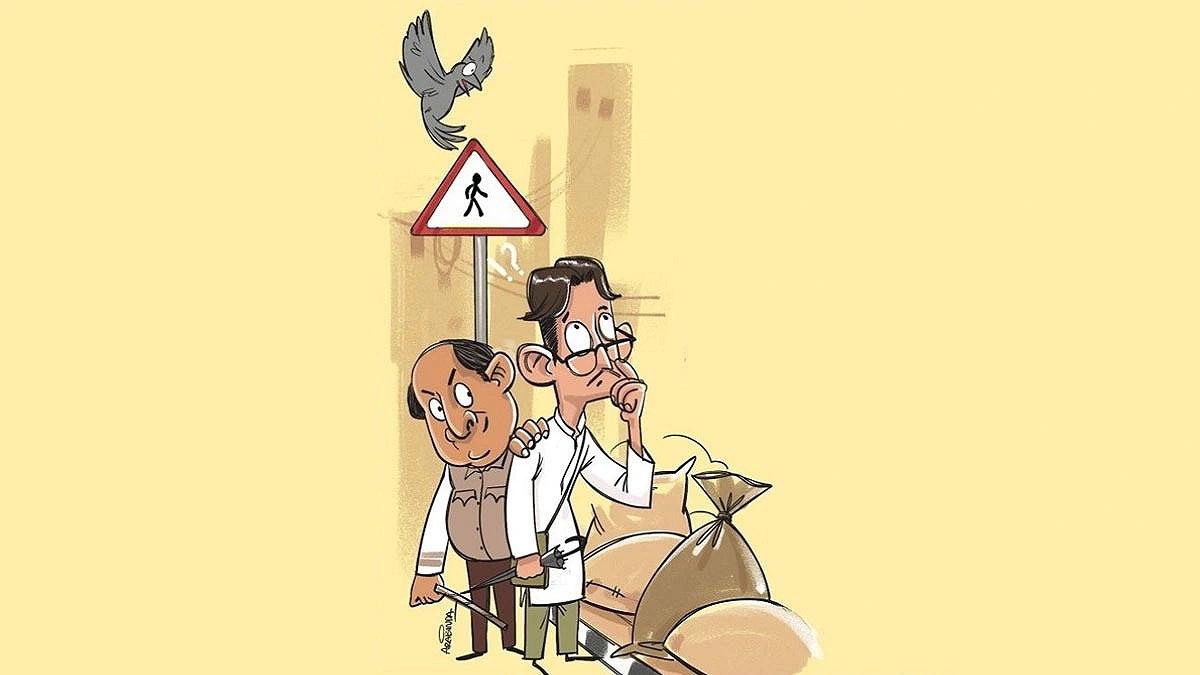
Graphics: Agamir Somoy
Until now, responsibility for road rule violations has largely fallen on drivers and vehicle owners. Now, the scope of that liability is expanding. The proposed 'Road Safety Act, 2026' suggests bringing passengers and pedestrians under its punitive provisions, alongside drivers and owners. It includes provisions for fining passengers a maximum of 1,000 Taka for offenses such as encouraging drivers to speed, boarding a vehicle dangerously, sticking hands or heads out of windows, or sitting outside designated seats. Pedestrians may also face the same fine for not using footpaths.
It is being proposed to prohibit carrying children under six years of age as passengers on motorcycles. How older children may be transported will be determined in the regulations. If an unlicensed minor is allowed to drive a motorcycle, the owner or guardian will be held responsible. The proposal also mandates standard-quality helmets for both the driver and the passenger.
The government is proceeding with this new law incorporating these provisions. It includes the formation of a National Road Safety Authority, and provisions for road infrastructure, safe motor vehicles, speed control, driver-passenger-pedestrian behavior, motorcycles, public transport, accident investigation, post-accident medical care and insurance, and offenses and penalties.
The draft of the law is currently with the Cabinet Division. The draft was sent to the Cabinet Division without being published on the website of the Road Transport and Highways Division for public opinion. It will then be placed before the Cabinet. Sultana Razia, Joint Secretary (Law Wing) of the Road Transport and Highways Division, said that once the draft is approved by the Cabinet, it will be sent to the Ministry of Law for opinion and review. After scrutiny and upon receiving the green light, it will go to Parliament.
The draft prohibits other passengers from sitting in seats reserved for women, children, the disabled, and the elderly. Pressuring a driver to stop a vehicle at an unauthorized location, or sitting or standing on the roof of a vehicle, on a goods vehicle, or in places not designated for passengers, is also prohibited. These offenses carry a proposed maximum fine of 1,000 Taka. Measures are also mentioned for dealing with obscene, intimidating, harassing, or suggestive behavior towards women in public transport. In such cases, action will be taken under Section 509 of the Penal Code and other relevant laws.
Pedestrians will be required to use footpaths, designated crossing points, and safe road dividers. Failure to comply for the first time carries a proposed maximum fine of 1,000 Taka. At the same time, the responsibility for constructing safe footpaths, adequate crossings, and road dividers is also placed on the relevant authorities.
Although the draft mentions the use of footpaths, many roads in the country either lack footpaths, or they are occupied, or are unfit for walking. Many people want to use footpaths but cannot. Although the draft places the responsibility for ensuring safe footpaths, crossings, road dividers, and pedestrian safety on the relevant authorities, the issue of ensuring safe walking infrastructure could not find a place in the draft.
Stricter measures are also coming for child transport. Children shorter than 135 centimeters or under 14 years of age cannot be seated in the front seat of a motor vehicle. The driver, conductor, or supervisor must ensure this. Provisions will also exist for a 'Child Restraint System' or special safety seat for children according to age, height, and weight. Sensitive provisions for the elderly, pregnant women, people with disabilities, and children in public transport have also been mentioned.
Proposals have been made to mandate the use of technologies such as airbags, seatbelts, speed governance, electronic stability control, anti-lock braking systems, modern speed limiters, GPS trackers, dash cameras, and driving monitoring systems for safe motor vehicles. Provisions also include autonomous emergency braking and intelligent speed adaptation. For new vehicles, a 'New Car Assessment Program' is proposed for safety checks, 'Star Rating' for determining road safety standards, and mandatory road safety audits conducted by independent organizations or experts from planning through to construction.
The draft proposes a national maximum speed limit of 80 kilometers per hour for motor vehicles, and 40 kilometers per hour within cities. It also calls for the introduction of speed cameras and automatic speed management systems. Overtaking is prohibited within 50 meters of pedestrian crossings, turns, railway crossings, when visibility is reduced due to fog, rain, or dust, and in crowded areas. Driving while drowsy or fatigued, and controlling the steering with one hand without absolute necessity, are also prohibited. For a first violation of these provisions, the penalty may be a maximum of one month's imprisonment, a fine of five thousand Taka, or both. A deduction of one point from the driver's license is also proposed.
To detect drunk driving, provisions have been made for testing a driver's breath, blood, or other samples. Arrangements will also be in place for prompt sample collection after an accident. Refusing to provide a sample may result in a maximum of three months' imprisonment, a fine of 10,000 Taka, or both. For motorcycle riders and passengers, 'standard-quality' helmets are mandatory. Violating this provision also carries a proposed penalty of up to three months' imprisonment, a fine of 10,000 Taka, or both.
The owner is also held responsible for vehicle fitness, driver qualifications, route permits, excessive working hours, overloading of passengers and goods, health safety of drivers and workers, and the reservation of seats for women, children, and the elderly. Provisions exist for issuing appointment letters to drivers, conductors, and transport workers. For a first failure of duty, a proposed fine of up to five thousand Taka, and ten thousand Taka for each subsequent offense, is recommended.
If provisions are violated in the design, construction, and management of roads, the concerned individual may be held liable singly or jointly. The punishment could be a maximum of two years' imprisonment, a minimum fine of one lakh Taka, or both. Road design, street lighting, footpaths, crossing systems, and faulty infrastructure also increase accident risks. These issues have been brought under legal framework for the first time.
The proposed law does not repeal the 2018 Road Transport Act. Section 3 of the draft states that the new law will be complementary to the Road Transport Act, 2018, the Bangladesh Road Transport Authority Act, 2017, and the Highway Act, 2021, along with related laws. Alongside existing provisions on licenses, fitness, speed, overtaking, and helmets, the new draft incorporates issues concerning passengers, pedestrians, child protection, technology, infrastructure, and post-accident medical care and research. It emphasizes a 'Safe System Approach,' considering safe roads, safe vehicles, safe speeds, safe road users, and post-accident services together.
Speaking about the necessity of enacting a new law, Inzamul Haque, a member of the law drafting committee and General Secretary of the Safe Road Movement, said, "While existing laws address technical issues like licenses and vehicles, they do not discuss road safety. Even if a commission or authority is formed to coordinate everything, a specific law was needed. The need for this law arose precisely to give importance to road safety alone."
However, Professor Md. Hadiuzzaman, former director of the Accident Research Institute at Bangladesh University of Engineering and Technology (BUET), stated that merely enacting a law will not make roads safe. In his view, penalizing pedestrians without safe footpaths, punishing passengers without safe buses, and declaring technology-dependent vehicles without the necessary technology will not yield benefits. Without concrete measures for infrastructure, technology, manpower, funding, and accountability, the new law will ultimately remain just another law.

