
Politics
Opposition parties see scales tipping toward failure

Graphics: Agamir Somoy
The BNP led government has completed six months in office. Evaluating its performance over 180 days, leaders of opposition political parties say the government has failed to bring visible changes in line with public expectations. They allege that failures are evident in almost every area, starting from state reform, implementation of the July National Charter and the referendum verdict to law and order, commodity prices, gas and electricity and energy shortages, employment and the economy.
According to opposition leaders, the new political settlement and state reforms expected after the July mass uprising have not produced any tangible results even after six months. In particular, the lack of effective progress in implementing the July National Charter and the referendum verdict is one of the administration's major failures. Instead of fulfilling the aspirations for change that brought the BNP to power, the government remains trapped within the old political and administrative structures.
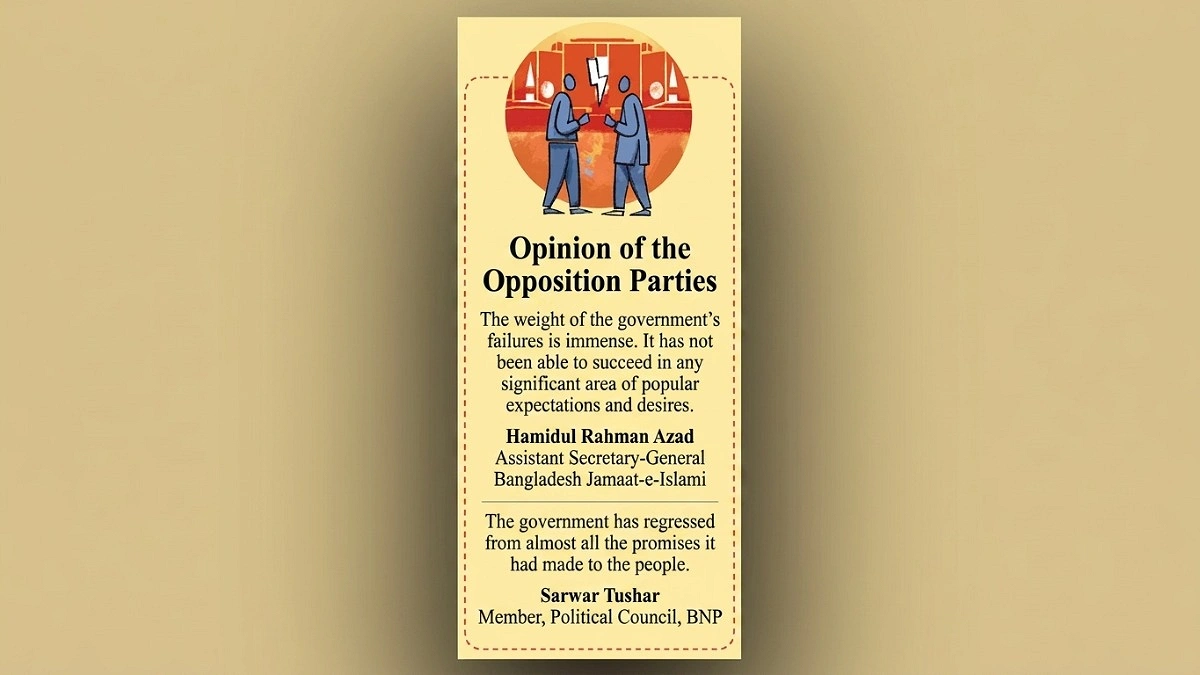
“The scales are heavier on the side of the government's failures than its successes. This administration has failed in any major area of public expectations and aspirations. From the very beginning, it has deceived the people in some way over the issue of the July Charter. At the same time, the deterioration in the law and order situation, energy and electricity shortages, politicization of the banking sector and various other incidents have created concern among the public. Overall, the current government is also following the old political path,” Jamaat e Islami Assistant Secretary General Hamidur Rahman Azad told Agamir Somoy.
The National Citizen Party (NCP) has also made similar criticisms in its assessment of the government's 180 days. According to the party's Joint Chief Coordinator and Member of Parliament Abdul Hannan Masud, first, the government has set the highest example of politicization within just 180 days. State institutions are also turning into rehabilitation centers for activists and leaders of the ruling party. Instead of addressing important issues such as preventing enforced disappearances, human rights and judicial reforms, the BNP government is doing whatever is necessary simply to remain in power. There is no visible initiative to strengthen any institution.
“In the government's first six months, people are disappointed, deceived and angry. They have backed away from almost every commitment they made to the people. Instead of real change, a form of publicity driven politics is underway,” alleged Sarwar Tushar, a member of the NCP's Political Council and head of its Media Subcommittee.
Opposition parties see the gas, electricity and energy crisis as one of the government's major failures during its first six months. They allege that the problem is no longer limited to load shedding or inadequate gas supplies. Its effects are being felt in industrial production, business and people's daily lives.
NCP Convener and Chief Opposition Whip in the National Parliament Nahid Islam alleged that widespread load shedding had emerged in the country within a few months of the government taking office. Industrial plants and businesses are being affected due to inadequate electricity and gas supplies. No one can conduct business because of extortion. If the government fails to change these circumstances, questions will also arise over whether the BNP government has the right to remain in power.
Sheikh Fazle Bari Masud, Joint Secretary General of Islami Andolan Bangladesh, criticized the government from a somewhat different perspective. “The deterioration in the law and order situation and people's insecurity are the most noticeable issues. People are becoming frustrated because there has been no justice in one murder and rape case after another. People do not feel much difference from the previous situation,” he said in frustration.
JAGPA spokesperson Rashed Pradhan also expressed disappointment while evaluating the government's 180 day performance. According to him, the expectations people had of the BNP government for a democratic Bangladesh after the July mass uprising have not been fulfilled. Instead of improving the economic and social situation, uncertainty and frustration have grown among ordinary people.
