
Half of Schools in Digital Darkness
- 13,000 educational institutions without websites
- Schools and colleges still outside digital services
- DSHE sets June 4 deadline for updates
- Admission notices now sought on Facebook

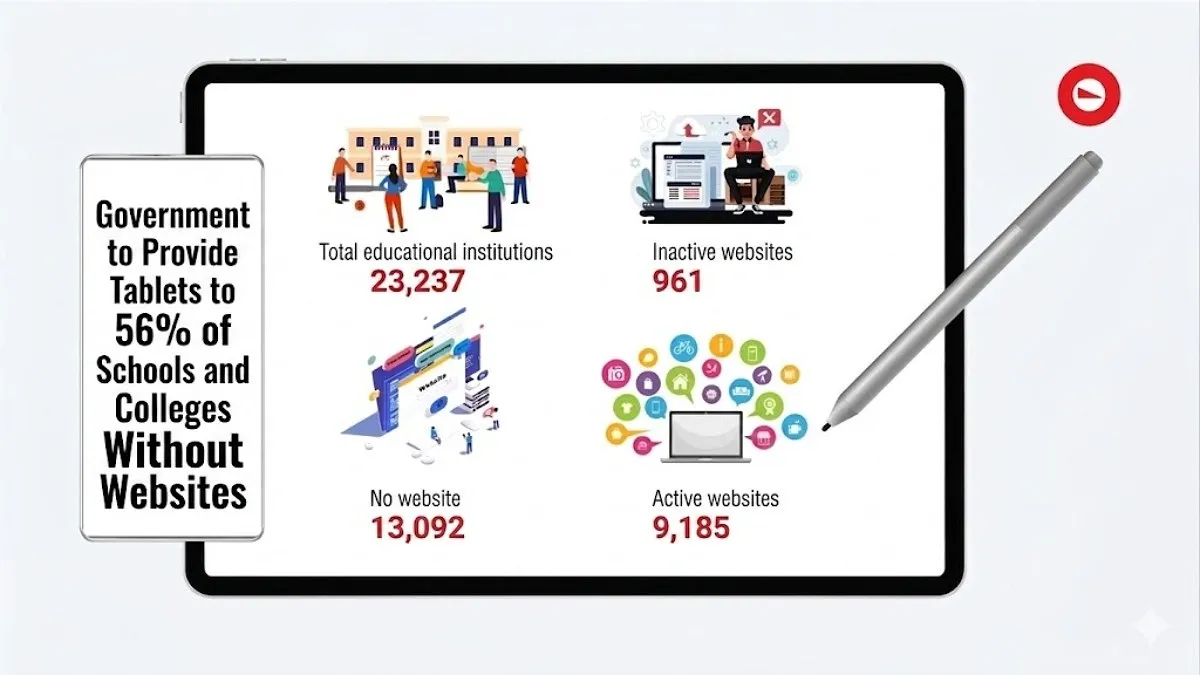
Graphics: Agamir Somoy
Access to information has become easier than ever before. Services in various institutions are now just a click away, reducing physical effort as needs are being met online. However, the institutions responsible for education itself remain largely outside this digital shift, as most schools and colleges in the country still do not have websites. In response, the government has taken an initiative to distribute tablets to these institutions. Questions are now being raised about whether these devices will be used effectively and whether teachers and students will truly benefit.
The government envisions a ‘smart’ education system. To achieve this, it has launched programs such as ‘One Teacher, One Tablet’ and plans to introduce digital classrooms. The Education Ministry has sought budget allocation in the upcoming fiscal year to implement these initiatives. If funded, the projects will be rolled out gradually. However, the gap between government ambition and ground reality becomes clear from the state of institutional websites.
Out of 23,237 schools and colleges under the Directorate of Secondary and Higher Education (DSHE), 13,092 institutions do not have their own websites. Another 961 websites exist but are not updated. In total, 56 percent of educational institutions remain outside digital information services.
Due to the absence of websites, teachers, students, and parents are deprived of administrative information, admission notices, teacher lists, notices, results, and emergency instructions. Everything, from student attendance to civic service information, remains out of reach, creating widespread information gaps. In this context, DSHE issued a strict directive on May 21, instructing all schools and colleges to create or update their websites by June 4.
Beyond schools and colleges, there are 8,743 approved technical and vocational institutions and 9,176 madrasas under various levels of the education system. It could not be confirmed whether these institutions have websites. However, a DSHE official said the situation in madrasas is even worse.
Parents are forced to search Facebook for admission notices due to the lack of institutional websites, said Ziaul Kabir Dulu, president of the Parents Unity Forum. He alleged that this is a common scenario in rural institutions, where parents often have to leave their work and visit schools for even minor information.
DSHE guidelines state that websites must include teachers’ and officials’ names and designations, notice boards, and service sections such as information rights, grievance redress systems, and citizen e-services. Officials consider the absence of websites a major gap and structural weakness in many institutions.
