
Dispute over bar president’s remarks, appellate division judges leave courtroom

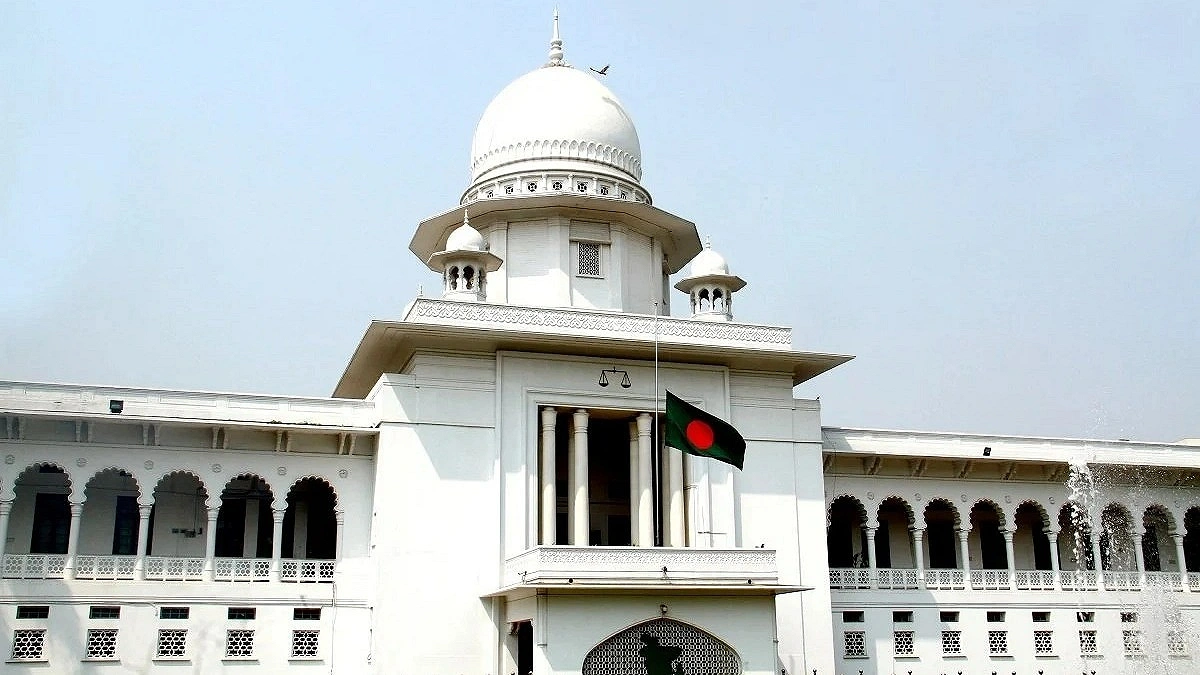
File Photo
After the president of the Supreme Court Bar Association remarked that lawyers’ income had declined since Justice Zubayer Rahman Chowdhury took office as chief justice, a heated argument broke out between the two sides. At one point, Chief Justice Zubayer Rahman Chowdhury and the entire bench of the Appellate Division left the courtroom.
The incident took place during a hearing on Tuesday.
Speaking to lawyers, it was learned that multiple writ petitions had been filed on the same issue regarding the appointment of nikah registrars under Item No. 1 of the Appellate Division. Writ petitioner Md. Nur Alam and his lawyer, Sufia Ahmed, were fined Tk 500,000 each for allegations of concealing information and fraud. They were ordered to pay the total fine of Tk 1 million to Dhaka Shishu Hospital within 30 days.
Supreme Court Bar Association President Barrister A.M. Mahbub Uddin Khokon applied for a waiver of the fine. Raising the question of where a lawyer would get the money to pay the fine, Barrister Khokon sought a waiver. At one point during the argument, Barrister Khokon told the court, “Since you became chief justice, lawyers’ income has decreased.”
Later, Barrister Khokon told reporters, “In the Appellate Division, a female lawyer was fined Tk 500,000 under Item No. 1 in the morning. At that time, I politely told the chief justice that since you became the honorable chief justice, there actually have not been many cases in the Appellate Division. As a result, lawyers’ income has decreased. She is a junior lawyer, and imposing a cost of Tk 500,000 on her has become too much. She should be forgiven.”
“Then he said, ‘Has lawyers’ income decreased because I became chief justice?’ Income has decreased in that sense... I was actually trying to explain to him... I have also said this to him at different times. Earlier, there were 11 judges in the Appellate Division and three benches. We would always hear cases in all three benches. Now there is one bench.”
Barrister Khokon further said that when a stay order is issued in a case, the hearing of that case often does not take place for a long time. As a result, although the case remains pending, the concerned person is deprived of justice. There is often no opportunity for a hearing through a writ, appeal or any other legal process.
“The same kind of problem is arising in cases where the chamber judge has issued a stay order. I myself applied four times in the chamber judge’s court over the past year for a hearing of one case. But it was not possible to complete that hearing. It is not only my case. Many lawyers are facing the same situation,” Khokon added.
Referring to the crisis facing lawyers, Khokon said its direct impact is also being felt by lawyers. If cases are not heard, lawyers cannot work either. Their relationships with clients deteriorate. This is because a lawyer comes to court to conduct a case on behalf of a person seeking justice.
“I politely raised these problems faced by lawyers with the chief justice. But he took the matter differently. He said he did not accept the statement that lawyers’ income had decreased because he became chief justice. But that was not what we meant to say. Our point was that lawyers are being professionally affected because cases are not being heard,” Barrister Khokon clarified.
At one point, 11 judges used to hear cases in three benches of the Appellate Division. Now the number of judges has decreased and a huge number of cases are effectively being handled by one bench. As a result, thousands of cases are waiting to be heard. Even when a chamber judge sets a date and item for hearing a case, it often does not reach the hearing stage. This is affecting both people seeking justice and lawyers.
“If lobbying is given priority in the hearing or listing of any case, it is in no way desirable for the Supreme Court. This increases the costs for people seeking justice and may undermine public confidence in the judicial process,” Barrister Khokon said.
According to Khokon, large costs are sometimes imposed on junior lawyers. A Tk 500,000 cost has also been imposed on a female junior lawyer. “I believe winning or losing a case is a normal part of a lawyer’s profession. It is necessary to consider how justified it is to impose a large cost simply for that reason.”
“I have said these things in the interest of justice and considering the rights of lawyers and their professional environment. I always speak about these issues publicly. Whether at receptions for new judges or meetings with the chief justice, wherever I have had the opportunity, I have raised the problems faced by lawyers,” Barrister Khokon clarified.


