
International Literacy Day
New literacy definition focuses on jobs, not just reading

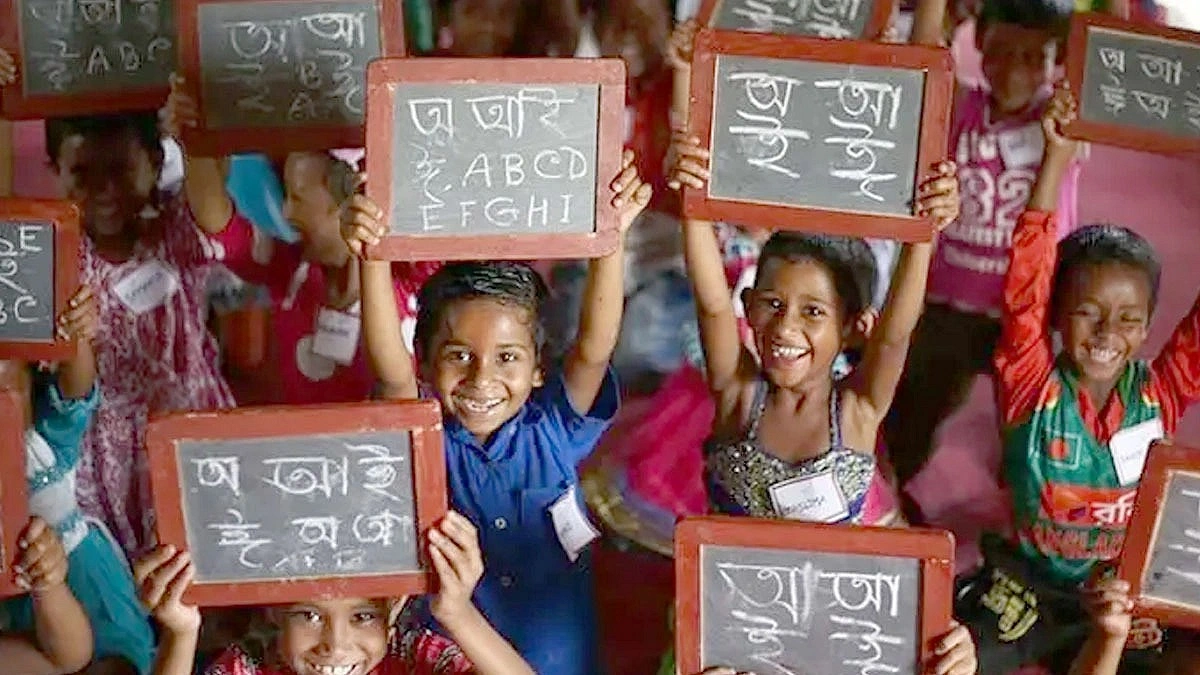
Collected Photo
According to the UNESCO, literacy is the ability to read, write, and understand any language. However, in Bangladesh, a person’s name was historically recorded on the literacy list if they could simply write their own name or provide a signature.
The government is now taking initiatives to change this long-standing practice. Under the new approach, merely writing one’s name, reading, or signing is no longer sufficient.
Instead, the government wants to include the ability to read and understand essential life information, write, perform basic arithmetic, and apply that knowledge to earn a livelihood as part of literacy.
School dropout children, adolescents, and youth will receive not only basic education but also technical and pre-vocational training. For adults, significant emphasis is also being placed on “functional literacy” or effective literacy.
With the theme “Literacy for People, Earth, and Prosperity,” International Literacy Day will be observed worldwide on Tuesday. To mark the day, Education Minister ANM Ehsanul Hoque Milon and State Minister Bobby Hajjaj will participate in a meeting organized by the Bureau of Non-Formal Education.
President Mirza Fakhrul Islam Alamgir and Prime Minister Tarique Rahman have issued messages on the occasion.
Ministry of Primary and Mass Education said the concept of literacy is now far more extensive. It is crucial whether a person can read and understand necessary writings in daily life, perform calculations, utilize information, and improve their life and livelihood using that knowledge.
This shift is reflected in the country’s new programs. Bureau of Non-Formal Education has integrated pre-vocational training, occupational trades, and livelihood skills into its planning. The target is not merely to make illiterate people literate but to make literate individuals skilled and employable.
Bureau of Non-Formal Education Director General Monoara Eshrat told Agamir Somoy, “There is no scope to evaluate a vast population solely by the number of literacy. We want to move towards functional literacy. Therefore, we want to provide illiterate individuals with such literacy that will help them function normally in their daily lives, society, and workplaces, and protect their rights.”
Regarding Bangladesh’s global standing in literacy, countries are compared internationally based on the literacy rate of the population aged 15 and older. According to this metric, most of the developed and relatively developed countries in Asia are significantly ahead of Bangladesh.
The literacy rate in the Maldives is 98 percent, Sri Lanka at 92 percent, and India at 80 percent. In Bangladesh, this rate stands at 77.9 percent. Meanwhile, it is slightly over 70 percent in Nepal. In contrast, it is below 60 percent in Pakistan and below 40 percent in Afghanistan.
This disparity becomes even more distinct in the broader Asian perspective. The adult literacy rate in countries such as China, Japan, South Korea, Singapore, Malaysia, Vietnam, Indonesia, and the Philippines is above 90 percent.
There is still no opportunity to categorize Bangladesh among the high-literacy nations in Asia. However, the progress made by Bangladesh over the last few decades is remarkable.
Bureau of Non-Formal Education Director Devabrata Chakraborty said the scope of literacy has expanded due to increased participation in primary education, stipends, free textbooks, various dropout reduction programs, and non-formal educational activities.
He told Agamir Somoy, “Our goal is how to bring illiterate individuals into the mainstream in the context of Bangladesh compared to other countries.”
According to the BBS Statistics-2025, the total population of the country is 16,98,28,911. Out of this, the literacy rate is 77.9 percent, which means 3,75,31,000 people are still illiterate.
Mujibur Rahman of the Institute of Education and Research at University of Dhaka believes that having this number of illiterate people 56 years after independence is inconsistent with the electoral manifesto of the government.
He said, “There was an announcement in the Awami League’s 2008 election manifesto to eliminate illiteracy from the country by 2014. Let alone 2014, the scenario remains the same in 2026. Governments have less interest in working in this area.”
Under such circumstances, fears have risen regarding making the country illiteracy-free by 2030 in order to achieve the Sustainable Development Goals (SDGs).
The government is breaking away from the old concept of literacy. In the new definition, skills, employment, livelihoods, and functional capabilities in daily life are being linked with literacy. As part of this initiative, a target was set in the fiscal year 2025-26 to provide pre-vocational education and training to 5,120 dropout youth in the headquarters of 64 districts.
Out of 4,312 registered individuals, 4,198 completed the training, and 3,882 entered employment. Following the training, 92.47 percent of the beneficiaries secured opportunities for employment, apprenticeships, entrepreneurship, or job linkage.
Devabrata added that initiatives have been taken to make dropout youth career-oriented through training and to equip adult illiterates with skills in essential reading, writing, and basic mathematics. At the same time, there is a plan to further expand these activities by engaging young people as “Literacy Ambassadors”.


