

All Four U-turns on 13 km Stretch are Death Traps
- In the past 6 months, 15 people killed and over 50 injured in 30 accidents in the Gazaria section
- Baluakandi, Bausia, Anarpura and Bhaberchar areas lack supervision at U-turns

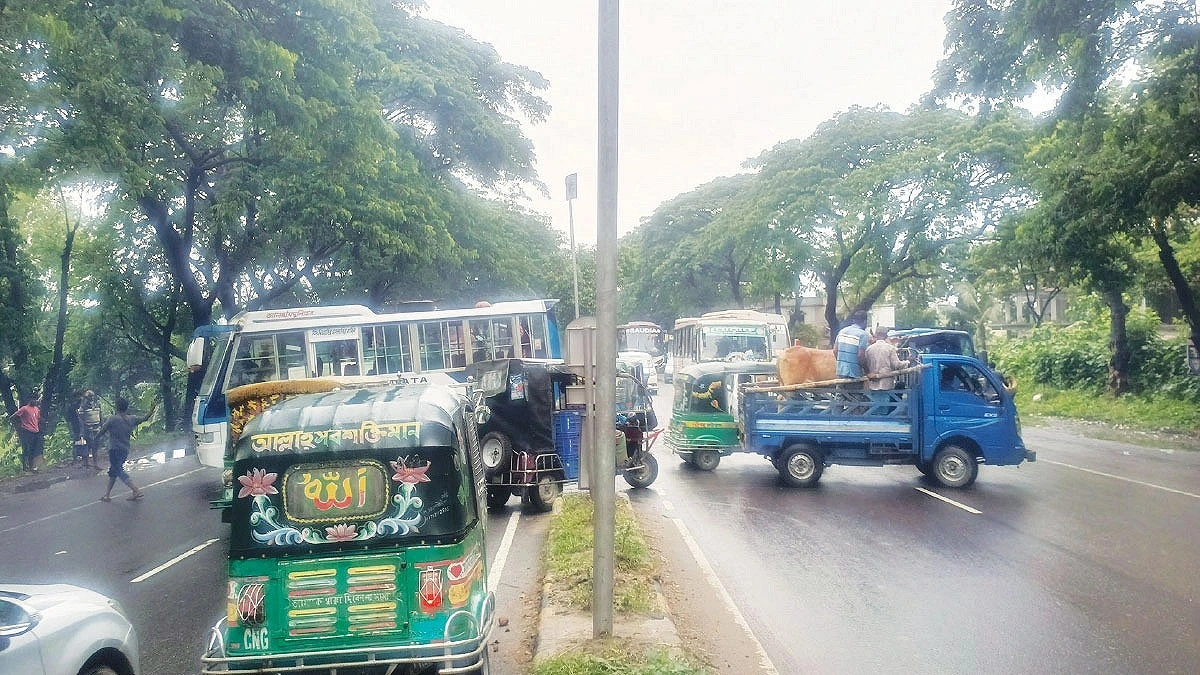
Collected Photo
The four U-turns along a 13-kilometer stretch of the Dhaka–Chattogram Highway in Gazaria upazila of Munshiganj have turned into deadly hazards. Each of these U-turns has effectively become a “death trap.”
Due to violations of proper traffic regulations while crossing these U-turns, along with insufficient monitoring and lack of safety measures by the relevant authorities, drivers, passengers, and pedestrians are frequently falling victim to accidents, resulting in deaths, disabilities, and property damage.
According to victims and related sources, the U-turns in Baluakandi, Anarpura, Bhaberchar, and Bausia on this vital highway—often called the lifeline of Bangladesh are being poorly supervised by road department officials. At the same time, the highway police responsible for road safety are also failing to properly monitor these areas, leading to repeated tragic accidents.
In the last six months alone, around 30 accidents have occurred in the Gazaria section of the highway, killing 15 passengers and pedestrians and injuring more than 50 others.
“We are working day and night to ensure highway safety,” said Md. Shah Kamal Akand, in-charge of the Bhaberchar Highway Police under Gazaria Police Station.
On-the-spot observations show that four U-turns have been created by cutting the central divider of the highway within the 13-kilometer stretch of Gazaria in Munshiganj, which falls under the Bhaberchar Highway Police jurisdiction. These U-turn points are located near Baluakandi, Anarpura, Bhaberchar Eidgah, and the area adjacent to Purana Bausia Mana Bay Water Park.
Accident rates are comparatively higher at these U-turn locations in Baluakandi, Bhaberchar, Anarpura, and Bausia.
Locals say that due to limited monitoring by highway police, small vehicles such as three-wheelers, CNG-run auto-rickshaws, battery-powered rickshaws, motorcycles, private cars, and even pedestrians frequently use these U-turns without restriction, often risking accidents.
Recently, in the Anarpura area, a battery-operated auto-rickshaw was hit by a long-distance bus while attempting to take a U-turn, resulting in the death of two passengers and serious injuries to three others.
Residents have demanded that security personnel or traffic police be deployed at these U-turn points. Otherwise, they are calling for alternative solutions such as the construction of overpasses or underpasses to ensure safer traffic movement.
The Roads Department is responsible for road construction and maintenance. The responsibility for road safety lies with the Highway Police.
Drivers and passengers of multiple vehicles using the highway have stated that reckless and high-speed driving without following traffic rules makes the highway unsafe, risky, and a major source of public suffering.
They also alleged that although police are deployed for highway safety, they are not properly fulfilling their responsibilities.
Locals have also demanded strict monitoring by the relevant authorities to stop various violations, including the unrestricted movement of banned three-wheelers, tractors, “nosimon,” and “mahindra”-type vehicles on the highway.
Monir Hossain, Deputy Assistant Engineer of the Narayanganj Roads and Highways Department, said that the Roads and Highways Department is responsible for road maintenance and construction, while highway safety is the responsibility of the Highway Police.
He claimed that extra space has been provided on both sides of each U-turn during construction to allow vehicles to move safely, and some public awareness stickers have also been installed. He added that everyone should be more conscious, which could help reduce accidents to some extent.
Md. Shah Kamal Akand, Inspector-in-Charge of the Bhaberchar Highway Police under Gazaria Police Station, said that they are working day and night to ensure highway safety. In particular, they have raised awareness among drivers to prevent the movement of CNG-run auto-rickshaws and three-wheelers on the highway and encouraged them to follow traffic rules through publicity campaigns.
He further stated that legal action is being taken against drivers who violate highway rules, and cases are regularly being filed against offenders as part of ongoing enforcement operations.

