

Bread Made Using Yeast Extracted from a Mummy

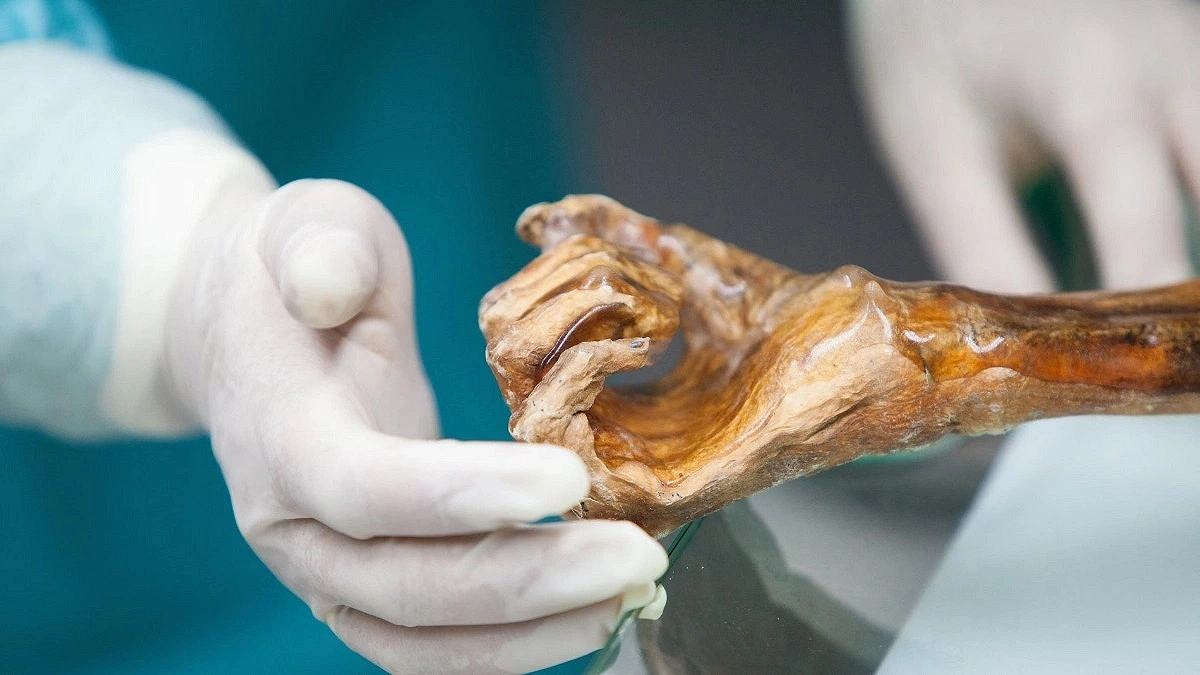
A researcher examining the hand of Ötzi the Iceman. Photo: South Tyrol Museum of Archaeology.
Scientists have achieved a remarkable feat by baking sourdough bread using yeast recovered from a nearly 5,000 year old frozen mummy. Researchers are now planning to explore whether the same yeast can also be used to produce ancient-style beer or other alcoholic beverages.
According to a report by The Guardian, the source of this historic yeast is the famous Alpine mummy known as “Ötzi the Iceman.” Ötzi’s naturally preserved body was discovered in 1991 in the icy mountains along the border of Italy and Austria. Since its discovery, Ötzi has become a major focus of scientific research, offering valuable insights into prehistoric European life.
Recently, scientists studying microorganisms preserved on and within Ötzi’s remains unexpectedly extracted viable yeast. They successfully used it to bake experimental traditional sourdough bread.
In a statement published on the website of the Institute for Mummy Studies’ Eurac Research, microbiologist Mohamed Sarhan said: “In the end, we were able to prepare a fully functional yeast, which behaved just like ordinary yeast and rose within 24 hours. We successfully produced a very good-quality dough with it.”
Sarhan also jokingly commented on his baking skills: “I had never baked bread before, and that became quite obvious in the final result. The first attempt had several flaws, but as I said, these were only preliminary experiments.”
After the successful bread experiment, researchers are now planning to move on to producing beer using the same yeast.
Sarhan added: “We want to take this research further. We are involving specialized food research teams. Bread making has been our first successful application; our next goal is to produce beer. We have already begun discussions with experts from the famous German brewing company Weihenstephan.”
Scientists believe the yeast survived only in extremely cold conditions, suggesting it may have entered Ötzi’s body shortly before or after his death. Genetic analysis also indicates that these microorganisms may have colonized his body very soon after he died.
Ötzi has long fascinated researchers worldwide. His body bears the world’s oldest known tattoos, with a total of 61 markings discovered so far. However, the greatest mystery remains his death.
Ötzi died around 5,300 years ago in the icy Alps, and his cause of death is still debated. An arrowhead found in his back has led historians and scientists to describe his case as one of the world’s oldest cold-case murders.

