


Can Trump make the Strait of Hormuz a US territory?

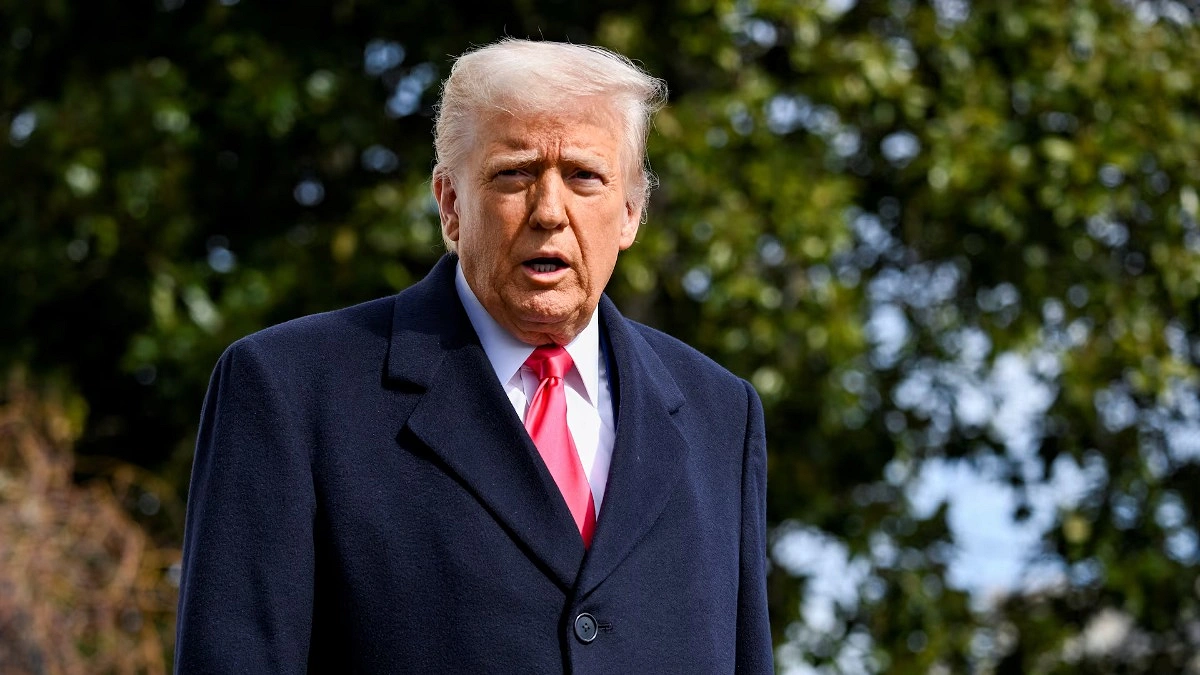
Photo: REUTERS
US President Donald Trump sparked an international firestorm on Friday by announcing his intention to designate the Strait of Hormuz as a United States territory “pretty soon”.
During a speech at a New York police academy, he characterized the ongoing war - which ignited on 28 February - as a game of “chess” while claiming that the US military is dealing Iran a severe defeat.
Trump asserted his authority over the vital global chokepoint, which handles one-fifth of the world’s oil and gas exports, by suggesting the US naval blockade already grants the US de facto control. He said, “After we finish defeating Iran, which is being very badly defeated, pretty soon I’ll be declaring the Hormuz Strait a territory of the United States.”
He emphasized the power of the American blockade by saying, “Essentially, that’s what it is,” and adding, “We have the blockade. No ships get through unless we want them to.”
International defiance and legal reality
Iranian officials immediately dismissed Trump’s remarks as “nonsense” as the June Memorandum of Understanding (MoU) between the two nations approaches its expiration this Sunday.
Kazem Gharibabadi, the deputy foreign minister of Iran, countered Trump’s claims by saying, “The Strait of Hormuz cannot be seized by tweet, nor by aircraft carrier, nor by issuing an order, nor by an election speech.”
He insisted that the waterway remains under Tehran’s authority, declaring, “The Strait of Hormuz has been Iranian, is Iranian, and will remain Iranian; this strait will only be closed and opened under Iran’s command, and as long as you do not accept the reality of defeat and cease your fanciful delusions, Iran will continue to enforce the blockade.”
While Tehran leverages the strait to pressure the global economy, Washington continues its military blockade against Iranian ports to further choke the Islamic Republic’s economy.
Foreign Minister Abbas Araghchi noted that while Iran is negotiating maritime management with Oman, the US must remove sanctions and the blockade before the waterway reopens.
Constitutional and political obstacles
Legal experts argue that Trump lacks the unilateral constitutional power to annex the strait. Bruce Fein, a former associate deputy attorney general under Ronald Reagan, explained that the Constitution requires a treaty ratified by the Senate or a specific statute to annex territory, citing the Louisiana Purchase and Hawaii as historical precedents.
Fein warned that a forced annexation would constitute a “crime of aggressive war” under the UN Charter. Natalie Klein, a specialist in international law, observed that such a claim would only hold plausibility if the US acted as an occupying power with military control over Iran’s coastal regions.
Domestically, the war remains deeply unpopular, with only 35 percent of Americans approving of the conflict according to a Reuters/Ipsos poll. Vice President JD Vance recently highlighted that the Trump administration prioritizes lowering petrol prices, which now exceed $4 a gallon, over stopping Iran’s nuclear ambitions.
A rhetorical showmanship
Paul Musgrave, an associate professor at Georgetown University, suggested that Trump’s rhetoric primarily targets his domestic support base, describing Trump as a “showman”. Musgrave cautioned, “This is a guy who speaks big. You have to take him seriously in some cases but not literally.”
Strait of Hormuz sits within international waters between Iran and Oman, and although neither nation has ratified the UN Convention on the Law of the Sea (UNCLOS), both generally follow its rules as customary law. UNCLOS limits coastal sovereignty to 12 nautical miles, whereas the strait is only 21 nautical miles wide at its narrowest point.
Despite Washington’s claims of a total blockade, maritime data indicates that some vessels still transit the passage. Analysts believe Iran’s recent attacks on its Gulf neighbors aim to force regional nations into pressuring the US at the negotiating table.
Trump’s statements, however, signal his determination not to accept defeat in the months-long conflict.
Source: Al Jazeera (adapted)

