
The Britain Starmer Leaves Behind

Graphics: Agamir Somoy
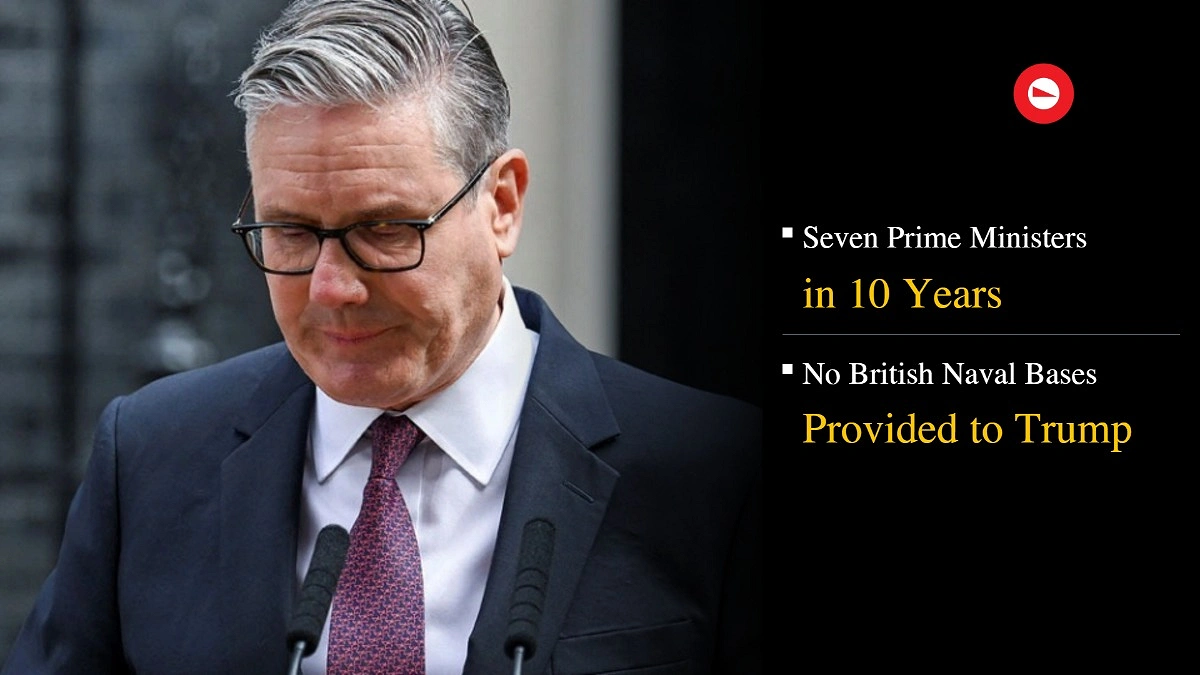
Keir Starmer has announced his final resignation, triggering what will mark the seventh change of British prime minister in the past decade. Since the 2016 referendum, the United Kingdom has undergone prolonged political turbulence following the vote to leave the European Union, a process known as Brexit. Although the referendum took place in 2016, Brexit formally came into effect on January 31, 2020, nearly three years later. Since then, political instability has continued to shape the country’s trajectory. The question now arises, what Britain did Starmer inherit, and what is he leaving behind?
Following the Brexit referendum, internal divisions within the Conservative Party, political instability, and a rapid succession of four prime ministers, Theresa May, Boris Johnson, Liz Truss, and Rishi Sunak, set the stage for Starmer’s rise to power. The ‘Vote Leave’ campaign had promised voters that exiting the EU would reduce immigration and improve the economy, but those expectations did not materialize. Instead, the country experienced years of political deadlock and economic stagnation.
Under Conservative rule, public dissatisfaction deepened through a series of crises, Boris Johnson’s policy failures and the ‘Partygate’ scandal, Liz Truss’s economic turmoil following a mini-budget that collapsed within 45 days, and Rishi Sunak’s tenure marked by a worsening cost-of-living crisis. Together, these developments fueled widespread anger and frustration among British voters after 14 years of Conservative governance. Against this backdrop of growing demand for political change, the Labour Party secured a landslide victory in the July 2024 general election, bringing Starmer to 10 Downing Street.
Starmer’s tenure is set to become the shortest among Labour prime ministers. Analysts are now assessing the extent of his legacy. Critics argue that he leaves behind little of lasting historical significance. Even Gordon Brown, who remained in office for nearly three years, is credited with steering the country through the global financial crisis and advancing reforms in the National Health Service and schools under Labour’s modernization agenda.
Critics argue that Keir Starmer’s two most significant achievements so far include rescuing the Labour Party from the influence of Corbyn-era factions and securing a decisive general election victory. They also describe his decision not to involve the United States directly in the Iran conflict as one of his more courageous foreign policy moves. However, as the memory of that election win faded, a more pressing question emerged: what was the real purpose of that victory? Increasingly, observers found it harder to answer.
Once in office, Starmer’s primary policy action focused on raising taxes. His government used much of the revenue to stabilize the fragile economy left behind by the Conservatives. It also directed additional spending toward welfare benefits. Starmer did not initially intend to exceed Conservative levels of welfare spending, but pressure from his own parliamentary party forced him into a key early defeat, which permanently weakened his authority. Critics argue that his government entered office without a clearly defined governing agenda.
On foreign policy, Starmer remained relatively active. He worked to unite Europe in support of Ukraine and sought to prevent U.S. President Donald Trump from abandoning Kyiv. He managed Trump’s unpredictability with notable skill, helping the United Kingdom avoid punitive U.S. tariffs and securing a nominal trade agreement, much of which was never implemented.
However, his success in managing Trump proved short-lived. Relations between the two deteriorated, particularly after Britain refused to allow its naval bases to be used for strikes against Iran. Within a short period, several difficult decisions made under pressure came to define Starmer’s leadership. Critics dispute many of those choices, although some acknowledge that he was correct in certain instances.
Starmer began his parliamentary career in 2015 after winning the Labour seat of Holborn and St Pancras in London. Even before entering the House of Commons, some already viewed him as a potential future prime minister. A mysterious Twitter account even called for the newly elected MP to become Labour leader.
He entered politics with a résumé shaped by his former role as Director of Public Prosecutions. During Jeremy Corbyn’s leadership of the opposition, he handled his responsibilities effectively, maintaining a careful distance from allegations of antisemitism within the party while strongly supporting European Union membership. This positioning helped him win influence within Labour ranks. After Corbyn’s second election defeat in 2019, Starmer emerged as a candidate who appeared distinctly prime ministerial, while also pledging continuity with much of his predecessor’s policy agenda.
Over the next four years, however, those pledges were gradually abandoned as Starmer sought to construct a platform capable of capitalizing on Conservative disarray and presenting himself as a credible alternative to voters. While this strategy succeeded electorally, it ultimately faltered in government.
The foundation of that political platform rested on a theoretical promise of change. Within weeks of taking office, Keir Starmer and his Chancellor Rachel Reeves made a major misstep by scrapping winter fuel payments for most retired elderly citizens. The cut also hit low-income groups. In the public imagination, the decision, taken amid winter, an energy crisis, and growing hardship among pensioners, delivered a harsh political message and came to symbolize a self-inflicted setback.
Starmer and Reeves reversed the decision nearly a year later, through a U-turn that further exposed their policy vulnerability and poor political judgment. However, critics say the decisive blow came in June last year when they were forced into another reversal over planned cuts to disability benefits.
A surge of voter dissatisfaction might have been contained if Starmer’s growth-oriented policies had shown tangible improvements in living standards. The situation could also have eased had there been visible progress in reforming the UK’s health service. Although waiting lists for treatment showed signs of improvement, doctors continued to strike even after substantial pay rises in Labour’s first year in office, preventing any clear sense of progress from reaching the public.
The issue of illegal migration across the English Channel, commonly framed as the “boat problem,” which Starmer had used aggressively against Rishi Sunak during the election campaign, also remained unresolved. Small boat crossings did not stop. Instead, the problem persisted, leaving Starmer to pass on a challenge to his successor that appears unlikely to be resolved quickly.
