
High tariffs create export discrimination, World Bank urges trade policy reform

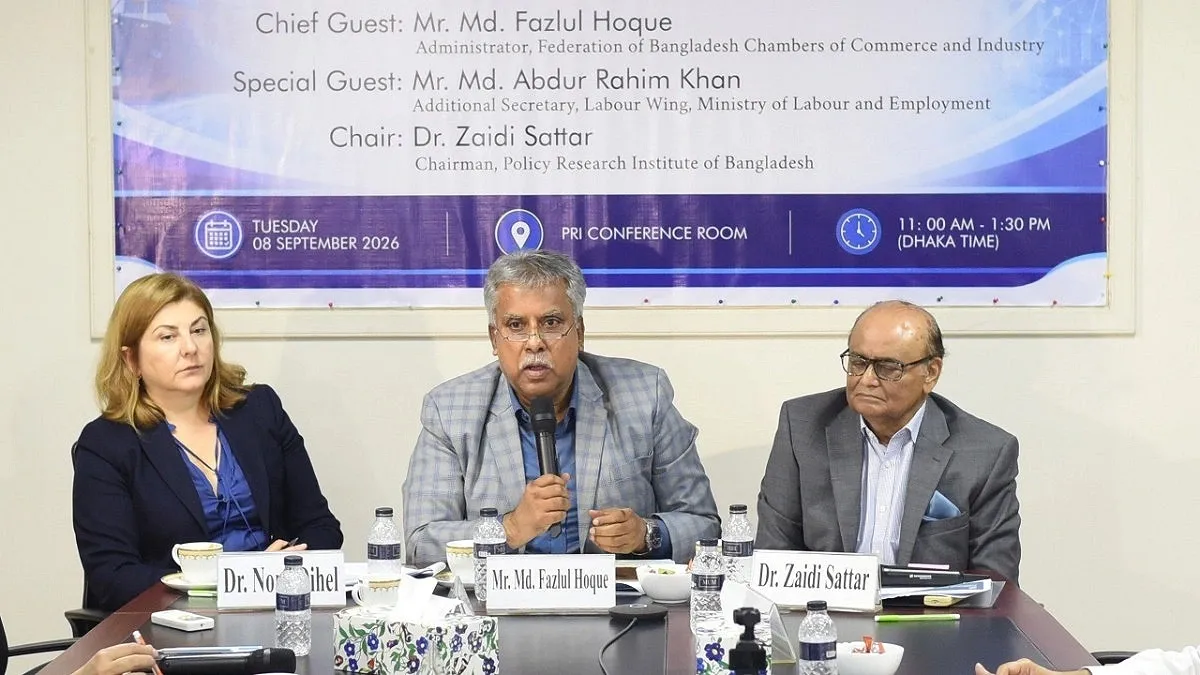
The Policy Research Institute of Bangladesh (PRI) and the World Bank jointly organized a discussion on Tuesday.
Bangladesh’s international trade and export sector are facing discrimination due to high tariffs and para tariffs, according to the World Bank. The organization said that outside the readymade garment sector, selling goods in the local market is more profitable than exporting them, creating a form of “antiexport bias” in the economy. Against this backdrop, the World Bank has urged trade policy reforms and tariff reductions ahead of Bangladesh’s graduation from the Least Developed Country (LDC) category.
The remarks came at a discussion organized jointly by the Policy Research Institute of Bangladesh (PRI) and the World Bank on Tuesday. The event was held in the capital under the theme “Bangladesh Trade Policy at a Crossroads: Evidence for the National Tariff Policy, LDC Graduation, and the Next Generation of Trade Agreements.”
World Bank Senior Economist Dr. Nora Diehl presented the keynote paper at the event. FBCCI Administrator Md. Fazlul Haque attended as the chief guest while Additional Secretary of the Ministry of Labour and Employment Md. Abdur Rahim Khan was present as the special guest.
According to World Bank data, Bangladesh’s trade weighted average Most Favored Nation (MFN) tariff was 7 percent in fiscal year 2026. However, when para tariffs are included, the effective average border protection rises to 15.4 percent. Para tariffs play a greater role than customs duties in protecting sectors such as footwear, leather products, stone and glass and transportation.
In addition, according to fiscal year 2025 data, around 28.4 percent of Bangladesh’s total imports entered the country without paying full tariffs or through various exemptions. A large portion of these imports came from India and China.
At the discussion, PRI Chairman Dr. Zaidi Sattar said that the actual picture of effective protection cannot be understood by considering only the tariffs imposed on imports. Bangladesh’s average nominal protection rate is expected to reach around 28 percent in fiscal year 2027. Nearly half of this will come from para tariffs.
While the World Bank has proposed reducing tariffs on intermediate raw materials, Dr. Zaidi Sattar warned that reducing tariffs only on raw materials could further increase effective protection for final products. This would hinder diversification of export products. Therefore, tariffs on final products also need to be reduced alongside those on raw materials.
She also said that the blanket “end user” tariff exemption system for products other than capital machinery should also be discontinued.
At the discussion, a two-phase tariff reform roadmap by 2029 was presented to facilitate trade. In the first phase, the proposal calls for abolishing all regulatory duties and withdrawing supplementary duties above 20 percent on products other than certain specified items.
