
From the Six-Point Movement to Parliamentary Politics

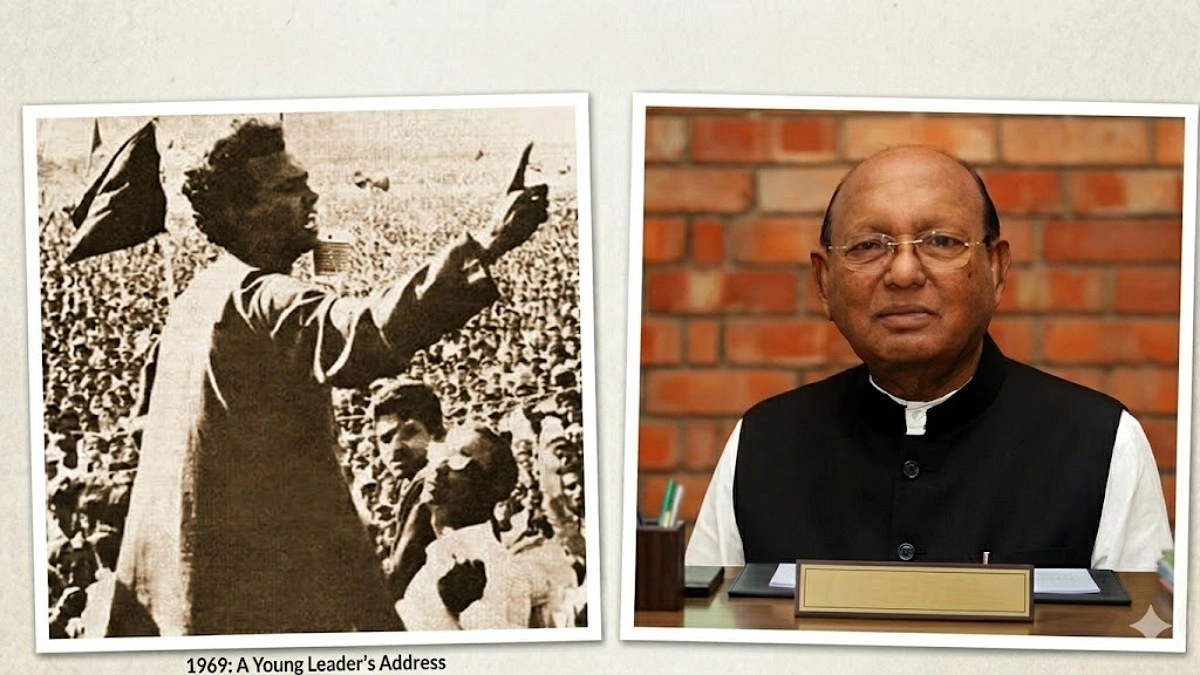
Graphics: Agamir Somoy
In the political history of the country, some names have not remained confined to individual identity; they have become symbols of their time. Tofail Ahmed was such a name. Through turbulent days of student movements, the Six-Point Movement, the 1969 mass uprising, the Liberation War, post-independence power politics, opposition movements, imprisonment, and a long parliamentary career, he became part of Bangladesh’s living political history. His death has marked the end of another old chapter in the country’s political narrative.
Born in 1943 in Bhola, Tofail Ahmed rose in politics from his student years. Dhaka University was then the epicenter of political consciousness in East Pakistan. Against the backdrop of discrimination, cultural domination, and political deprivation by the Pakistani ruling establishment, the youth gradually organized themselves. In this environment, Tofail Ahmed became active in Chhatra League politics and soon emerged as a recognizable figure among students.
In the 1960s, the Six-Point Movement announced by Bangabandhu Sheikh Mujibur Rahman elevated the demand for self-determination and political freedom of Bengalis to a new height. Although the Pakistani ruling regime branded the Six Points as separatist, the people of Bengal embraced it as their charter of liberation. Tofail Ahmed was among the young leaders who played a key role in organizing students in support of the movement. He took to the streets, led processions and rallies, and did not step back in the face of repression.
The 1969 mass uprising marked one of the most significant chapters of his political life. As East Pakistan erupted in protest demanding the release of Bangabandhu from the Agartala Conspiracy Case, Tofail Ahmed stood at the forefront of the Student Struggle Council leadership. The united student movement of the time shook the foundation of Pakistan’s military rule. Historians believe that the 1969 uprising laid a strong foundation for the subsequent independence movement. It was during this movement that Tofail Ahmed gained national prominence.
In 1971, after the Pakistani forces launched a genocide, the Bengali struggle for independence turned into an armed war. During the Liberation War, like many other leaders and activists of the Awami League, Tofail Ahmed played an active role in support of independence. He represented a generation that risked both life and future for the dream of a free Bangladesh.
After independence, his importance in Awami League politics increased further. As a close political associate of Bangabandhu, he quickly established himself in national politics. He served multiple terms as a Member of Parliament and held key ministerial responsibilities. Through his roles in ministries including industries and commerce, he participated in state governance. His long political career included both government responsibilities and the harsh realities of opposition politics.
Tofail Ahmed also witnessed closely several critical phases of Bangladesh’s political history. Following the political change of 1975, he, like many Awami League leaders and activists, went through difficult times. During military rule, he faced imprisonment, legal cases, and political harassment due to his opposition politics. In the 1980s anti-autocracy movement, he remained an active participant. Overall, street movements, arrests, and political repression became an inseparable part of his political life.
His political journey was long, but not entirely free from controversy. In the reality of Bangladesh’s politics, he faced criticism at various times over power dynamics, party conflicts, and political positions. Yet, among his supporters, he remained an experienced politician committed to the ideals of Bangabandhu, who rose from the politics of mass movements to the center of state governance.
His speeches in parliament, political language, and organizational skills gave him a distinct identity. Among politicians of the older generation, his politics bore the imprint of street movements. Compared to today’s technology-driven and strategy-based politics, his generation was more ground-centered. Their political development grew through rallies, posters, student gatherings, and the heat of the streets.
Tofail Ahmed’s name remains deeply intertwined with the political history of pre-independence Bangladesh. He belonged to a generation that viewed the struggle against Pakistani rule as greater than personal ambition. For them, politics was a question of national existence. Times have changed and the language of politics has evolved, but the memory of that generation remains an important part of Bangladesh’s political history.
With his death, not only has a veteran leader passed away, but also a powerful voice of the Six-Point Movement generation has fallen silent, marking the end of a living chapter in the political history of Bangladesh.
