
'Two-state solution' back on the agenda at the UN, what is the ground reality?

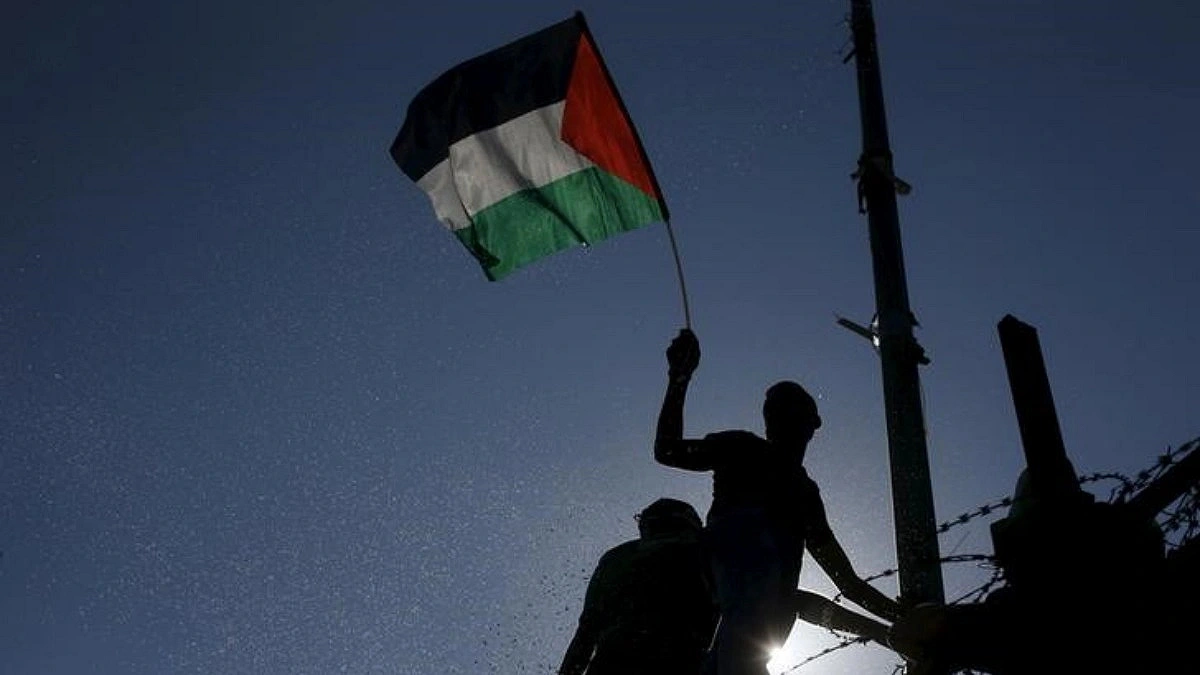
A spectator waves a Palestinian flag during the first leg of the Palestine Cup final between Gaza Strip's Shujaiya and Hebron's Al-Ahli at Gaza's Al-Yarmouk Stadium on August 6, 2015. File photo / Reuters
Two-State Solution Resurfaces at the UN on Palestine Issue: What Is the Ground Reality? In speeches by world leaders at the United Nations, an old yet increasingly elusive concept has once again taken center stage: the "Two-State Solution." This framework envisions two independent nations—Israel and Palestine—existing side-by-side with mutual recognition, security, and internationally recognized borders. During the 81st Session of the UN General Assembly in New York, UN Secretary-General António Guterres said that the two-state solution must not be allowed to disappear from sight. He emphasized the necessity of stopping the conflict in Gaza, ensuring the delivery of humanitarian aid, and halting violence, displacement, and settlement expansion in the West Bank.
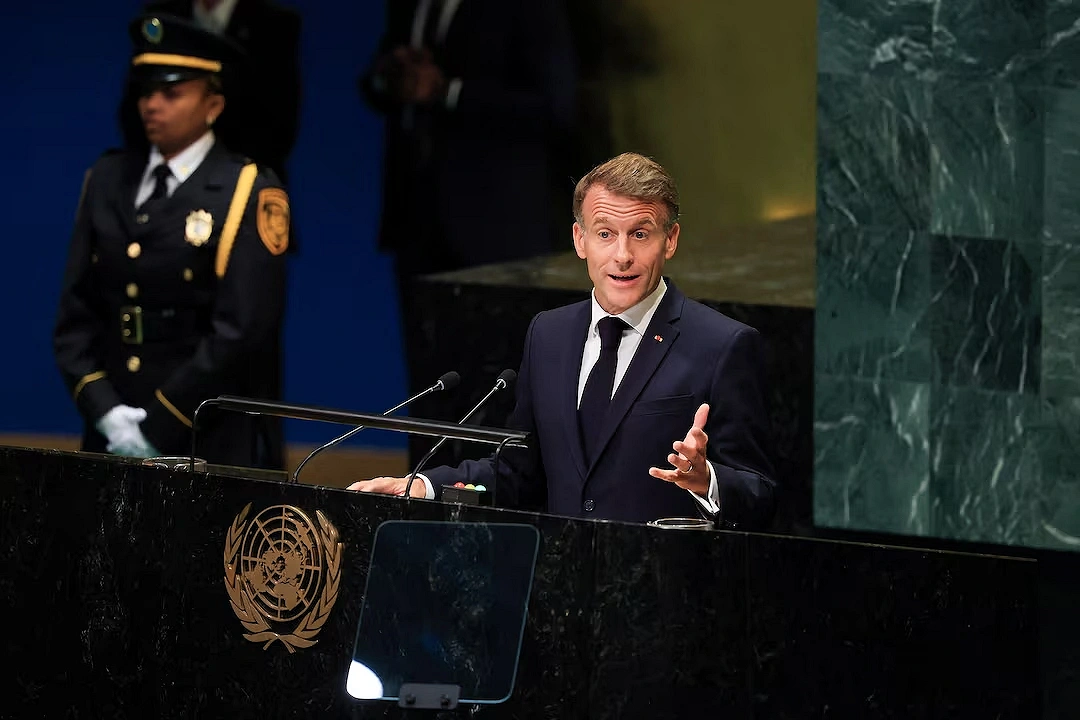
French President Emmanuel Macron. Reuters photo.
His remarks clearly highlighted that current conditions are severely constricting the path toward a political resolution for Palestine. Palestinian President Mahmoud Abbas also called for international action to implement the two-state solution. Alongside halting the Gaza war, he urged an immediate end to Israeli settlement expansion in the West Bank. However, his presence at this year's assembly became a major diplomatic issue. President Abbas was unable to travel to New York after the United States denied him a visa. Consequently, the General Assembly voted to allow him to deliver his address via video message. The decision passed with 152 votes in favor, while the US, Israel, and Paraguay voted against it.
French President Emmanuel Macron reaffirmed his support for the establishment of a Palestinian state during his address at the UN General Assembly. Recently, several other European nations have heightened political pressure in favor of a two-state solution by recognizing Palestinian statehood. Major international initiatives regarding the recognition of a Palestinian state were also evident during the 2025 UN Session. Leaders from Arab and Muslim countries, including Jordan, expressed deep concern over the situations in Gaza and the West Bank, a sentiment echoed in statements by European leaders. Despite widespread international support for the two-state solution, the reality on the ground is moving in the opposite direction. The United States continues to oppose the recognition of a Palestinian state and certain international initiatives led by Palestinian leadership. During this assembly session as well, US representatives delivered sharp criticisms of the Palestinian Authority's actions. As a result, despite strong diplomatic backing for the two-state solution at the UN, significant disagreements remain among global powers regarding its practical implementation. This brings forth key questions: What exactly is this "Two-State Solution" that has served as a cornerstone of international diplomacy for nearly three decades? Why is it so crucial? Where did the path forged by the Oslo Accords in the 1990s break down? And in today's geopolitical reality, is that path still viable? What Is the Two-State Solution? Simply put, the core concept of the two-state solution is the establishment of an independent Palestinian state alongside Israel.
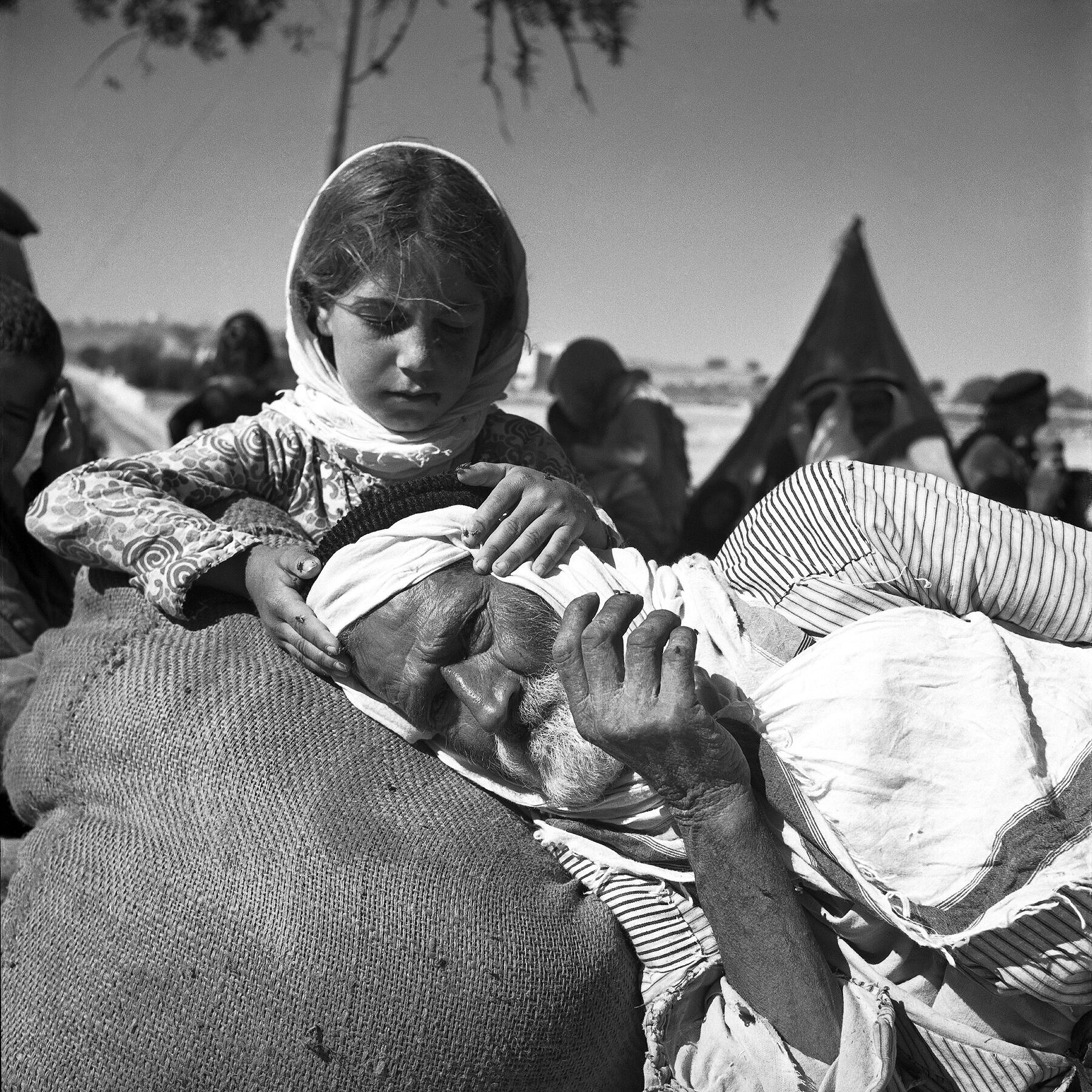
A displaced Palestinian girl cradles her father's head in her lap. Photo: Collected.
Both states would possess their own governments, territories, and security apparatuses, coexisting peacefully side-by-side. On the international stage, the standard framework relies on the pre-1967 War borders as a baseline. Under this model, a Palestinian state would be established comprising the West Bank, East Jerusalem, and the Gaza Strip. However, deep-seated disputes have persisted for decades regarding the final demarcation of borders, the status of Jerusalem, Israeli settlements, and the future of Palestinian refugees. Various UN resolutions have also depicted Israel and Palestine as two distinct states. UN Security Council Resolution 2334, adopted in 2016, identified Israeli settlements in occupied Palestinian territories as a major obstacle to the two-state solution. This position was reaffirmed in a report by the UN Secretary-General published in June 2026. Origins of the Concept Tensions surrounding the Palestine region intensified under British rule following World War I. On one hand were the independence aspirations of the native Arab population, and on the other was the British promise to establish a national home for Jewish people in the Palestinian territory—bringing the two sides into direct conflict. In 1947, as the British prepared to withdraw from the region, the United Nations adopted a Partition Plan.
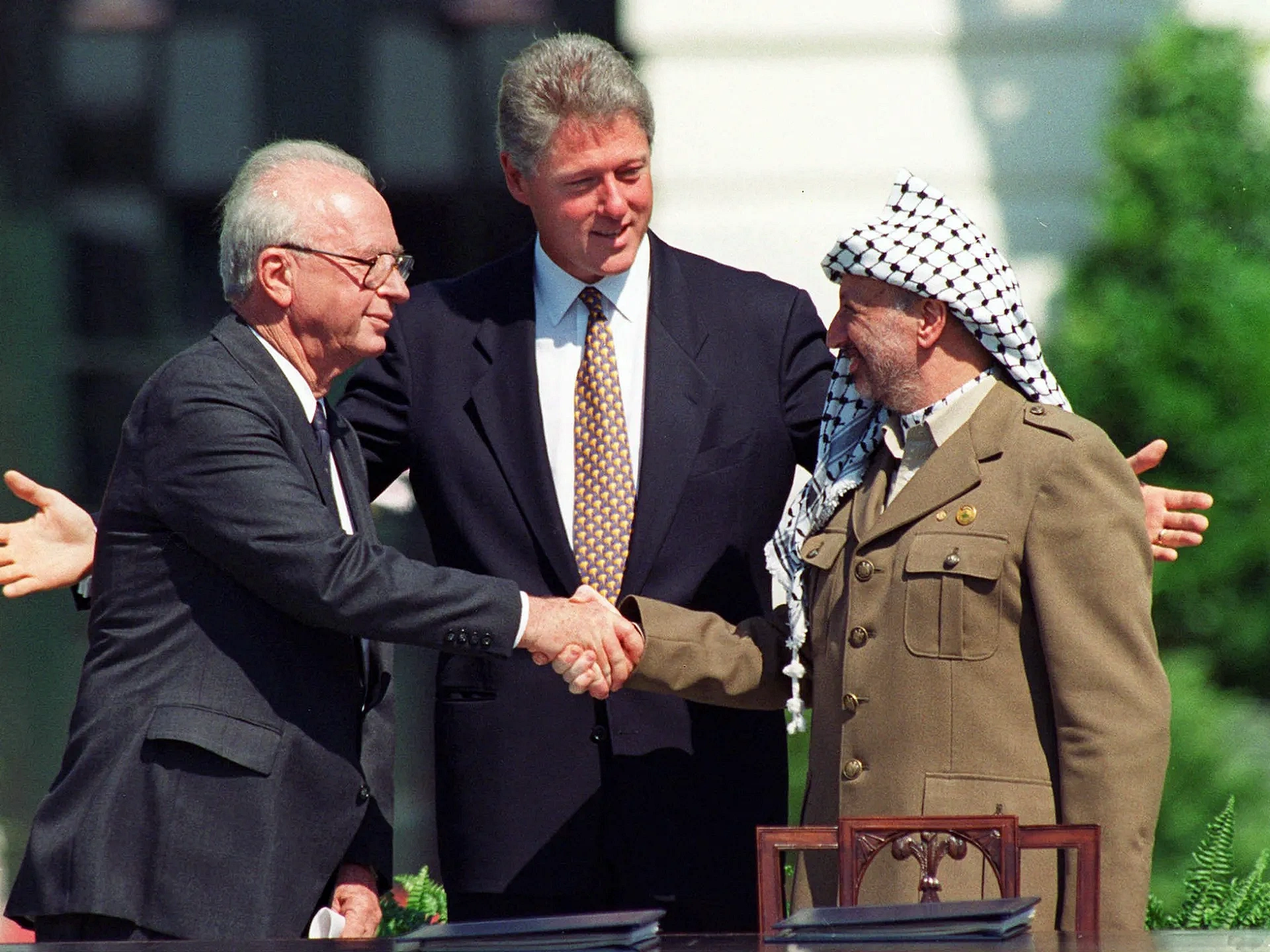
Top leaders of Palestine, U.S.A. amd Israel are seen smiling after the signing of the historic Oslo Accords. File photo / Reuters
The proposal called for the establishment of one Jewish state and one Arab state. The Arab side rejected the plan. Conflict ensued, leading to the 1948–49 war through which the State of Israel was established. However, an independent Palestinian state was not created at that time. Following the war, the West Bank came under Jordanian control and the Gaza Strip under Egyptian control. Vast numbers of Palestinians were displaced. Conversely, large numbers of Jewish people relocated to Israel from various Arab nations. The situation transformed again during the 1967 Six-Day War, when Israel occupied the West Bank, East Jerusalem, and Gaza. It was after this war that the concept of "land for peace" gained prominence in international diplomacy. Under this premise, Israel would withdraw from a significant portion of the territories occupied in 1967 in exchange for peace and recognition from Arab nations and Palestinians—a principle that became a cornerstone of subsequent peace processes.
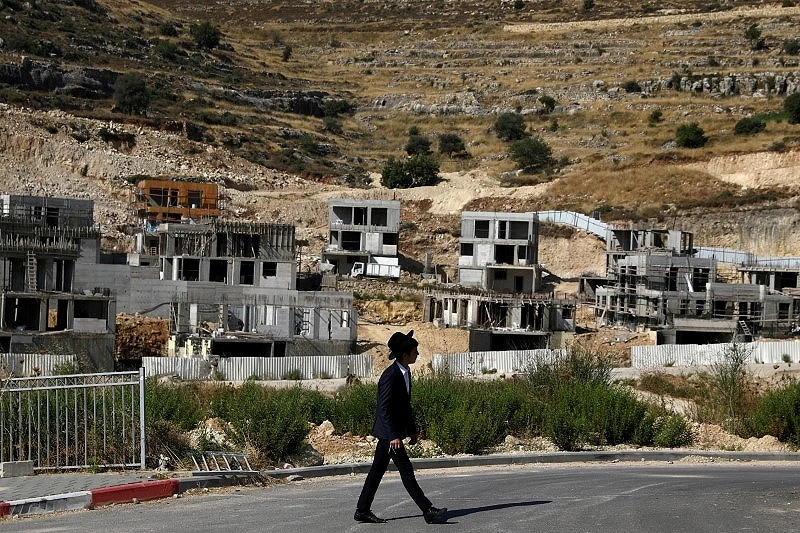
Oslo Accords: A Major Diplomatic Breakthrough The most significant turning point in the history of the two-state solution occurred in the 1990s. Following the 1991 Madrid Conference, negotiations commenced between Israeli and Palestinian representatives. Secret talks held in Oslo, Norway, subsequently led to the 1993 Oslo Accords. On September 13, 1993, the accord was signed in Washington, D.C., in the presence of Israeli Prime Minister Yitzhak Rabin and Palestine Liberation Organization (PLO) leader Yasser Arafat, with then-US President Bill Clinton hosting the historic event. The greatest achievement of this agreement was mutual political recognition between Israel and the PLO. The PLO recognized Israel's right to exist, while Israel recognized the PLO as the representative of the Palestinian people. Simultaneously, it paved the way for the creation of the Palestinian Authority (PA) to exercise limited self-governance. The plan was designed to progress in phases. Palestinian self-rule was meant to expand over a five-year interim period, after which negotiations would address the most contentious permanent-status issues. These core issues included: Finalizing the borders between Israel and Palestine The future status of Jerusalem The status of Israeli settlements in the West Bank The return or resettlement of Palestinian refugees Security arrangements for both sides Thus, the Oslo Accords did not constitute a final peace treaty itself, but rather served as an interim framework toward achieving a ultimate two-state solution. Successes of the Oslo Accords Labeling the Oslo process a complete failure overlooks its notable achievements. Following the agreement, Israel withdrew its military forces from Gaza and parts of Jericho. The Palestinian Authority was established, granting Palestinians limited administrative and security control over portions of their territory for the first time. Under the 1995 Oslo II Accord, the West Bank was divided into three administrative zones: Area A: Under full Palestinian administrative and security control Area B: Under Palestinian administrative control and joint Israeli-Palestinian security control Area C: Under full Israeli administrative and security control The most vital outcome was formal political recognition. After decades of direct conflict, Israel and the PLO officially entered a structured diplomatic dialogue. In 1994, Yitzhak Rabin, Yasser Arafat, and then-Israeli Foreign Minister Shimon Peres were jointly awarded the Nobel Peace Prize for their contributions. However, this momentum ultimately proved insufficient to secure a lasting peace. Why the Oslo Process Collapsed The primary vulnerability of the Oslo Accords lay in establishing a temporary arrangement without resolving the fundamental issues. While border demarcation, the status of Jerusalem, Israeli settlements, and the refugee question were slated for resolution within five years, trust between the two sides steadily eroded instead. Opposition to the accords mounted within Israeli politics, while dissatisfaction grew on the Palestinian side as well. Simultaneous acts of violence and attacks further undermined confidence among both populations. The peace process suffered a severe blow in 1995 when Prime Minister Yitzhak Rabin was assassinated by an Israeli extremist, significantly weakening its political foundation. Attempts to reach a final agreement at the Camp David Summit in 2000 failed. Following this, the outbreak of the Second Intifada triggered widespread violence, effectively bringing the Oslo process to a halt. Although negotiations occurred sporadically in subsequent years, a major political breakthrough on the scale of the 1990s was never achieved again. Progress Toward Establishing a Palestinian State Crucially, Palestine is not yet a full member state of the United Nations. However, in 2012, the UN General Assembly voted by an overwhelming majority to grant Palestine "Non-Member Observer State" status—with 138 countries voting in favor, 9 against, and 41 abstaining. This marked significant progress for Palestine in terms of international diplomatic recognition. By 2025, several countries—including France, the United Kingdom, Canada, and Australia—took steps toward or officially granted recognition to the State of Palestine. While a vast majority of the world now supports the establishment of a Palestinian state, diplomatic recognition and actual statehood remain two distinct realities. A functional state requires an effective government, contiguous territory, border control, defense capabilities, an economy, and political authority. In the case of Palestine, significant hurdles persist across all these areas. Gaza and the West Bank remain geographically disconnected. Within the West Bank, Israeli settlements and checkpoints fragment the territory. Gaza was long under Hamas control, whereas the Palestinian Authority maintains limited administrative governance in parts of the West Bank. Consequently, while the concept of a "State of Palestine" enjoys broad international backing, its physical territory, administration, and security framework do not yet function like those of a fully realized sovereign state. The Main Obstacle: Illegal Israeli Settlements in the West Bank One of the most critical practical barriers to a two-state solution is the expansion of illegal Israeli settlements in the West Bank. Under UN Security Council Resolution 2334, Israeli settlements built in Palestinian territories occupied since 1967 have no legal validity under international law and constitute a major impediment to achieving a two-state solution. The UN Secretary-General's June 2026 report reiterated grave concerns over settlement expansion. Furthermore, a 2025 European Union status report highlighted an increase in planning and construction for new settlements and outposts in the West Bank. According to the EU, these measures accelerate territorial fragmentation and severely undermine the viability of a future two-state solution. The issue extends beyond the sheer number of settlements—it directly impacts territorial contiguity. If a prospective Palestinian state is broken into isolated enclaves across the West Bank, operating it as a viable and sustainable sovereign nation becomes nearly impossible. A Critical New Chapter in International Law In 2024, the International Court of Justice (ICJ) issued a landmark advisory opinion concerning the Palestinian territories. The Court concluded that Israeli policies and practices infringe upon the right of the Palestinian people to self-determination. The ruling also brought into focus issues regarding territorial fragmentation, settlement expansion, and prolonged control over the West Bank and East Jerusalem. While it did not establish a formal peace treaty, the opinion laid a vital new foundation in international legal discourse regarding Palestinian self-determination and the future of occupied territories.
The Gaza Strip in Palestine has been reduced to rubble by recent Israeli attacks. File photo: Reuters
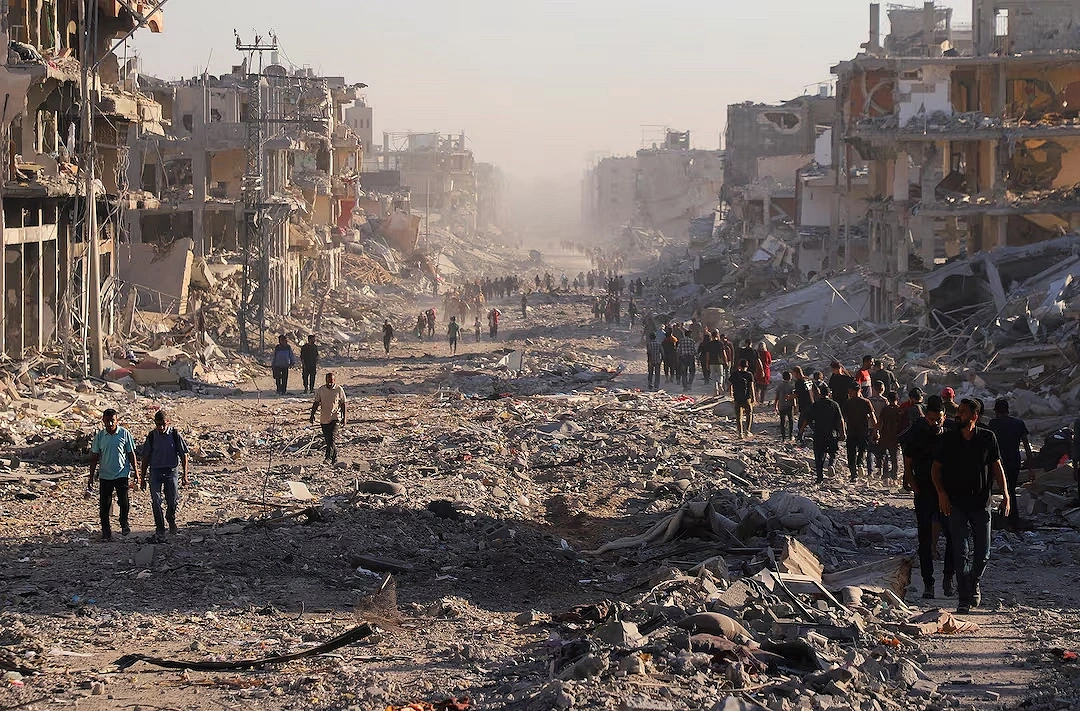
Public Opinion on Both Sides Ground realities remain equally challenging. A Pew Research Center survey conducted in mid-2026 revealed that only 17% of respondents in Israel and 21% in the West Bank and East Jerusalem believe Israel and an independent Palestinian state can peacefully coexist side-by-side. Conversely, 56% in Israel and 68% in the West Bank and East Jerusalem expressed skepticism about such a prospect. This marks a profound shift: while diplomatic backing for the two-state solution remains widespread globally, confidence in the process among the people living in these regions has severely diminished. This represents a critical development, as no peace framework can endure on state-level diplomatic support alone—it must ultimately command legitimacy among the populations involved. Is the Two-State Solution Dead? This remains the central debate. One perspective argues that West Bank settlement expansion, territorial fragmentation, the destruction of Gaza, and the collapse of mutual trust have rendered the two-state solution increasingly unrealistic. On the other hand, much of the international community continues to view two separate states as the most established framework for a long-term political resolution for both Israelis and Palestinians—a stance reaffirmed in recent UN resolutions. However, the escalation of Israeli military operations in Gaza following the October 7, 2023 attacks has further complicated this path. Israeli Prime Minister Benjamin Netanyahu has long opposed the two-state framework advocated by the international community, a position that has hardened significantly amid the ongoing war. Netanyahu explicitly stated that there can be no sovereign, independent Palestinian state in the area between the Jordan River and the Mediterranean Sea. In his view, Israel must retain overall security control over the entire territory west of the Jordan River. In response to US pressure regarding post-war Gaza reconstruction, Netanyahu affirmed that even after the complete destruction of Hamas, Israel will maintain overall security and military control over Gaza. He emphasized that granting full sovereignty to Palestinians directly conflicts with Israel's national security interests. He declared that no amount of international pressure, foreign advice, or social media commentary would alter this stance. He further noted that Israel would not accept the establishment of a Palestinian state even as part of a historic normalization deal with Saudi Arabia. Thus, current realities present a stark contrast: while international diplomatic endorsement of the two-state solution has maintained—or even increased—its momentum, the physical, geographical, and political foundation required to sustain it has grown markedly more complex. The Road Ahead Analysts suggest that several structural shifts would be necessary to implement a two-state solution moving forward. Re-engaging in final-status political negotiations presents the foremost challenge. Such talks would inevitably need to address the long-standing core issues: Defining final borders Determining the status of Jerusalem Resolving the status of settlements
Addressing the question of Palestinian refugees Establishing secure arrangements for both states Beyond theoretical endorsements, international efforts since 2024 have increasingly focused on building actionable multilateral frameworks to advance implementation. The UN continues to emphasize coordinated international initiatives alongside a credible political process. While the path opened by the Oslo Accords three decades ago has not closed entirely, it faces unprecedented obstacles today. Nevertheless, the framework endures at the UN because, despite various discussions around alternative models, establishing two separate states remains the institutional baseline of the United Nations and the centerpiece of international diplomatic initiatives. The fundamental question is no longer merely whether a two-state solution is possible, but whether the required territorial continuity, political leadership, security structures, and mutual trust can be rebuilt. While speeches by world leaders at the 81st UN General Assembly reaffirmed support for this traditional model, they also underscored that declarations alone cannot deliver a resolution. Achieving progress will require ceasing hostilities, addressing ground realities, restoring political dialogue, and establishing a secure, viable state framework acceptable to both sides—a test that will define the future of the two-state solution.
