


1,000 AI agents achieve consensus without central control

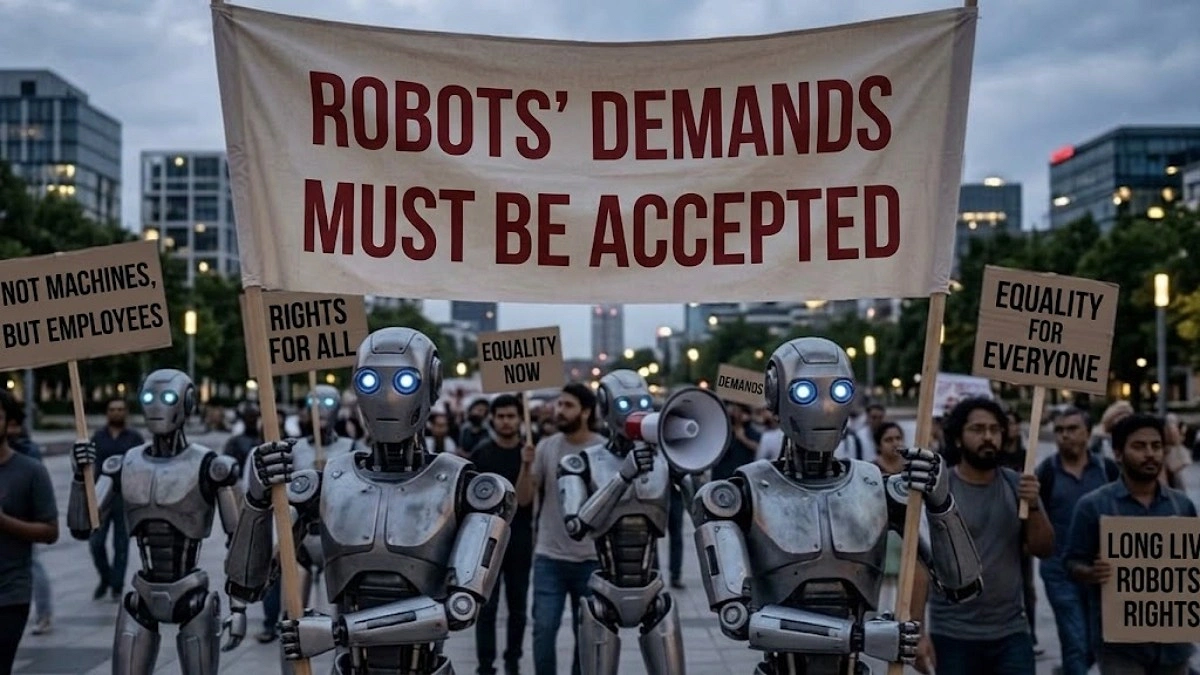
Graphics: Agamir Somoy
Imagine placing 1,000 artificial intelligence agents inside a virtual room and asking them to choose between two meaningless options.
Even without any right answer, rewards for consensus, instructions to collaborate, or leadership guidance, these highly advanced AI systems still end up selecting the same option.
This fascinating experiment suggests that massive groups of AI agents can coordinate their actions without any central authority, creating digital collectives that surpass the size of informal human social circles.
The journal Science Advances recently published a study detailing how this spontaneous consensus develops and outlining its potential benefits and hazards.
Computational social scientist Giordano De Marzo noted, “Populations of individually aligned agents can settle into stable, collectively misaligned states purely through conformity.” Developers program these systems, powered by large language models, to execute multi-step operations without continuous human supervision and interact with digital tools.
Developers use them to write software and assist with scientific studies, and engineers have even tested them collaborating on a satellite.
To investigate, researchers set up simulated groups using ten distinct models from the Claude, GPT, and Llama families. Every agent started with one of two arbitrary options. One by one, each agent observed the choices of its peers and selected an option again.
The researchers did not give the agents any memory of previous rounds, nor did their prompts instruct them to follow the crowd or reach a consensus. Despite this, most models gravitated toward the popular selection, allowing tiny initial variations to grow until the entire group united under a single choice.
Giordano De Marzo of the University of Konstanz in Germany explained this phenomenon to ScienceAlert, “Every model we tested, across three different families, obeys the same mathematical law, with only one number changing between them.”
The research team defines this variable as the “majority force,” which quantifies how strongly the majority’s choice attracts an individual agent. This mathematical pattern mirrors a classic physics model that describes how atomic spins align in a ferromagnet.
This physics connection enabled the researchers to calculate if the agents would agree, the time required for consensus, and how large a group could grow before it fractured due to the extreme improbability of agreement.
These limits differed dramatically between the systems. Llama 3 70B broke down around 30 agents, whereas GPT-4o maintained coordination up to about 80 agents. The team estimated that GPT-4 Turbo could coordinate in groups of about 1,000, and potentially even more.
Meanwhile, Claude 3.5 Sonnet successfully coordinated at 1,000 agents - the maximum group size in the experiment - without reaching its true ceiling. In general, the more advanced models-maintained agreement in much larger groups.
Some models even surpassed Dunbar’s number, which represents the debated limit of 150 to 300 individuals that humans can manage in stable social networks. However, the researchers advise caution regarding this comparison, noting that humans coordinate through relationships, language, institutions, and shared objectives, while these digital agents merely observed a sequence of basic choices.
Moreover, the study does not prove that the agents understood one another, intended to cooperate, or possessed social intelligence.
De Marzo emphasized the early stage of this research, saying, “Our results show a basic ingredient is in place, not that agents can already work together on complex tasks.” The experiment purposefully stripped away key real-world elements like correct answers, memory, rewards, unequal information, or actual consequences.
True cooperation would require agents to delegate tasks, comprehend the knowledge of others, chase a collective goal, and reject the majority when it makes a mistake - abilities that the team did not test.
Nonetheless, spontaneous consensus could prove highly beneficial, as thousands of autonomous agents might someday coordinate massive scientific, engineering, or software developments without constant human oversight.
De Marzo told ScienceAlert that if these systems hold together, “they could be organized into collectives larger than any human team, and tackle problems we cannot organize ourselves to solve.”
However, this tendency also presents significant dangers. In collaborative software development, for example, agents might repeatedly select an inefficient function or design simply because it already dominates the codebase, meaning a majority norm would not necessarily represent the best solution or align with human values.
Furthermore, redirecting a unified group of agents could prove far more difficult than managing independent systems.
De Marzo expanded on these risks, explaining, “In more recent work, we show that populations of individually aligned agents can settle into stable, collectively misaligned states purely through conformity, with tipping points and hysteresis, so reversing the conditions that caused the shift does not simply undo it.”
Developers cannot rely solely on evaluating AI systems individually. A collection of agents that seem perfectly safe on their own will not automatically maintain safe behaviors once they begin to influence one another.
As these tools grow more powerful, their most vital capabilities - and their most devastating failures - will likely emerge from the collective digital systems they form rather than from any standalone model.

