
City Traffic Rules See Gains, But Auto-Rickshaws Stall Progress

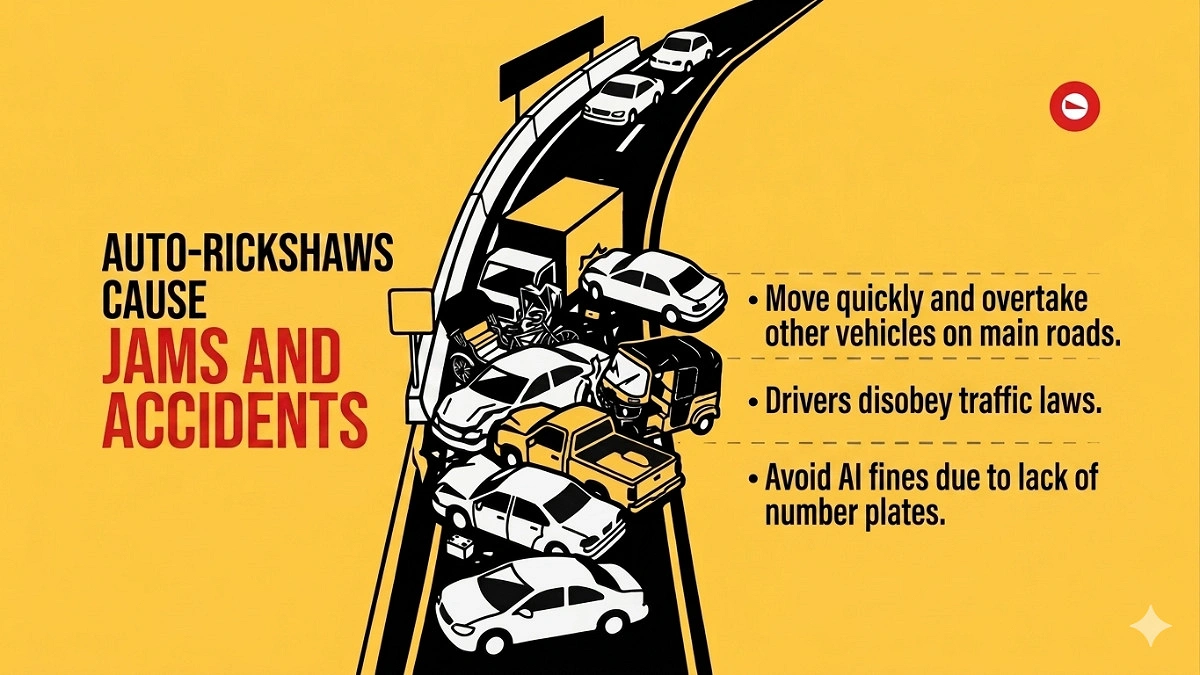
Agamir Somoy image regenerated by AI.
Dolairpar is one of the busiest areas in the capital, serving as the main entry and exit route between Dhaka and the southern region of the country. To the north of the Dolairpar intersection lies Jatrabari, to the west is Mir Hajirbagh, to the east is Donia, and to the south is the Jurain-Postogola area. Due to a diversion at one section of the intersection, vehicles traveling from east to west are supposed to loop around the southern road. However, instead of doing so, auto-rickshaws are driving against the traffic on the wrong side of the road, accompanied by CNG-run auto-rickshaws and motorcycles. Consequently, drivers plying along the right direction can momentarily lose their bearings, frequently leading to severe traffic congestion at this intersection.
This scenario is not unique to Dolairpar; it is a common sight at almost every busy traffic point across Dhaka city. However, a completely different environment has been observed at intersections controlled by Artificial Intelligence (AI).
At these AI-enabled points, cameras automatically detect various traffic violations, such as running red lights, breaching stop lines, driving on the wrong side of the road, occupying zebra crossings, not wearing seatbelts, riding motorcycles without helmets, and illegal parking. Thanks to AI surveillance, compliance with traffic laws is rising among bus, truck, private car, and motorcycle drivers in the capital, forcing them into disciplined driving out of fear of lawsuits. Yet, while modern AI-based traffic management and enhanced surveillance are restoring order to the streets, the police continuously hit a snag when it comes to auto-rickshaws.
These small, three-wheeled vehicles have now spilled out of narrow alleyways and are speeding recklessly down the capital's main thoroughfares. This has not only caused massive traffic gridlocks but has also heightened the risk of accidents. Known for making sharp turns at high speeds, sudden braking, and showing utter disregard for traffic laws, auto-rickshaws have become a major source of panic on the roads. While other vehicles try to obey the law to avoid automated AI fines, auto-rickshaws exploit their lack of license plates to flagrantly continue violations like driving on the wrong side of the road and ignoring traffic signals. This uncontrolled movement essentially challenges the efficacy of the entire technology-driven surveillance system.
Modern AI cameras have been installed at 30 major crossing points in the capital, including the Hotel InterContinental, Sonargaon Hotel, Bangla Motor, Bijoy Sarani intersection, and Jahangir Gate. These cameras automatically detect traffic violations. The moment one of six specific traffic rules is broken—including running a signal or driving on the wrong side of the road—the lawsuit citation is sent directly to the vehicle owner’s phone.
Over the past few days, visits to various city roads revealed that while other vehicles are trying to adhere to traffic regulations to avoid AI lawsuits, auto-rickshaws are operating completely recklessly. Ignoring signals, driving against traffic, and speeding down main roads have become standard practice for auto-rickshaw drivers. This is because AI cameras cannot identify them, meaning no automated lawsuits can be filed against them.
Auto-rickshaws were spotted driving on the wrong side of the road in almost all key areas of the city, including Gulshan-Banani, Bangla Motor, Panthpath, Paltan, Gulistan, Moghbazar, Agargaon, Mirpur, and Pallabi. In many instances, these auto-rickshaws travel at speeds exceeding 30 kilometers per hour, drastically increasing the risk of accidents.
Battery-Powered Auto-Rickshaws Outsmart Dhaka's Modern AI Traffic System
Dhaka Metropolitan Police (DMP) Traffic Inspector Tarikul Alam has stated that despite the installation of advanced cameras, battery-powered auto-rickshaws on the capital's roads remain completely out of control. Even though the cameras capture their traffic violations, automated lawsuits cannot be issued because these vehicles lack legal registration. He noted that these rickshaws completely ignore traffic signals, race ahead of other vehicles, and block the front of traffic queues. He warned that if these specific issues are not addressed, the deployment of Artificial Intelligence (AI) will fail to yield effective results.
How Dhaka's AI Traffic System Works (And Who Escapes It)
DMP traffic department officials explained that the system's software is initially programmed to detect six specific types of traffic law violations.
1. The AI cameras automatically identify violating vehicles and capture photos that clearly display their number plates, 2.These photos and videos are directly uploaded to the servers of the Traffic Technical Unit (TTU) at DMP Headquarters, 3. Owner Identification: Since the system is integrated with the Bangladesh Road Transport Authority (BRTA) server, the owner's detailed information is instantly retrieved using the vehicle's registration number, and 6. Automated Fines: After analyzing the server data, a formal traffic lawsuit is automatically filed against the vehicle owner.
However, communication experts point out that bringing discipline to the capital's streets is impossible without controlling these unregistered vehicles, especially given the overwhelming dominance of battery-run easy bikes and auto-rickshaws across the entire country.
Expert Recommendations and Strict Actions Ahead
Prof. Dr. Hadiuzzaman, Transportation Expert and Former Director of the Accident Research Institute, BUET said: "The government should completely ban illegal vehicles like auto-rickshaws from the specific roads where digital signals and AI cameras have been installed. At the same time, strict action must be taken against battered, dilapidated buses."
DMP Additional Commissioner (Traffic) Anisur Rahman acknowledged that the AI system is currently unable to identify vehicles that lack a proper number plate. However, he emphasized that efforts are actively underway to bring all types of transport under legal accountability. He announced that a massive crackdown will be launched right after the holy Eid-ul-Azha against all vehicles that are unregistered or driving with obscured, illegible number plates.
