
Chaotic Commerce Policy
High tariffs hold consumers hostage, stifle investment, exports
- Hyper-protectionism under the guise of para-tariffs creates an ‘anti-export bias’: Dr. Zaidi Sattar
- There are ‘many small (opposing) governments’ within the government: BIDA Chairman

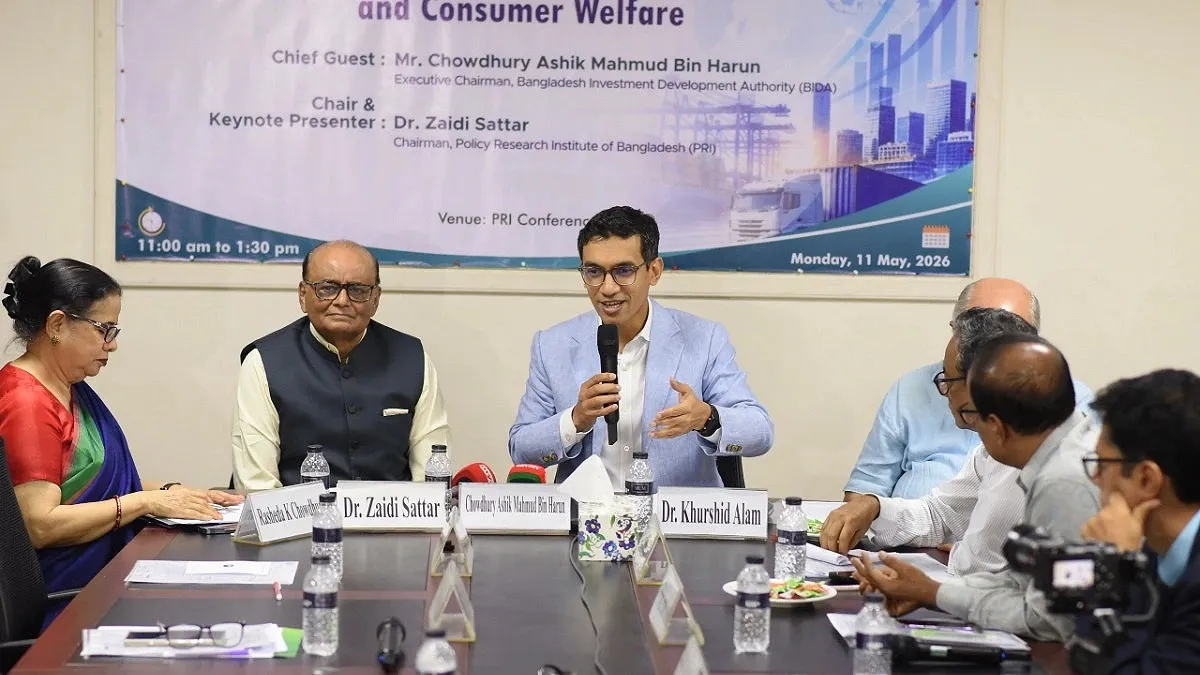
Photo: Agamir Somoy
Bangladesh’s current trade policy and tariff structure have emerged as major obstacles to export diversification and investment attraction. Not only the high tariff structure is forcing the country’s 180 million consumers to buy goods at nearly double global prices, but also a severe lack of coordination between the National Board of Revenue (NBR) and relevant ministries has stalled business-friendly reforms.
Even within the government, policy formulation and implementation suffer from competing interests among different groups, resulting in a clear absence of collective efforts.
These observations were shared today at a roundtable discussion organized by the Policy Research Institute of Bangladesh (PRI), attended by leading economists, policymakers, and business leaders. The keynote paper was presented by PRI Chairman Zaidi Sattar.
In his presentation, Dr. Sattar showed that Bangladesh’s average tariff rate is currently around 28 percent—far higher than the global average of 6 percent and the average of lower-middle-income countries at 7.2 percent. He said, “In trying to protect a few selected industries, we have created excessive protection that effectively acts as a ‘protection tax’ on consumers. As a result, ordinary people are forced to pay 50 to 100 percent more than world market prices for essentials ranging from rice, lentils, and salt to other daily necessities.”
The paper further noted that para-tariffs have made selling in the domestic market more profitable than exporting. As a result, entrepreneurs lack incentives to export, creating a strong “anti-export bias” in the economy.
Bangladesh Investment Development Authority (BIDA) Chairman Chowdhury Ashik Mahmud bin Harun spoke candidly about internal government challenges. Comparing the government to a “forest,” ecology he said, “People think of the government as a single entity, but inside there are many small governments. Like tigers and lions, everyone has their own interests. In practice, I don’t see much tendency to work collectively. Even when there is consensus at the top on reforms, various obstacles arise during implementation at ports or at the field level.”
Rejecting the notion that the Bangladesh Investment Development Authority (BIDA) focuses only on foreign direct investment (FDI), Ashik Chowdhury said, “BIDA’s responsibility is to advocate within the government on behalf of all investors—both local and foreign. The bulk of total investment in the country comes from domestic sources, and that will remain the case in the future. However, until the energy crisis is resolved, it will be difficult for either foreign or local investors to believe in the ‘Bangladesh story.’ Our goal should be to build an accountable, credible, and sustainable economy. Job creation is a major focus of the new government’s mandate, and there is no alternative to improving the investment climate if employment is to grow.”
Former National Board of Revenue (NBR) commissioner Md Farid Uddin criticized the current structure of the NBR, saying, “If the same institution that formulates policy also implements it, a conflict of interest is inevitable. Tax policy must be separated from the NBR.” He alleged that before the budget, the Ministry of Commerce or the Ministry of Industries does not submit any written, concrete proposals to the NBR to protect supply chains or consumer interests—clear evidence of severe coordination failures.A H M Shafiquzzaman, president of the Consumers Association of Bangladesh (CAB), said, “In trying to protect a handful of businessmen, we are sacrificing the interests of 180 million people. In the name of protecting 300,000 salt farmers, consumers are being forced to buy salt at prices four times higher than imports. If beef imports were allowed, people could buy it at Tk 500 per kg, whereas it now costs Tk 900.” He warned that one of the main reasons for the fall of the previous government was high commodity prices, and urged the current government to ensure consumer representation in the tariff-setting process.Speakers at the roundtable agreed that to meet post-LDC graduation challenges in 2026, concluding free trade agreements (FTAs) and rationalizing the tariff structure are essential. They advised moving away from a revenue strategy reliant solely on tariffs and instead increasing import volumes and expanding the tax net through digital systems. Otherwise, Bangladesh risks falling behind countries like Vietnam and Thailand in attracting investment.
