
Most Corruption Victims Don’t Know Where to Complain

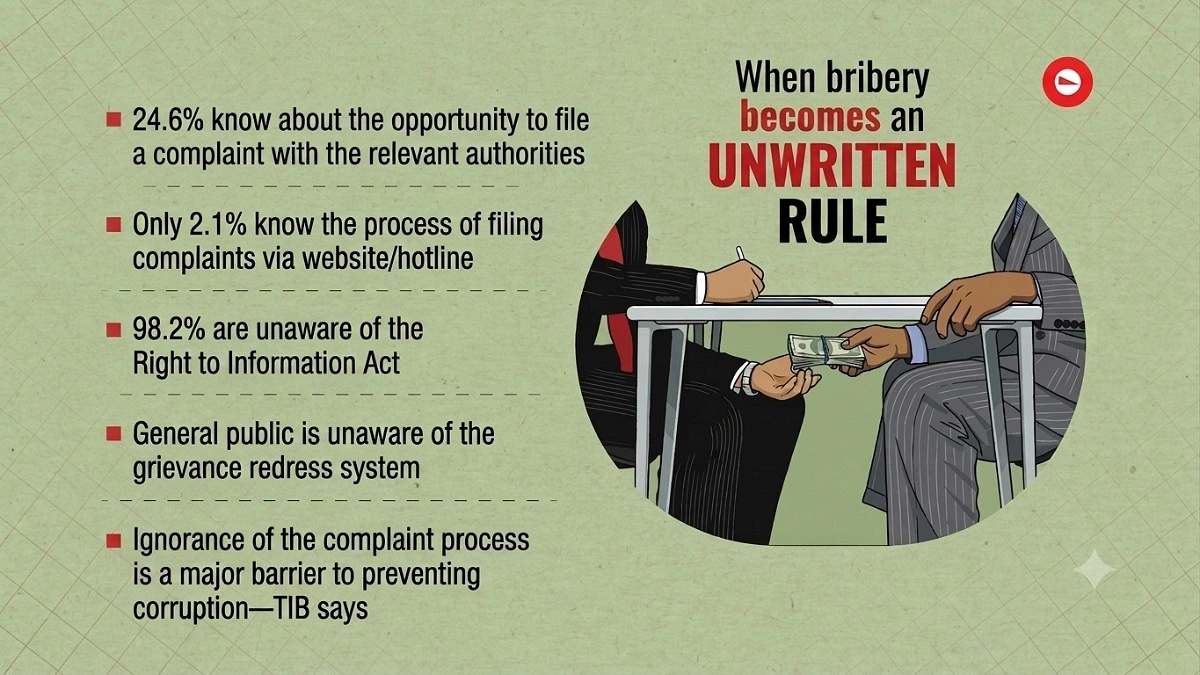
Graphics: Agamir Somoy
Citizens encounter irregularities at nearly every step of daily life. Files remain stalled unless money changes hands, and people often fail to receive services that should be provided free of charge. Ordinary citizens continue to bear the burden of corruption, yet more than half of the population does not know where to turn for redress or which government office is responsible for addressing their complaints. As a result, many endure wrongdoing and injustice in silence.
That troubling picture emerged in the recently published Corruption in Service Sectors: National Household Survey 2025 by Transparency International Bangladesh.
According to the survey, 53.3 percent of households that fall victim to corruption are unaware of any mechanism for seeking redress. In other words, more than one in every two families does not know how or where to file a complaint.
Overall, only 46.7 percent of respondents said they were aware of at least one channel for submitting complaints. For the rest, the path to seeking justice remains entirely unknown.
Many people are familiar with the name of the Anti-Corruption Commission. The survey found that 29.5 percent of respondents know about the institution. However, only 6.9 percent are aware of its anti-corruption hotline, 106, which serves as the commission’s primary complaint mechanism.
Officials at the Anti-Corruption Commission rejected the findings. Akhtar Hossain, a deputy director at the agency, told Agamir Somoy that everyone in the country knows about the ACC. He declined to comment further, saying he did not know how TIB had arrived at its findings.
Limited Awareness of Complaint Mechanisms
Only 24.6 percent of respondents said they knew they could file complaints directly with the relevant authorities if they encountered corruption. Just 2.1 percent were aware of complaint procedures through websites or hotlines. Awareness of the Right to Information Act stood at 1.8 percent, while only 1.4 percent knew about the government’s Grievance Redress System (GRS).
Meanwhile, 6.1 percent of respondents cited other sources for filing complaints. Altogether, 46.7 percent of people reported knowing at least one avenue for seeking redress.
The survey also suggests that paying bribes has become an almost unavoidable part of obtaining public services. Among those who experienced bribery, 98.1 percent said they had been forced to pay money to receive government services.
Nearly 82 percent of victims believe obtaining the desired service from government institutions is difficult without paying a bribe. More than 33 percent said people must pay under the table to have their work completed on time. Another 58 percent reported falling into bribery traps because they were unaware of the official fees for government services.
At the same time, 23.1 percent of respondents admitted paying bribes in collusion with officials to obtain additional benefits. Among them, 11 percent said they paid bribes specifically to bypass established procedures.
The Economic Toll of Corruption
Economists warn that the flow of illicit money is harming Bangladesh’s economy.
Dr. Mohammad Jahangir Alam, a professor in the Department of Economics at Jahangirnagar University, explained that bribe payments typically occur outside the banking system. As a result, the money remains unrecorded in official accounts and effectively becomes black money. A significant portion of those funds eventually leaves the country, placing additional pressure on Bangladesh’s foreign exchange reserves.
“Money generated through bribery and corruption essentially turns into black money,” he said. “Much of it does not remain in the domestic economy and is instead transferred abroad. When those funds are converted into foreign currencies and moved out of the country, they create pressure on foreign exchange reserves. Governments often introduce stricter measures to curb corruption and prevent money laundering. However, such efforts have not always produced meaningful results because, in many cases, influential individuals and senior government officials have been linked to corruption.”
How Bribery Affects Ordinary Citizens
The experiences of ordinary citizens paint an equally troubling picture.
Mohammad Kabir, a CNG-powered auto-rickshaw driver, recalled paying a 2,000-taka bribe during the police verification process for his driving license 10 years ago.
“If you handle it yourself, it costs less, around Tk 3,000. If you use a broker, it costs more,” he said. “We drive CNGs and often do not know where to go or whom to approach, so we end up relying on brokers to get things done.”
Mohammad Mazharul Islam, a student at Eknabin CA Firm, described a different experience. He said people often have to pay unofficial fees to obtain certificates from union councils or educational institutions.
“We are constantly forced to pay bribes, or sometimes we pay them willingly,” he said. “If you visit a union council office or any government institution, you usually have to give employees 100 or 200 taka. Likewise, when you need a certificate from an educational institution, office staff often ask for money. Because the amounts are small, we rarely question them. But these payments are also forms of bribery and corruption.”
According to TIB, limited awareness of complaint mechanisms remains one of the biggest obstacles to combating corruption. Many people do not know where to file complaints, while others avoid doing so out of fear.
As a result, most incidents of corruption remain hidden from public view. That allows offenders to escape accountability and reduces the likelihood that they will ever face justice.
