
The other World Cup nation
- Bangladesh never qualified, yet every World Cup somehow qualifies Bangladesh.

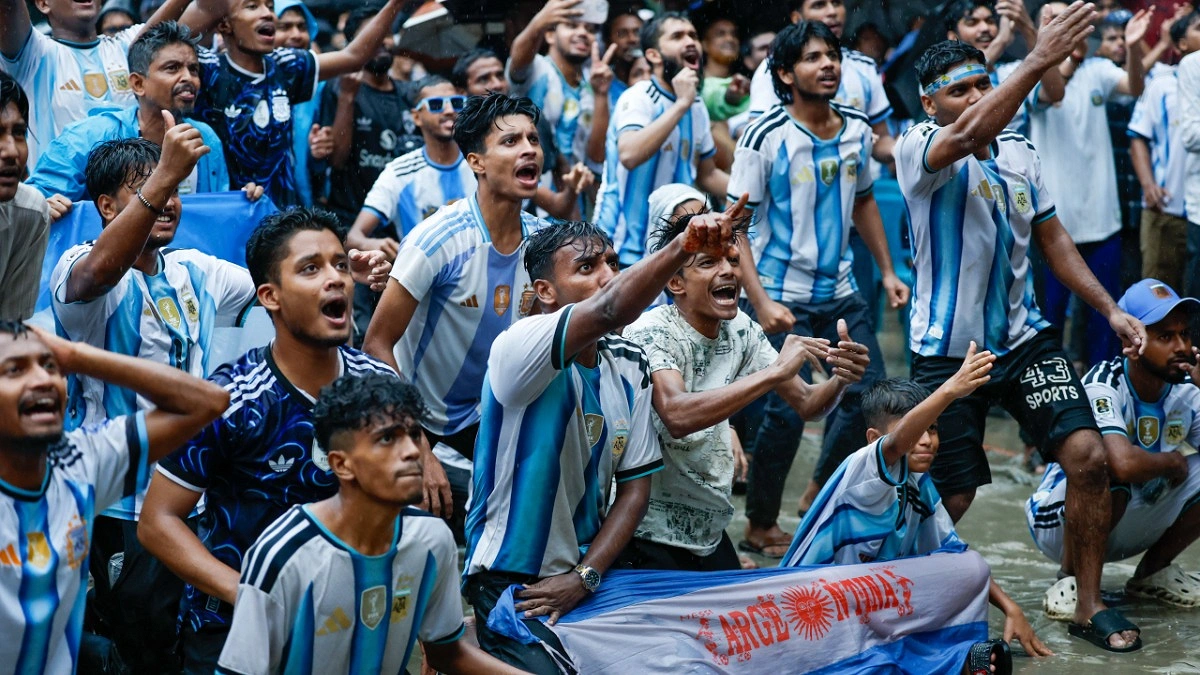
Photo: Agamir Somoy
Every four years, the same question echoes across drawing rooms, tea stalls and social media timelines of Bangladeshis.
"Will Bangladesh ever qualify for the FIFA World Cup?"
It is an understandable question. Qualification is football's ultimate passport. Forty-eight nations now earn the right to stand beneath the brightest lights in world sport. Bangladesh has never been one of them.
But perhaps we have spent too much time looking only at the pitch.
Because a World Cup is not merely a football tournament. It is the largest shared cultural event on Earth. Twenty-two players play on the ground, but billions of people complete the spectacle. Without them, there are no goosebumps after a dramatic win, no collective silence before a decisive penalty, no streets erupting with joy or heartbreak deep into the night. The matches may be played inside stadiums, but the World Cup truly comes alive in homes, cafes, tea stalls, factories and city squares scattered across the globe.
Seen through that lens, Bangladesh has been qualifying for the World Cup all along.
In fact, Bangladesh has perfected perhaps the strangest World Cup qualification route ever invented, we qualify as the most devoted audience.
That may sound like a paradox.
But it is also surprisingly true.
No country, however rich or powerful, can stage a World Cup alone. FIFA organizes it. Players perform in it. But the tournament belongs to billions of strangers who fill the empty spaces between kick-off and the final whistle with hope, debate and emotion. Every flag raised above a rooftop, every alarm set for a 3 a.m. match and every argument over an offside decision transforms a sporting competition into a global celebration.
By that measure, Bangladesh is not a spectator standing outside the gates.
It is already inside.
Walk through almost any Bangladeshi town during the World Cup and you could be forgiven for thinking football's biggest festival has quietly arrived here too.
Argentina's sky blue and white flutter from rooftops. Brazil's yellow brightens entire neighborhoods. Portugal, Germany and France all find loyal pockets of supporters in places where many residents have never met anyone from those countries. Tea stalls become miniature stadiums. Rickshaw pullers debate tactics with university professors. Children inherit football loyalties long before they can locate Buenos Aires, Lisbon or Rio de Janeiro on a map.
The matches may be taking place halfway around the world.
The emotions unfold right here.
The tournament gently rearranges everyday life. Dinner is served early because kick-off is after midnight. Morning meetings begin with discussions about refereeing decisions rather than office deadlines. Sleep becomes negotiable. Productivity becomes a little more forgiving. Even people with only a passing interest in football eventually find themselves asking colleagues for the latest score.
There is something wonderfully irrational about it all.
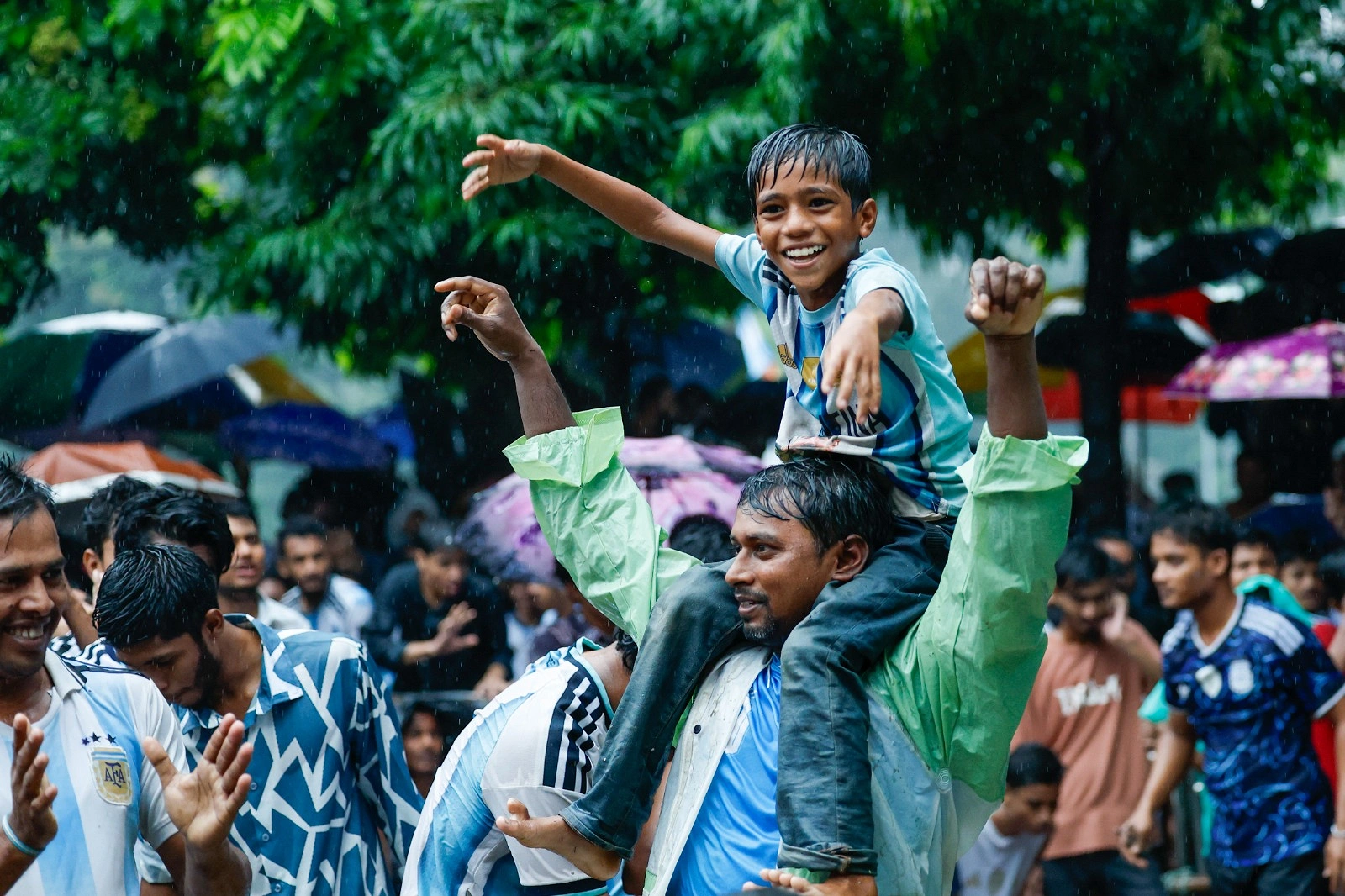
Bangladesh has no team in the tournament. No player wearing the national flag. No anthem before kick-off.
Yet millions celebrate victories and mourn defeats with an intensity that would puzzle anyone witnessing it for the first time.
Perhaps that is because the World Cup has never belonged only to the countries that qualify.
It has always belonged to those who care.
Few countries care as deeply as Bangladesh.
And the rest of the world has noticed.
For Bangladeshis, the sight of apartment buildings draped in giant Argentine or Brazilian flags is almost routine. For much of the world, however, it came as a surprise. The BBC was among the international news organizations that explored Bangladesh's extraordinary passion for the World Cup, a fascination later echoed in reports by media outlets from around the world. The stories were remarkably similar: neighborhoods draped in giant flags, sleepless nights and football rivalries unlike almost anywhere else.
Few countries absent from the World Cup have attracted so much attention because of it.
Bangladesh's football passion has become a story in its own right.
Sometimes that passion has produced moments almost too unusual to believe.
In 2014, thousands of Bangladeshis unexpectedly threw their support behind Honolulu. The wave of encouragement was so overwhelming that the Pacific Island side responded with a promise: if they scored, the goal would be dedicated to Bangladesh.
Only in Bangladesh could a country with no connection to the competition suddenly become part of its story.
It was a light-hearted episode.
But it revealed something larger.
Football's greatest tournament has a remarkable ability to create emotional connections that ignore geography, language and distance.
And Bangladesh may understand that better than most.
Yet Bangladesh's relationship with the World Cup does not end in front of television screens.
There is another Bangladesh.
One that rarely appears in television broadcasts or post-match analysis. One that begins work long before the opening whistle and continues long after the trophy has been lifted.
It is the Bangladesh of factory floors, sewing machines and shipping containers.
For decades, Bangladesh has grown into one of the world's largest garment exporters, supplying apparel to some of the biggest international brands. Millions of workers, most of them women, have quietly helped clothe the world, often without receiving the recognition their craftsmanship deserves.
Every World Cup, that quiet contribution finds its way onto football's grandest stage.
Every jersey tells two stories.
One belongs to the footballer wearing it beneath the floodlights.
The other belongs to the worker who stitched it, checked every seam, folded it into a carton and watched it begin a journey across oceans.
Some of those stories begin in Bangladesh.
The cameras focus on a captain lifting the trophy or a young star celebrating a winning goal. They rarely linger on where the shirt came from. Yet behind every iconic photograph lies an invisible supply chain powered by countless workers whose names will never appear on a team sheet.
That, too, is part of the World Cup.
This year's tournament offered another quiet reminder of that reality. Cape Verde took the field wearing jerseys which is ‘Made in Bangladesh.’ It was a small detail in a tournament dominated by goals and headlines. Yet for Bangladesh, it carried its own significance. Even without a place on the fixture list, the country was present on football's biggest stage.
Football's greatest celebration is not created by players alone. It is sustained by designers, manufacturers, broadcasters, volunteers, engineers, groundskeepers, security personnel and millions of supporters who invest their time, labor and emotions in the spectacle.
The tournament belongs to all of them.
And Bangladesh has earned its place among them.
There is a quiet irony in that.
For decades, Bangladeshis have wondered when the country would finally reach the World Cup.
In one sense, it already has.
Not through a qualifying campaign.
Not through a dramatic playoff victory.
But through the patient hands that help produce the tournament itself.
No, it is not the kind of qualification children dream about.
No child grows up imagining a sewing machine instead of a winning goal.
But global events are rarely built by dreams alone. They are built by millions of ordinary people performing extraordinary work far from the spotlight.
Bangladesh is one of those countries.
Its fingerprints are all over the tournament, even when its name is missing from the fixture list.
The country's presence is visible in another way too.
Every four years, Bangladesh's skyline transforms into a patchwork of colors. Argentina's sky blue and white flutter above rooftops. Brazil's yellow brightens narrow lanes. Portugal's green and red appear from apartment balconies. France, Germany and Spain all find devoted followers.
To some observers, the scene can be perplexing.
Why would Bangladeshis wave another country's flag with such passion?
The question resurfaces every World Cup.
The answer is simpler than it first appears.
One flag celebrates a football team.
The other defines who they are.
Supporting Argentina or Brazil for a month does not make anyone less Bangladeshi. If anything, it reflects a confidence that allows people to admire another nation's football without surrendering their own identity.
The two flags do not compete.
They coexist.
One expresses sporting affection.
The other expresses home.
Perhaps that is what belonging really looks like.
Not always standing at the center of the stage.
Sometimes helping build it.
Sometimes cheering from afar.
Sometimes stitching the very shirts that become part of football history.
Sometimes simply reminding the world that football can unite people who share neither language nor nationality.
Sometimes, that passion travels farther than anyone expects.
When Argentina lifted the World Cup in Qatar in 2022, images of jubilant celebrations in Bangladesh spread rapidly across international media. Argentine players acknowledged the extraordinary support from Bangladesh, and the warmth between supporters in the two countries became a widely shared story. Months later, Argentina reopened its embassy in Dhaka after more than four decades, renewing diplomatic ties at a moment when football had unexpectedly brought the two nations closer in the public imagination.
It was a reminder that sport can sometimes accomplish what politics alone cannot.
None of this suggests that Bangladesh should stop dreaming of qualifying for the World Cup.
Quite the opposite.
Sport is built on impossible ambitions. Every nation that has stood on football's biggest stage was once an outsider. Bangladesh should continue investing in youth development, coaching and domestic football until the dream becomes a realistic ambition.
And when that day finally arrives, it will deserve every celebration it receives.
But perhaps we have spent too much time believing that the World Cup belongs only to the countries listed on the fixture schedule.
It does not.
The players may represent 48 nations.
The World Cup represents far more than that.
It belongs to the billions who stay awake through impossible hours. It belongs to the volunteers who welcome supporters from around the world. It belongs to the broadcasters who carry the tournament across continents. It belongs to the workers who manufacture the balls, stitch the jerseys and prepare the stadiums. It belongs to every supporter whose joy and heartbreak give meaning to ninety minutes of football.
Without them, there is no World Cup.
That is why measuring participation only by qualification tells only part of the story.
Bangladesh's football journey remains unfinished.
The national team has yet to earn its place among the world's elite.
That remains the dream.
And it should remain the dream.
But dreams are not the only measure of belonging.
Every four years, Bangladesh reminds us that the World Cup is far more than a tournament.
It is a shared human experience.
One day, perhaps, Bangladesh will qualify in the conventional way.
Eleven players.
One national anthem.
Ninety minutes.
A place on football's biggest stage.
Until then, Bangladesh has already found another way to belong.
Through the roar that rises from countless living rooms after a last-minute goal.
Through neighborhoods transformed into oceans of blue, yellow and white.
Through the patient hands that stitch jerseys worn by football's greatest stars.
Through an enthusiasm so remarkable that it has drawn the attention of the world.
The fixture list may never mention Bangladesh.
The scoreboards may never display its name.
Yet every four years, when the world gathers for football's greatest celebration, Bangladesh quietly takes its place.
Not on the field.
But in the soul of the World Cup.


