
The jingle that scared a generation: how BTV’s ‘cigarette theke shuru’ became Bangladesh’s most unforgettable public message


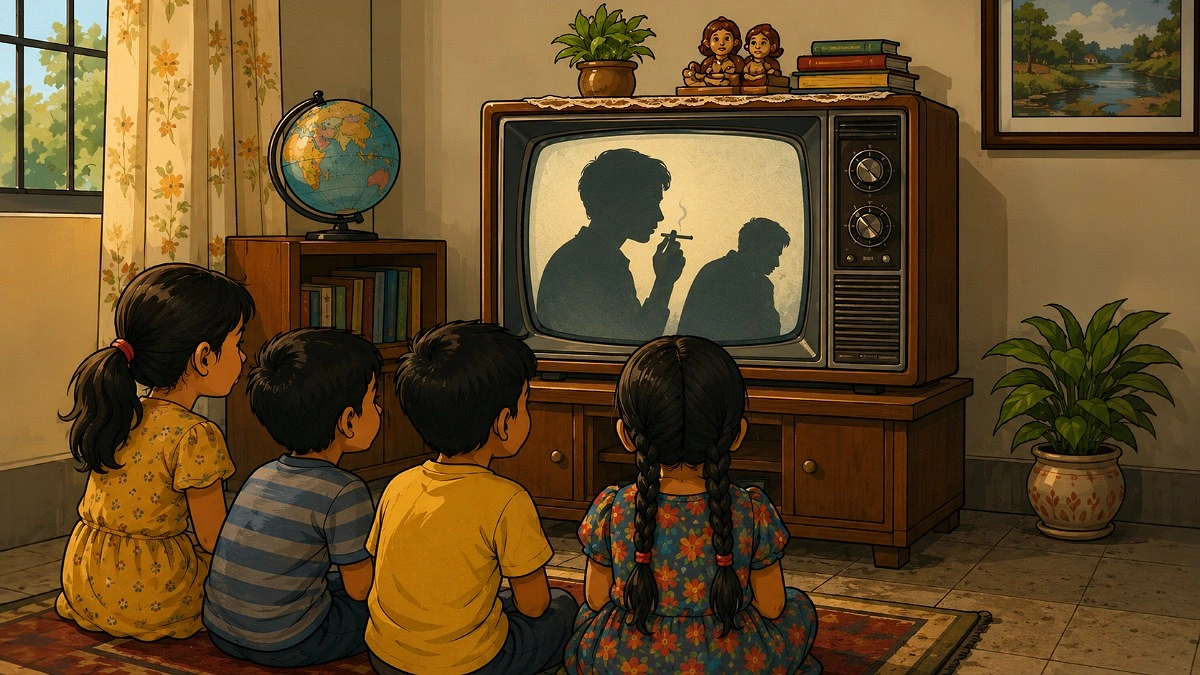
Graphics: Generated By AI
Ask anyone in Bangladesh who grew up watching television before the mid-1990s, and there is a good chance they will hum a few lines of it without needing a reminder. ‘Cigarette theke shuru, sheshkale heroin’ was not a hit song in the commercial sense.
It was a public service message, broadcast in the slots between programs on Bangladesh Television, BTV, the only channel most households could receive at the time. Decades later it still shows up in nostalgia posts, remix videos, and parody clips on YouTube and Facebook, tagged as a ‘90s BTV old ad’ by people who were children when it aired.
That staying power is the reason it is worth examining seriously, not just as a curiosity of old television, but as a case study in how a single piece of state media content can do the work of an entire public communication campaign.
What the message actually said
The piece functioned as a short musical public service announcement rather than a conventional advertisement. It carried a simple warning dressed in a memorable tune: smoking a cigarette is often the first step on a path that can lead to harder substances, ending in heroin addiction. Several reposts of the clip online credit it to a figure identified as Arup Ratan, described as its writer or performer, though public records of BTV’s own production archives from that period are not easy to verify independently, and this attribution should be read as something that has circulated with the video rather than as a confirmed production credit.
What is not in dispute is the format. It used a jingle, not a lecture. A folk inflected melody, a repeated refrain, and a warning built to lodge in a child’s memory rather than to argue like a policy paper. That choice of format turns out to be central to why it worked.
The world this message was born into
To understand why a warning about cigarettes leading to heroin made sense to broadcast to a general audience in the 1990s, it helps to look at what Bangladesh was dealing with at the time. According to Bangladesh Asiatic Society, the country’s shift from opium toward heroin and other harder drugs was already visible from the early 1980s onward. By the 1990s, heroin, cannabis, pethidine, and various psychotropic substances were the main drugs of abuse in the country, and law enforcement agencies recorded thousands of arrests and significant seizures through the decade.
Bangladesh’s geography made this worse. The country sits close to both the so-called Golden Triangle and Golden Crescent drug producing regions of Asia, and researchers writing on the subject have described it as a transit corridor for narcotics moving through the region, a position that fed a growing domestic addiction problem even though Bangladesh itself does not produce these drugs. The government’s own policy response, the Narcotics Control Act of 1990, shows that this was treated as a serious enough problem to require new legislation right in the years this jingle would have been airing.
In other words, the ad was not manufacturing a fear out of nothing. It was responding to a real and rising public health concern, using the state broadcaster to reach as many households as it could.
Why this counts as a public relations campaign
It is worth being precise about what ‘public relations’ means here, because this was not a commercial brand campaign selling a product. It was closer to what public health communicators call social marketing or public interest messaging, a deliberate effort by a state institution to shape public behavior and public understanding around a social problem. The tools are the same ones a PR campaign would use: a clear core message, a repeatable and memorable format, a trusted channel of distribution, and consistent airing over time so the message sinks in through repetition rather than a single exposure.
BTV was the natural, and at the time the only, vehicle for this kind of campaign. Bangladesh Television began broadcasting in 1964 and remained the sole domestically available television channel for most of the country through the 1980s and into the 1990s. Bangladesh’s first private satellite channel, ATN Bangla, only launched in 1997. Until then, if the government or a public institution wanted to reach the entire television watching population of the country with one message, there was exactly one door to knock on, and BTV was it.
That monopoly is precisely what makes this a textbook case of a public relations campaign built entirely on reach and repetition rather than on multi-channel strategy or targeted media buying. There was no audience fragmentation to worry about, no competing entertainment channel pulling eyeballs away. A message placed in BTV’s rotation reached rural and urban households, children and adults, in a way that is almost impossible to replicate in today’s fragmented media environment of dozens of channels and endless streaming options.
The mechanics of why it worked so well
A few things came together to make this particular message so effective, and so memorable, compared to other public announcements of its time.
The first is the format itself. A sung jingle with a simple, rhyming, almost singsong warning is built for memory in a way that a spoken announcement is not. Advertising research has long recognized that music and rhyme aid recall, and this piece leaned entirely on that principle, wrapping a serious warning in something closer to a children’s rhyme than a government notice.
The second is the slot it occupied. Public service announcements on BTV ran in the gaps between programs, which meant they were seen not by an audience that had chosen to watch them, but by everyone who was already watching whatever came before or after. That is the essence of the reach advantage of state broadcast monopoly. Nobody had to opt in.
The third is the emotional shape of the message. Rather than listing statistics or issuing a bureaucratic warning, it told something closer to a mini narrative, a path that begins with something as common and socially unremarkable as a cigarette and ends somewhere devastating. That gateway framing, whatever one thinks of its scientific nuance, is emotionally sticky. It gives a child or a teenager a clear, dramatic image to associate with a habit they might otherwise see as harmless or even glamorous.
The fourth is sheer repetition over years. A jingle repeated across broadcast slots for a long stretch of time does something that a single striking advertisement cannot. It becomes part of the ambient culture, absorbed the way a nursery rhyme is absorbed, without anyone consciously trying to memorize it.
Why it still resonates today
The clearest evidence of the campaign’s power is not anything from the 1990s, it is what has happened to the clip since. People who were children when it aired have kept it alive online for years, in nostalgic reposts calling it part of their ‘BTV childhood,’ and in parody remakes made purely for laughs, referencing the original tune with obvious affection rather than mockery. That kind of afterlife, where a piece of state messaging becomes a genuine, spontaneous piece of shared cultural memory across an entire generation, is something most modern public health campaigns, with far larger budgets and far more sophisticated media planning, rarely achieve.
It is a reminder that reach and memorability, more than production polish, are often what decide whether a public message actually lands. A short, simple, sung warning delivered through a single channel that the whole country was watching turned out to be more durable than almost anything since.
Sources: Banglapedia, Prothom Alo, SSRN (K. F. Rahman), UNODC, Wikipedia (Bangladesh Television, ATN Bangla).
