
Tribute
The Solitary Beacon of Wisdom: Abul Kashem Fazlul Haq

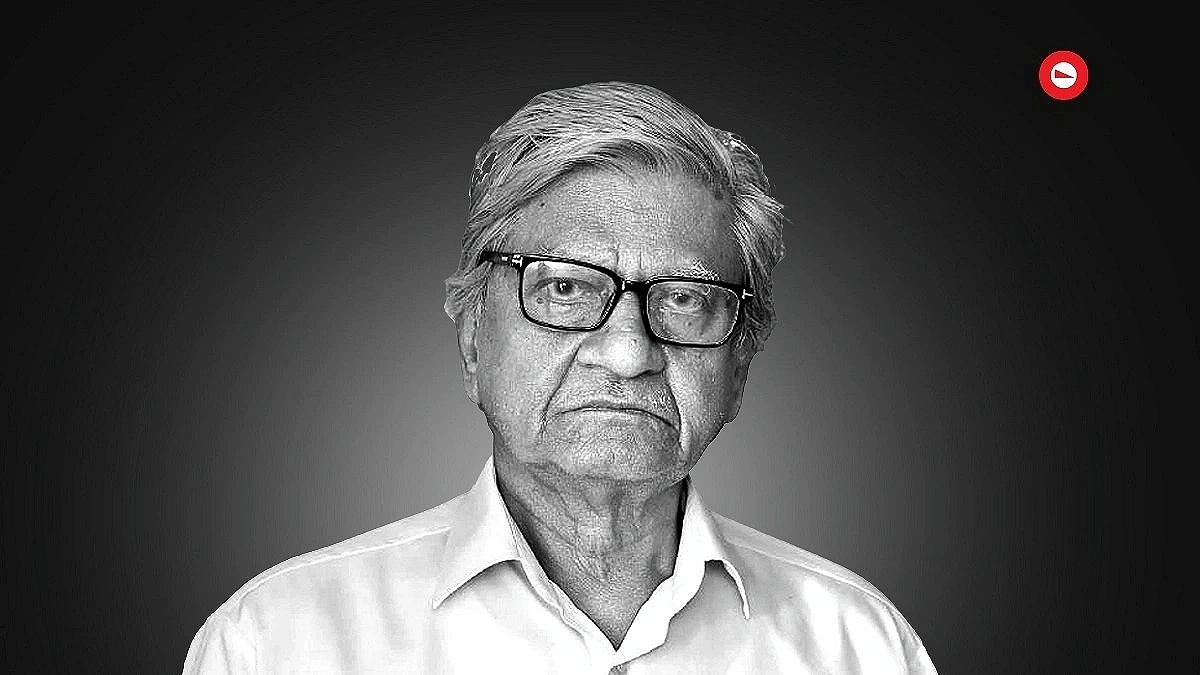
Professor Abul Kashem Fazlul Haq. Photo: Collected.
When a great banyan tree falls, the surroundings do not erupt in lamentation; rather, a profound and hushed stillness takes over. Professor Abul Kashem Fazlul Haq was that name of silent wisdom who, for four long decades, sharpened our fading intellectual faculties. When the news of his passing reached my ears today, it felt as if a vast living archive of time had suddenly burned to ashes. He was not merely a professor or an essayist; he was that "saviour" of our national life—whenever the black smoke of politics tried to choke our breath, we opened the window of his lucid thought and breathed in free air with full lungs!
A new newspaper, Agamir Somoy, has its inaugural issue's first section themed around "Politics." In this labyrinth of intense contemporary politics, whose voice was most indispensable for guidance and for speaking about extremism? For those of us who spend our days arranging words on the pages of newspapers, one name emerged like a fixed star—Professor Abul Kashem Fazlul Haq. Because he viewed the present through the lens of history and measured the future on the precise scales of philosophy. During the past decade and a half of oppressive misrule that sat like a boulder on our chests, or at the recent turning point of power transition, whenever our pen faltered out of fear for safety, when activists cowered in speaking out, we rushed to Professor Haq. He was that wise man whose words no one could afford to disregard; at best, those in power could pretend to ignore him with discomfort, but the sting of his logic would invariably pierce their subconscious.
Even around noon today, I spoke with him. What a strange and miraculous coincidence! I had called him regarding the honorarium for the seven distinguished writers of our inaugural issue. We easily obtained the bKash or bank account details of the other six, but in Professor Haque's case, we hit a dead end. He informed me that he had no bKash number, and he would send the correct name for his bank account tomorrow after going to the Bangla Academy. In this modern, mechanical digital age, his "orthodox" stance offered a deep sigh. It reminded me of those upright intellectuals of the 1960s, for whom writing was a sacred vow—where the unyielding expression of truth was far more valuable than any material reward. Did he ever accept any remuneration for his countless articles and interviews? Or were these mundane transactions utterly trivial to his stature of statecraft and philosophical nobility?
Professor Haq's personality bore an astonishing Renaissance-like fortitude. The greatest tragedy of his life was the murder of his son, Faisal Arefin Dipan. When the progressive publisher Dipan's blood soaked the soil of Dhaka under the cleaver blows of extremists, what we heard from the grieving father was not the speech of an ordinary man. He did not demand for any personal vengeance or retributive justice; rather, with an air of supreme detachment, he said—"I want human conscience to awaken."
There was no resentment, no inferiority complex toward the justice system, no blind emotion. He stood like that Socrates of history, who, even at the moment of drinking hemlock, sought the form of truth. Whenever I met him afterwards, I observed a remarkable, wise gravity. He never allowed personal emotion or the memory of his son to stand before the dispassionate analysis of history. Some may have considered him "emotionless," but in truth, the depth of his wisdom was like that of Renaissance men—at whose summit only stillness and serene composure reside.
Professor Haq's final article on extremism in the inaugural issue of Agamir Somoy reads like an ultimate warning. He clearly pointed out why our progressive and democratic parties keep failing time and again. In his view, those who treat religion solely as an enemy or seek to abolish it from society are, in reality, denying reality itself. He believed that Prophet Muhammad (PBUH) was not merely a religious preacher but also a successful statesman; consequently, there is no way to deny the political dimension of Islam. If democrats fail to fulfil the aspirations of ordinary people, they will inevitably turn to religion as an alternative. He was a sharp critic of the recklessness of leftists and the opportunism of liberals. To him, Bangali nationalism and secularism were the fundamental pillars of existence, which could never be subject to compromise under any circumstances.
Professor Haq was a living archive. His four-decade-long journey in the Department of Bengali at Dhaka University was not just an engagement with grammar or literature; it was a unique and radiant tradition of contemplative essay writing. Through timeless works such as Muktisangram, Kaler Jatrar Dhoni, and Rashtrabhasha Andolan, he acquainted the Bengali nation with its roots. Yet, what an astonishing and cruel irony! Whenever we faced critical times, whenever we suffered from crises of security, we used him as a shield. But the moment our need was fulfilled, we easily forgot him. Despite this neglect, he never expressed any resentment.
Today, it feels deeply that we have not just lost a researcher or a professor, but we have lost our most reliable advisor. The extraordinary feat of transforming grief into strength that he accomplished after mourning his son will remain a golden chapter in the history of our morality. Professor Abul Kashem Fazlul Haque has indeed become a figure of the past from today onwards, but the 32 seminal books he left behind and his unparalleled philosophical detachment will guide us for generations to come.
Even when viewed through the passage of time, it is evident that his historically grounded philosophical intellect was utterly unwavering. The turbulent times of the last century—'71, '75, or the '90s—or the intellectual currents of the post-2024 era of this newly matured century, all bear this out. Professor Haque always simply articulated his own truth, where there was no calculation of personal gain. And looking into the depth of that proclaimed truth, one can unmistakably recognize a Bangladesh that can either manifest as our supreme consciousness or pierce our hearts like the agonizing wail of failure.
Sir, you said that society must be built not through religion, but through human moral sense and reason. I do not know how much the so-called "narrative warriors" of Bangladesh or its intellectual sphere will carry forward that torch of your ideals. But whenever deep darkness surrounds us again, we will miss you terribly. You have departed to join your beloved son Dipan, like a serene and tranquil cloud.
Finally, as a devoted admirer, I say this one last time—"Stay well, Sir."
Author: Poet and Journalist.
