

Greek Volcano May Reawaken After 100,000 Years, Challenging 'Extinct' Label

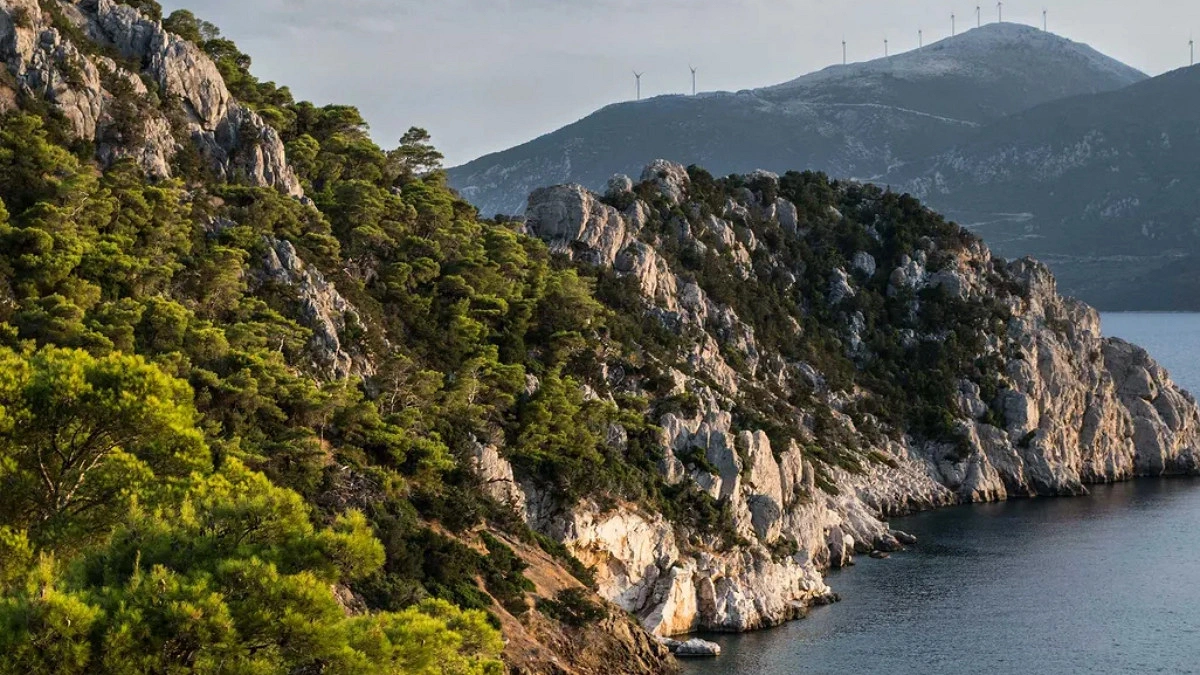
Photo Courtesy: Smithsonian Magazine.
For centuries, a volcano on Greece’s Methana peninsula seemed quiet—almost lifeless. Its last known eruption occurred around 250 B.C.E., recorded by the ancient geographer Strabo. Since then, the mountain has stood in silence across the Saronic Gulf from Athens, giving little outward sign of activity. But new research suggests that this calm surface may conceal a far more dynamic and potentially risky reality beneath.
A recent study published in Science Advances reconstructs roughly 700,000 years of Methana’s volcanic history. Scientists identified at least 31 eruptions over that long span. What surprised them most was not the eruptions themselves, but the long pauses between them—especially one stretch when the volcano appeared completely inactive for about 100,000 years.
Traditionally, volcanologists have often classified a volcano as “extinct” if it has not erupted for about 10,000 years. By that standard, Methana might easily have been considered dead during its long silent phase. But the new findings challenge that assumption. Even while the volcano showed no visible eruptions, activity was quietly building underground.
“I think that we definitely have to start reevaluating how we classify extinct volcanoes,” said volcanologist Răzvan-Gabriel Popa, one of the study’s lead researchers.
To understand what was happening beneath Methana, researchers analyzed tiny mineral crystals—especially zircon—found in volcanic rocks. These crystals form deep inside magma chambers and can act like timestamps, revealing when magma was present below the surface. By studying more than 1,000 such samples, the team pieced together a detailed timeline of the volcano’s behavior.
What they found was unexpected: during the long “quiet” period between about 280,000 and 168,000 years ago, magma was not absent. Instead, it was accumulating. In fact, crystal formation peaked during this supposedly inactive era, suggesting that the volcano was far from dead—it was simply dormant on the surface while remaining active underground.
This challenges a long-standing idea in geology: that a long silence means a volcano’s internal system has shut down. Instead, Methana shows that silence can mask ongoing processes that may eventually lead to renewed eruptions.
The reason lies in the nature of the magma itself. In some cases, magma can become rich in water and extremely viscous. As it rises through the Earth’s crust, gas bubbles form—similar to a fizzy drink being opened. This process can cause the magma to thicken and slow dramatically, preventing it from reaching the surface.
Rather than erupting, the magma becomes trapped below ground, gradually filling and expanding the volcano’s internal reservoir. Over time, this buildup may actually increase the potential for future eruptions.
In other words, a volcano that appears inactive might not be dying—it could simply be “taking a nap,” as Popa described it in related research.
Methana itself is still classified as an active volcano because of its relatively recent eruption in historical times. However, the study’s implications extend far beyond this single site. Around the world, many volcanoes are labeled extinct based largely on the absence of recent eruptions. The new findings suggest that some of these classifications may need to be reconsidered.
Volcanoes do not always follow simple timelines. Their activity can stretch across hundreds of thousands—or even millions—of years, with long gaps between eruptions. As a result, the boundaries between “active,” “dormant,” and “extinct” are often blurry rather than fixed.
This has important implications for hazard assessment. Communities living near quiet volcanoes may assume they are safe, especially if no eruption has occurred in recorded history. But Methana’s history suggests that appearances can be misleading.
Modern technology offers some reassurance. Even when a volcano shows no visible activity, subtle signs of magma movement can often be detected. Small earthquakes, slight swelling of the ground and changes in gas emissions can all indicate that magma is accumulating below. Sensitive instruments such as seismometers, GPS systems and satellites allow scientists to monitor these hidden processes.
Still, the challenge remains: how to interpret long periods of silence. If a volcano can remain inactive for more than 100,000 years and then erupt again, how should scientists—and the public—define “extinct”?
The Methana study does not suggest that all quiet volcanoes are about to erupt. In fact, researchers emphasize that Methana itself currently poses a relatively low risk. But it does highlight the need for caution in making assumptions based solely on surface activity.
The broader lesson is clear: geological systems operate on timescales far beyond human experience. What seems like permanence—a mountain unchanged for thousands of years—may actually be a brief pause in a much longer cycle.
As scientists continue to refine their understanding of volcanic systems, studies like this one may lead to more nuanced classifications and better risk assessments. Rather than labeling volcanoes as simply “alive” or “dead,” researchers may need to consider a spectrum of activity, including processes hidden deep underground.
For now, Methana stands as a reminder that the Earth is rarely as quiet as it appears. Beneath its शांत slopes, the forces that shape the planet continue to move—slowly, invisibly and sometimes unpredictably.
And as Popa and his colleagues suggest, “quiet doesn’t always mean safe.” (Source: Smithsonian Magazine)