

China Erodes Japanese Dominance in Bangladesh Car Market

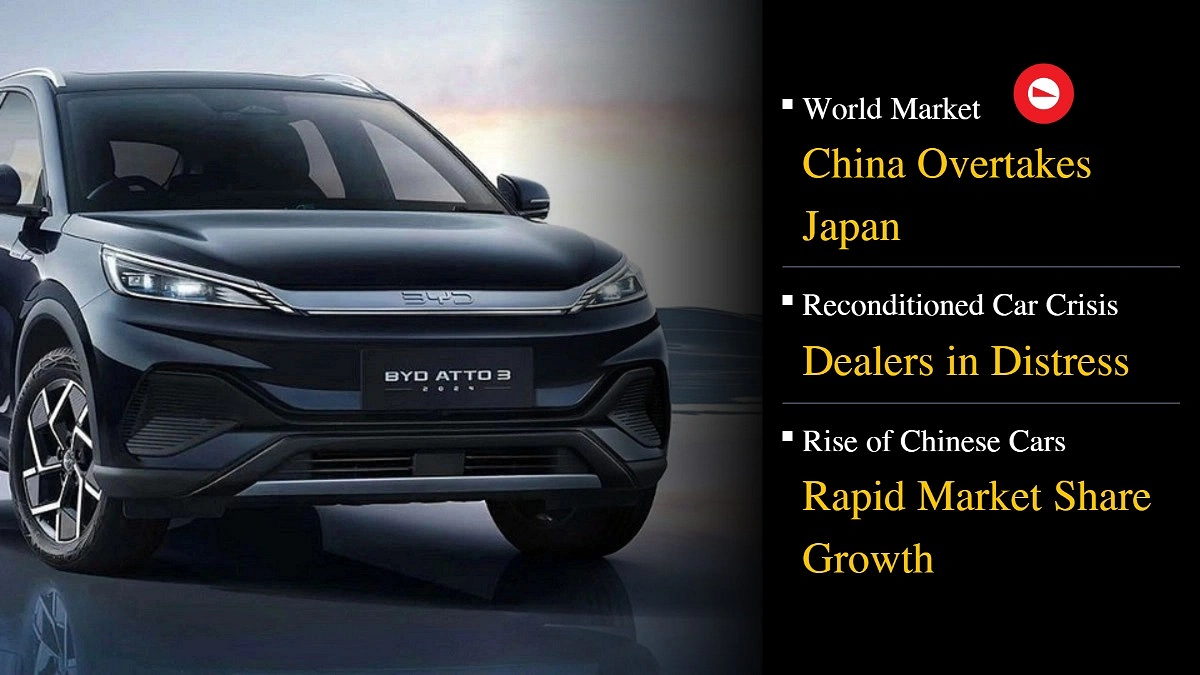
Graphics: Agamir Somoy
In Bangladesh, the word ‘car’ has long been synonymous with Toyota in the minds of middle and upper-middle-class buyers. Models such as the Corolla, Axio, Allion, and Premio have dominated the country’s roads for decades. However, a shift is now underway as China makes steady inroads into this long-standing Japanese reconditioned car market.
Instead of reconditioned vehicles, buyers are increasingly turning to brand-new cars equipped with advanced in-car technology and offered at competitive prices, gradually shifting control of the private car market towards Chinese brands.
A major policy shift in import regulations aimed at addressing fuel concerns has accelerated this trend. In the proposed budget, the government introduced incentives for importing environmentally friendly and fuel-efficient vehicles over conventional fuel-powered cars. Import duties on electric vehicles (EVs) have been reduced, while tariffs on Japanese reconditioned or used cars have been increased. This policy shift has created new opportunities for Chinese hybrid, plug-in hybrid, and EV models to enter the market.
At present, Japanese brands still dominate about 85 percent of Bangladesh’s private car market, down from an almost complete monopoly in the past. Most of the remaining 15 percent is occupied by Chinese vehicles. In the newly imported vehicle segment, Chinese brands are now clearly gaining ground. Buyers are finding brand-new Chinese cars priced lower than reconditioned Japanese vehicles. Alongside price advantages, features such as advanced artificial intelligence, powerful batteries, modern design, and strong fuel efficiency are drawing customers to Chinese showrooms.
BYD, a Chinese electric vehicle brand that has achieved global success, is among the key players in this shift. Mahbubul Kabir Khan Shanto, managing director of Autotech, the authorized BYD dealer in Chattogram, said the company has sold more than 50 vehicles in the past year.
“No complaints have been received about the vehicles sold, which is our biggest achievement. Customer demand is higher than our target. It is clear that trust is growing, and that is driving demand,” he said.
He expressed optimism that if charging infrastructure expands across the country, the market for reconditioned and brand-new cars could become evenly split within the next five years.
For decades, Japanese cars, particularly Toyota, have maintained dominance in Bangladesh due to strong resale value, durability, and easy availability of spare parts. Their reliability has been proven over time on the country’s rough roads and in challenging weather conditions. Additionally, mechanics across the country are generally familiar with repairing these vehicles with ease.
According to the Bangladesh Reconditioned Vehicles Importers and Dealers Association (BARVIDA), the annual market value of used or reconditioned cars in Bangladesh stands at around $1.54 billion, or nearly Tk 180 billion. Domestic investors have put about Tk 200 billion into the sector.
At one-point, annual sales of reconditioned vehicles ranged between 20,000 and 30,000 units. That figure has now fallen to around 9,000. As sales have dropped sharply, government revenue from what was once a top-performing tax sector has also declined. Despite the downturn, high import duties still generate about Tk 60 billion in annual revenue from the reconditioned car market.
Former BARVIDA president Habib Ullah Don said the sector is under pressure due to high tariffs, tighter bank lending conditions, and what he described as discriminatory government policies.
“Reconditioned hybrid and plug-in hybrid vehicles are also fuel-efficient, like EVs. But the government has provided incentives for EVs while excluding us. As a result, government revenue is also declining. We hope this business-friendly government will reconsider its decision in the interest of the trade before the budget is passed,” he said.
However, current electric vehicles available in Bangladesh are priced above Tk 6 million, limiting buyers mostly to those in the Toyota Harrier category. EV options suitable for buyers of Toyota Axio, Premio, or Allion have yet to enter the market. While a Toyota Yaris sedan costs around Tk 6 million, a brand-new BYD Seal 5 from China is priced at Tk 3.9 million, offering significantly lower prices. BYD is also preparing to launch a model priced at around Tk 2.5 million to compete with the Toyota Aqua, which is expected to gain popularity once introduced.
Around five Bangladeshi industrial groups are now importing Chinese passenger car brands to capture the Japanese-dominated market. CG Runner Group is importing BYD, Rencon Motors is bringing in MG, H Autos is importing Haval and Great Wall, while Asian Motorspex is bringing Chery and Omoda. Among these, BYD and MG have gained the most popularity.
A report by Japan’s leading financial newspaper Nikkei Asia said China has overtaken Japan in the global automobile market. In 2025, Chinese automakers sold a record 27 million vehicles, while Japan’s sales slipped to 25 million.
Of the total vehicles produced in China in 2025, about 74 percent, roughly 20.1 million units, were sold in the domestic market, while the remaining 26 percent were exported.
According to the China Passenger Car Association, the top five destinations for exported electric vehicles were Belgium, the United Kingdom, Mexico, Brazil, and Thailand. In 2025, China exported 284,000 EVs to Belgium, 231,000 to the UK, 221,000 to Mexico, 200,000 to Brazil, and 151,000 to Thailand.