

Torn Notes Trade Crumbles as Funds Remain Stuck

Graphics: Agamir Somoy
Md. Mizanur Rahman makes a living by buying torn, damaged, dirty, and defective banknotes from the public at discounted prices. He then exchanges the notes at Bangladesh Bank for new or usable currency and earns a profit.
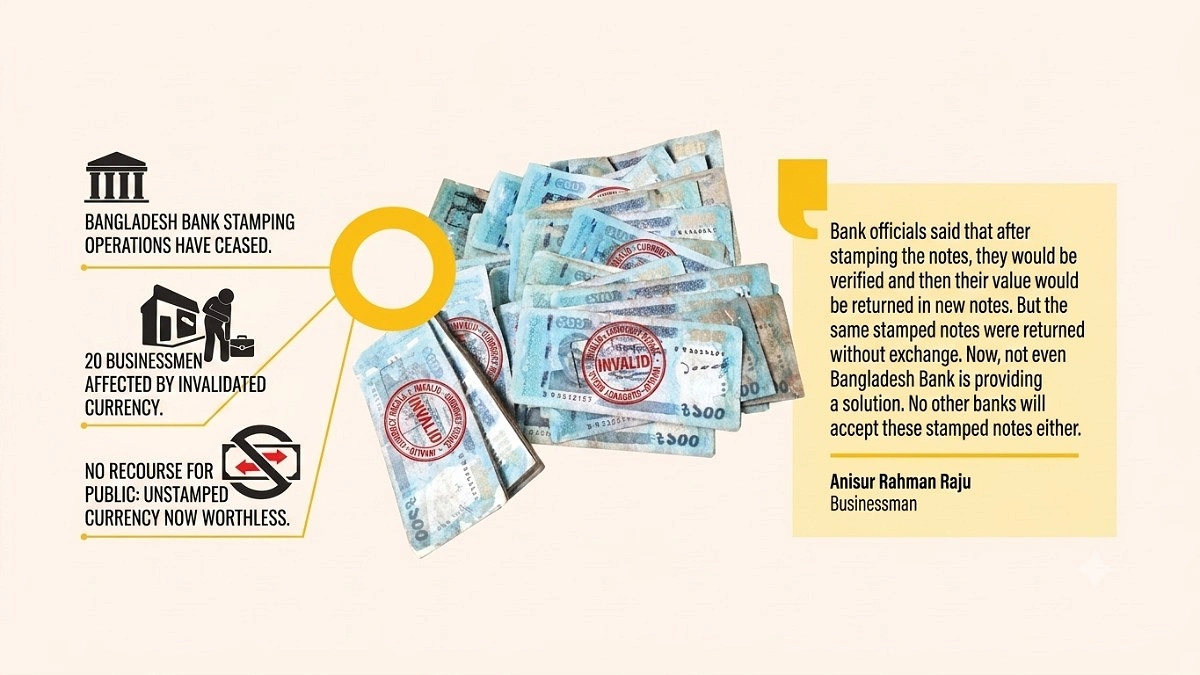
Hoping to make a return, he gradually deposited old notes worth Tk 370,000 at the Khulna branch of Bangladesh Bank. The bank accepted the notes and stamped them as ‘sold.’ However, instead of paying the exchange value, the branch later returned the same notes to him.
Other banks now refuse to accept the stamped notes.
Mizanur is not alone. At least 32 traders buy and sell torn and damaged banknotes on the sidewalk in front of the Khulna branch of Bangladesh Bank. They said they had collectively deposited at least Tk 2.5 million with the branch at different times.
According to the traders, the bank accepted their old notes and stamped them as ‘sold,’ but later returned the same notes without paying the exchange value. Commercial banks have also refused to accept the stamped notes.
As a result, their capital has become tied up. Twenty traders have already shut down their businesses, while the remaining 12 continue operating on a very limited scale.
Sources at the Khulna branch of Bangladesh Bank said the central bank has 10 branches across the country. A directive from its head office instructed all branches to suspend the acceptance and exchange of torn, damaged, dirty, and defective notes.
In line with the directive, branches have stopped accepting such notes since November 20 last year. The policy change has left both note exchangers and ordinary customers in Khulna facing serious difficulties.
One affected trader, Abdur Rahman Raju, said he deposited torn, damaged, dirty, and defective notes worth Tk 300,000 with the assistance of Bangladesh Bank officials.
“Officials stamped the notes and told me I would receive the exchange value after verification. Instead, they returned the same notes without exchanging them. The returned notes carry the ‘sold’ stamp. Bangladesh Bank has not provided any solution, and other banks are not accepting the stamped notes either. My business has become nearly inoperative due to a shortage of capital,” he said.
Another trader, Ilias Munshi, said he had collected old notes from local markets and different areas before depositing Tk 500,000 with Bangladesh Bank in several installments.
He said he has also fallen into financial hardship after failing to receive the exchange value.
The affected traders said they would face even greater financial losses if authorities do not quickly arrange to return or exchange the funds that have remained tied up for a long time. They called for immediate and effective measures to resolve the issue.
Azgar Ali, another note exchanger, said he had invested all of his capital in purchasing torn and damaged notes.
“All my money is now stuck at Bangladesh Bank. I have lost my capital and become destitute. My source of income has stopped,” he said.
The policy change has affected not only traders but also ordinary customers.
Tarun Pal and Sandeepan Biswas traveled from Dumuria Upazila to the Khulna branch of Bangladesh Bank to exchange torn notes. They said customers had previously been able to exchange damaged notes at the branch, but the relevant counter has now been closed.
“After spending time and money to come here, we have to return empty-handed,” they said.
Muntasir Mamun, joint director of the Khulna branch of Bangladesh Bank, said the branch had accepted the notes before receiving the directive from the head office.
“However, after the new directive was issued, we could no longer pay the exchange value. We have written to the head office seeking a solution,” he said.
He expressed hope that the matter would be resolved soon.
Addressing customers, Mamun said Bangladesh Bank had instructed scheduled banks through a circular to stop accepting defective notes. However, the circular also directed banks to pay the exchange value of such notes.

