
Rising Smuggling Threat Clouds Eid Hide Market
- Tannery owners inform Home Minister
- Businessmen demand strict border vigilance for 3 months from Eid

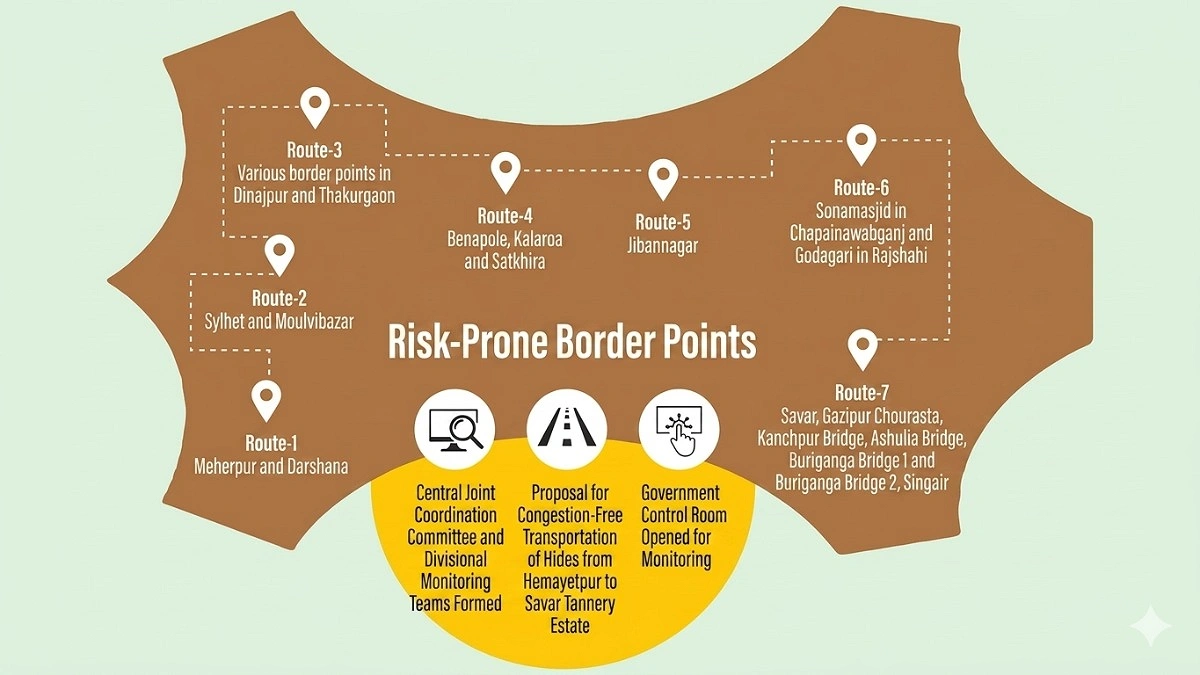
Graphics: Agamir Somoy
As Eid-ul-Azha approaches, long-standing concerns have resurfaced in Bangladesh’s leather industry. Tannery entrepreneurs worry that sacrificial animal hides may once again be smuggled into neighboring countries. India’s West Bengal has reportedly halted animal sacrifice this year, while its leather industry continues to require raw hides. Business leaders fear that smuggling networks could become active along the border, taking advantage of cash shortages in the local leather trade, preservation problems, syndicates, and collapsing prices. Leaders of the leather industry recently informed the home minister about the matter, according to relevant sources.
However, the Ministry of Commerce has formed three committees to maintain the preservation, trading, transportation, and supply chain of sacrificial animal hides. Authorities have also opened a monitoring cell. The Bangladesh Tanners Association (BTA) estimates that the country will collect around 7 to 8 million animal hides this year.
BTA Chairman Shahin Ahmed told Agamir Somoy on Monday that law enforcement agencies must strengthen surveillance in border areas from Eid day for the following three months. According to him, West Bengal has suspended animal sacrifice this year. However, the leather industry in that region still requires raw hides to remain operational. Against that backdrop, concerns remain over the possible smuggling of raw hides into India through border routes.
Sources said tannery owners recently held a meeting at the Ministry of Home Affairs. During the meeting, they asked Home Minister Salahuddin Ahmed to ensure the supply of cash, strengthen border surveillance, and provide security support for hide transportation. Business leaders alleged that many traders fail to purchase hides in local markets during Eid because banking transactions remain limited at that time, creating a cash crisis. Smuggling networks allegedly exploit that situation by purchasing hides at low prices.
Sources said the Ministry of Home Affairs is treating the issue seriously. Authorities have already instructed the Border Guard Bangladesh, police, Rapid Action Battalion, and other law enforcement agencies to intensify surveillance in border areas, increase checkpoints, and strengthen monitoring of hide transportation.
Relevant sources said several high-risk routes could be used for hide smuggling. Hides collected from the areas of Jashore, Khulna, Satkhira, Patkelghata, Kaliganj, Narail, and Rajarhat may be smuggled through the Benapole, Kalaroa, and Satkhira border points.
In addition, smugglers often transport hides from Jhenaidah, Magura, Shailkupa, Kotchandpur, and Maheshpur through the Jibannagar border route. Smugglers also move hides collected from Natore cattle markets through the Sonamasjid border in Chapainawabganj and the Godagari border in Rajshahi.
Sources further said smugglers use the Meherpur and Darshana border points to move hides from Chuadanga, Kushtia, Allahar Dorga, Daulatpur, and Alamdanga. Authorities also consider the Jaflong, Tamabil, and Karimganj border routes vulnerable to the smuggling of hides from the Sylhet and Moulvibazar regions. In addition, concerns persist over hide smuggling through various border routes in Dinajpur and Thakurgaon.
Meanwhile, large numbers of animals are slaughtered in and around the capital, Dhaka. In those cases, smugglers reportedly use Savar, Gazipur Chourasta, Kanchpur Bridge, Ashulia, Buriganga Bridge 1 and 2, and Singair Bridge as transportation routes.
