
Asset recovery
Laundered money moves through multiple countries

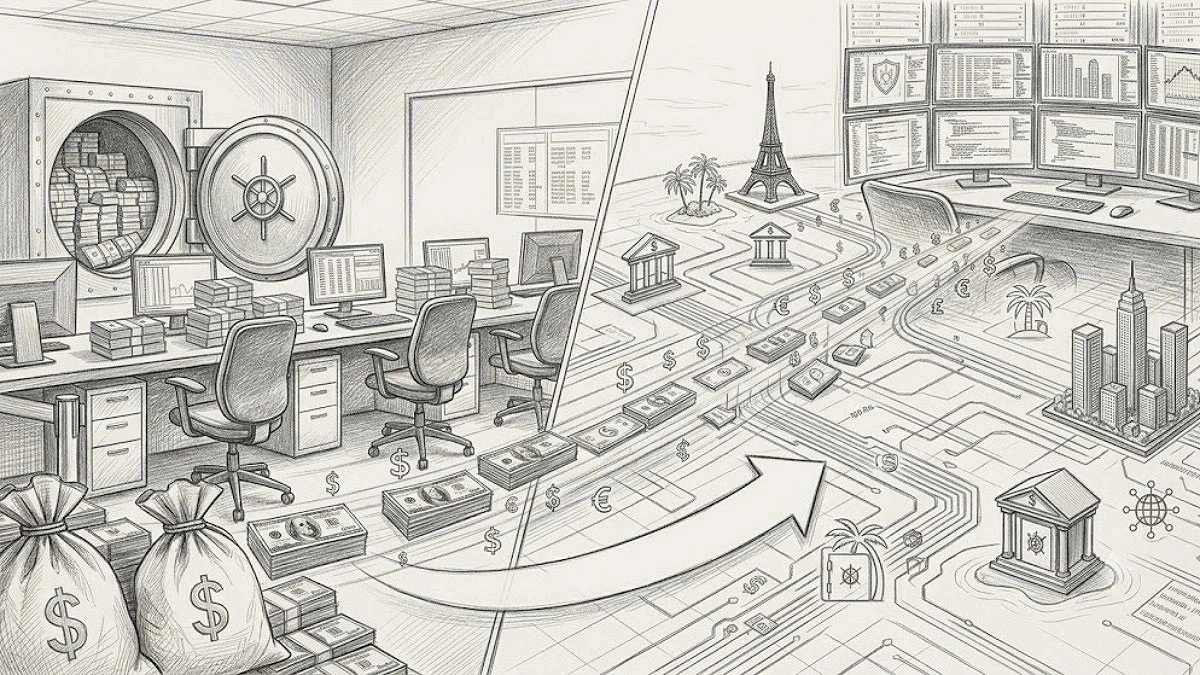
Symbolic photo
Bangladesh is facing a new challenge in its efforts to recover money laundered abroad. As soon as authorities begin seeking information from a foreign country, money launderers often transfer the funds to another jurisdiction. The practice disrupts investigations, complicates evidence collection, and prolongs the asset recovery process. To address the problem, the government has launched an initiative to establish a faster communication mechanism with foreign authorities.
Time has emerged as one of the biggest obstacles to recovering laundered assets. In many cases, once Bangladesh starts requesting information or legal assistance from a foreign country, the laundered funds are moved elsewhere. As a result, the money changes jurisdictions before authorities can act, making it difficult for the requested country to provide the necessary information and complicating investigations.
The issue came to light during the 28th meeting of the Working Committee on Anti-Money Laundering and Combating the Financing of Terrorism, held on May 21 under the chairmanship of Nazma Mobarek, secretary of the Financial Institutions Division at the Ministry of Finance.
The meeting noted that one of the biggest obstacles to implementing Mutual Legal Assistance (MLA) requests is obtaining admissible evidence. In many cases, funds are first transferred from Bangladesh to one country before being moved to a second or even a third jurisdiction. While investigators may obtain information on the initial transfer, tracing subsequent transactions becomes much more difficult, prolonging both investigations and legal proceedings.
Under the current system, requests for information are sent from the Ministry of Home Affairs to the Ministry of Foreign Affairs. They are then forwarded through Bangladeshi embassies to the central bank or relevant authority in the destination country. The process takes time, allowing launderers in many cases to move the funds before authorities can respond.
To speed up information sharing, the meeting proposed establishing a mechanism for direct communication between the Ministry of Home Affairs and the relevant authorities in destination countries.
The meeting also decided that the Ministry of Foreign Affairs will provide the Ministry of Home Affairs with the reference number for every MLA request. Designated focal points at the Home Ministry will then regularly monitor progress and coordinate follow-up actions.
Five countries have expressed interest in cooperating with Bangladesh on combating money laundering and terrorist financing. They are the United States, the United Kingdom, Canada, Australia, and Switzerland.
At the same time, the government has initiated efforts to sign Mutual Legal Assistance agreements with 10 countries to facilitate the recovery of laundered assets. Malaysia, Hong Kong-China, and the United Arab Emirates have already agreed, while discussions are continuing with the remaining seven countries—the United States, the United Kingdom, Canada, Australia, Switzerland, Thailand, and Singapore.
The initiative comes after a report published in March this year by Global Financial Integrity (GFI) identified Bangladesh as one of the developing Asian countries most vulnerable to trade-based money laundering.
According to the Working Committee on Anti-Money Laundering and Combating the Financing of Terrorism, about $68.3 billion was laundered out of Bangladesh over the past decade, equivalent to about Tk 8.33 trillion at the current exchange rate. On average, more than $6.83 billion was laundered each year, primarily through trade misinvoicing involving imports and exports.
According to the Ministry of Finance and Bangladesh Bank, the largest destinations for laundered funds during the period were the United States, the United Kingdom, Canada, Australia, Singapore, Hong Kong, the United Arab Emirates, Malaysia, the Cayman Islands, and the British Virgin Islands.
Ikhtiar Uddin Mohammad Mamun, head of the Bangladesh Financial Intelligence Unit (BFIU), told Agamir Somoy that Bangladesh had already been cooperating with various countries. He said the recent meeting reviewed the progress of those efforts and discussed ways to make cooperation more effective. The countries described as newly interested had, in fact, already been working with Bangladesh at different levels, he added.
People familiar with the matter said that despite initiatives to strengthen international cooperation, Bangladesh has yet to achieve the desired progress. Although the country joined the Egmont Group in 2013, it has not yet adopted the Common Reporting Standard (CRS), which allows the automatic exchange of financial information among participating countries. Experts said Bangladesh has not yet developed the required capacity because key financial sector reforms remain incomplete, making the recovery of laundered assets an ongoing challenge.
