
PM instructs police not to consider political identity of offenders

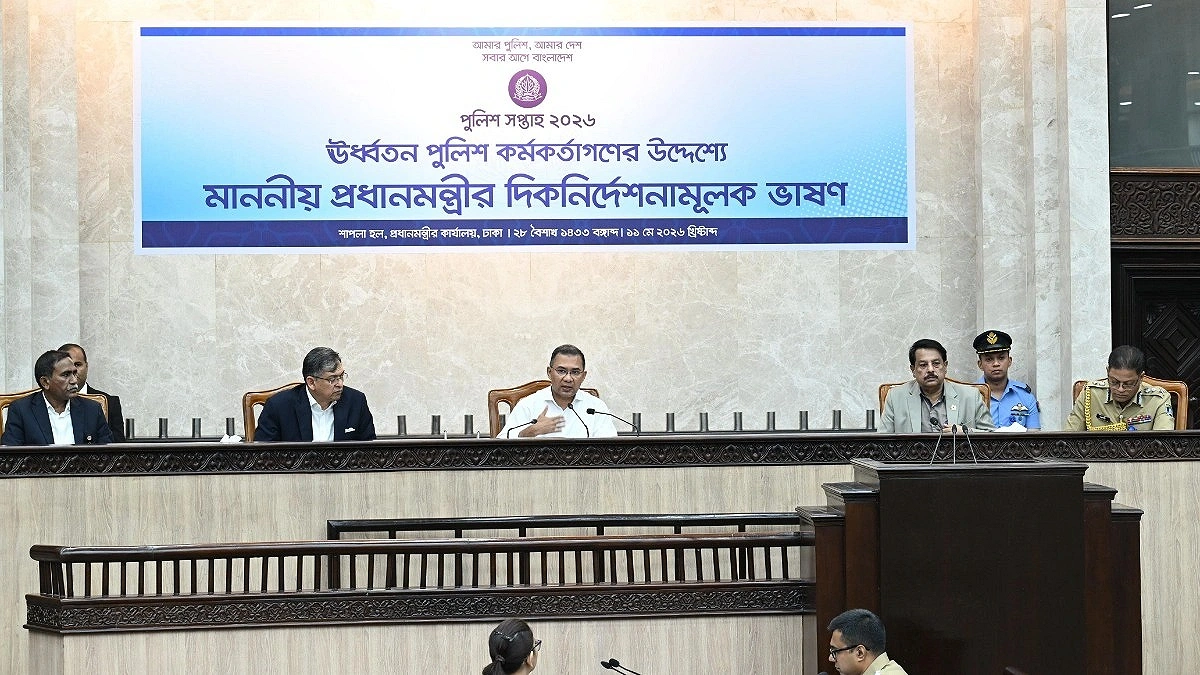
Prime Minister Tarique Rahman speaks at the Prime Minister’s Office in Tejgaon, Dhaka, in the morning. Photo: Collected
Prime Minister Tarique Rahman has directed police officials to ignore the political identity of individuals and treat offenders solely as criminals. He also reiterated the government’s uncompromising stance against corruption, terrorism and misrule.
Addressing police officers, the Prime Minister said, “While working to curb corruption and terrorism, you often face political identity or political influence. I want to make it clear today that you must not consider anyone’s political identity. Whoever commits a crime must be treated as a criminal. The application of law is equal for all. You will carry out your duties for the welfare of the state and its people.”
He made these remarks on Monday morning while speaking at an event marking Police Week-2026, held at Shapla Hall of the Prime Minister’s Office in Tejgaon, Dhaka, in the presence of police officials.
The Prime
Minister said, “Police play an undeniable role in building a strong,
accountable, lawful and people-friendly state system. The government does not
want to compromise on corruption, terrorism or misrule.”
Due to technology, the nature of crime has increased, the Prime Minister said, “As
the nature of crime has changed, the scope of police administration’s
activities has also expanded significantly. Therefore, police operations are no
longer confined within cities, towns, or districts as they were a few decades
ago.”
He said that “transnational organized crime” is now a material reality. For this reason, every police officer needs to be multi-skilled. This is now a demand of the time. In this context, no specific post in the police administration is unimportant; every position is highly significant. Therefore, a professional mindset is essential across all levels of the administration.
Addressing police personnel, the Prime Minister said, “If professionalism is compromised just for promotions or postings in preferred places, officers may gain temporary satisfaction, but it amounts to a compromise with professionalism. Therefore, I make a special appeal to you: wherever responsibility is assigned within the police administration, carry out that duty with full seriousness. Only then will we be able to ensure an efficient, dynamic and professional police force.”
Referring to power as temporary, the Prime Minister said, “This government is for five years. Similarly, no post in the public administration or police administration is permanent for anyone. For this reason, I do not want to view today’s meeting as a mere formality. Rather, let this meeting become an important moment of commitment and a guiding framework for maintaining law and order in the days ahead.”
Stressing that there is no alternative to a skilled, brave, honest and impartial police administration for the success of a government, the Prime Minister said, “People first turn to the police when they are in trouble. I believe that if the police sincerely wish, they can resolve many incidents at the initial stage through legal and strategic intervention.”
Referring to
the post-5 August 2024 situation, he said, “In the past one and a half years,
the police have dealt with various difficult situations strategically and have,
in many cases, successfully contained mob violence.”
The government wants to transform the police into a truly people-friendly
force, the Prime Minister said, adding that the administration envisions a
police service that is both citizen-friendly and trusted by the public. He
noted that in any country, people generally view the police as a mirror of the
government. Therefore, he said, the success of the police is effectively seen
as the success of the government.
The Prime Minister said the relationship between the public and the police must be both legal and humane. Alongside other duties, a significant portion of police work is spent on controlling politically unstable situations, which is also part of their responsibility. The current government, he said, is committed to ensuring the democratic and political rights of the people. However, he stressed that everyone must ensure that no one becomes involved in communal unrest or any form of sabotage.
Referring to the government’s electoral manifesto and the July Charter, the Prime Minister said, “A clear understanding must be established that the current government is firmly committed to implementing every clause and every pledge of its election manifesto and the publicly signed July Charter step by step and word for word. There is no reason for any doubt in this regard.”
Emphasizing that the state’s objective is to bring every citizen, regardless of party or opinion, under a framework of state and social security, the Prime Minister said the safety of the people must be the first priority of police personnel. He added that wherever they are assigned duty, they must perform it with seriousness and sincerity. Only then, he said, can an efficient, dynamic and professional police administration be built.
The Prime Minister said, “In society and the state, people become involved in crime for various reasons. One of the main reasons is economic inequality. That is why, after assuming office, the present government has taken various initiatives to reduce economic disparities among different classes and professions and to ensure a social and economic safety net for citizens.”
The Prime Minister, Tarique Rahman, said the government will continue working for the welfare of the police force. He said, “Integrity, merit and efficiency will be the guiding principles for recruitment, transfer and posting in the administration. We know that police duties are never confined to a fixed timeframe.”
He noted that the way the public evaluates the government depends largely on the conduct and activities of the police. The state, he said, expects honesty, efficiency, service, justice, professionalism and humanity from the police.
He said, “If you are able to embody these qualities to the best of your ability, then the slogan ‘My police, my country—Bangladesh first’ will truly be meaningful and successful. Let us all move forward from our respective positions, giving whatever small sacrifices we can for the country, the nation and the people.”
Speeches were also delivered at the event by Home Minister Salahuddin Ahmed, Senior Secretary of the Ministry of Home Affairs Manjur Morshed Chowdhury, Inspector General of Police (IGP) Md. Ali Hossain Fakir, Additional IGP AKM Aulad Hossain, and other senior police officials.
During the event, police officers presented various demands before the Prime Minister. They also said that Bangladesh Police is always ready to assist the government in maintaining peace and order in the country.
Military and civilian police officials were present at the event.
In addition, a documentary was screened highlighting the sacrifices and contributions of police officers during various national crises since the Liberation War period, as well as initiatives taken by Shaheed President Ziaur Rahman and former Prime Minister Begum Khaleda Zia to develop the police force.
The Prime Minister inaugurated the four-day Police Week-2026 in a colorful ceremony held on Sunday at the Razarbagh Police Lines ground in the capital, Dhaka. This year’s theme of Police Week is: “My police, my country—Bangladesh first.”
After the program, the Prime Minister joined a photo session with police officers in front of Tiger Gate.
