
Electric Vehicles Gaining Ground

Graphics: Agamir Somoy
A proposal initially aimed at allowing educational institutions to import electric minibuses without paying any duty gradually expanded to include other buses. The initiative has now moved further to incorporate trucks as well. However, importers of buses and trucks will have to pay a 15 percent duty.
When an official from the finance division was asked about the current applicable tax rate, he could not give a direct answer. He muttered through a calculation of customs duty, regulatory duty, value-added tax, supplementary duty, advance tax, and advance income tax. He ultimately failed to provide a figure.
He then called a desk officer for clarification. The official responded from memory, stating that “all duties and taxes combined stand at 61.80 percent.”
The government is expected to face some revenue pressure due to the reduction in duties. However, officials say the move aims to reduce pressure on fuel consumption. Public transport across schools, colleges, universities, and private institutions remains heavily dependent on fuel, contributing significantly to environmental pollution.
The Iran conflict highlighted the country’s dependence on Middle Eastern fuel supplies. With global markets remaining unstable, Bangladesh is also affected. Fuel import costs in foreign currency have increased sharply during the conflict compared to normal times. Although there may be short-term revenue losses, officials expect long-term savings in fuel costs and foreign exchange. They also anticipate reductions in air pollution, offering some improvement in environmental and public health conditions. Overall, the decision is expected to benefit both the economy and society.
It was against this backdrop that Finance Minister Amir Khasru Mahmud raised the idea of introducing fuel-efficient alternative transport. He called relevant officials, presented the concept, and a proposal was prepared accordingly. The matter was later placed before the Cabinet meeting.
At the meeting, all members agreed that environmental pollution from transport emissions could no longer be ignored. They noted that exhaust emissions are a long-term cause of asthma, respiratory illness, and lung diseases, posing a serious public health risk. Members also said continued dependence on diesel imports was becoming increasingly burdensome and unsustainable.
The Cabinet concluded that the country must move away from fuel dependence. It approved a proposal allowing fully electric buses to be imported duty-free for registered educational institutions, while other cases would face a total 20 percent duty. The decision was taken on April 2.
Later, on May 3, another Cabinet meeting reduced the duty on other bus imports by an additional 5 percent. The finance minister was not present at that meeting, yet the decision to further reduce taxes was approved in his absence.
Concerns over possible misuse of tax exemptions were also discussed at a Cabinet meeting. The meeting decided to limit the tax exemption facility until June 30. A gazette notification for zero-duty benefits has already been issued. A notification on the proposed 15 percent duty is also in the final stage of publication. A draft notification is also being prepared for trucks with a carrying capacity of five tons or more.
The National Board of Revenue issued a press release stating that all buses carrying students must be painted yellow. It also said the words “school bus,” “college bus,” “student bus,” or “transport” must be clearly and visibly written on the vehicles.
Authorities expect that the initiative will help educational institutions build modern, environment-friendly transport systems at lower costs. They also believe it will make student transportation safer and more comfortable.
The NBR further expects that parents’ transportation costs for students will decrease significantly due to the decision.
However, doubts have emerged on social media over whether costs will actually fall. Comments circulating online suggest that English-medium schools will benefit the most, as they may import electric vehicles without duty and charge parents with double fares, effectively creating a ‘dual profit’ system.
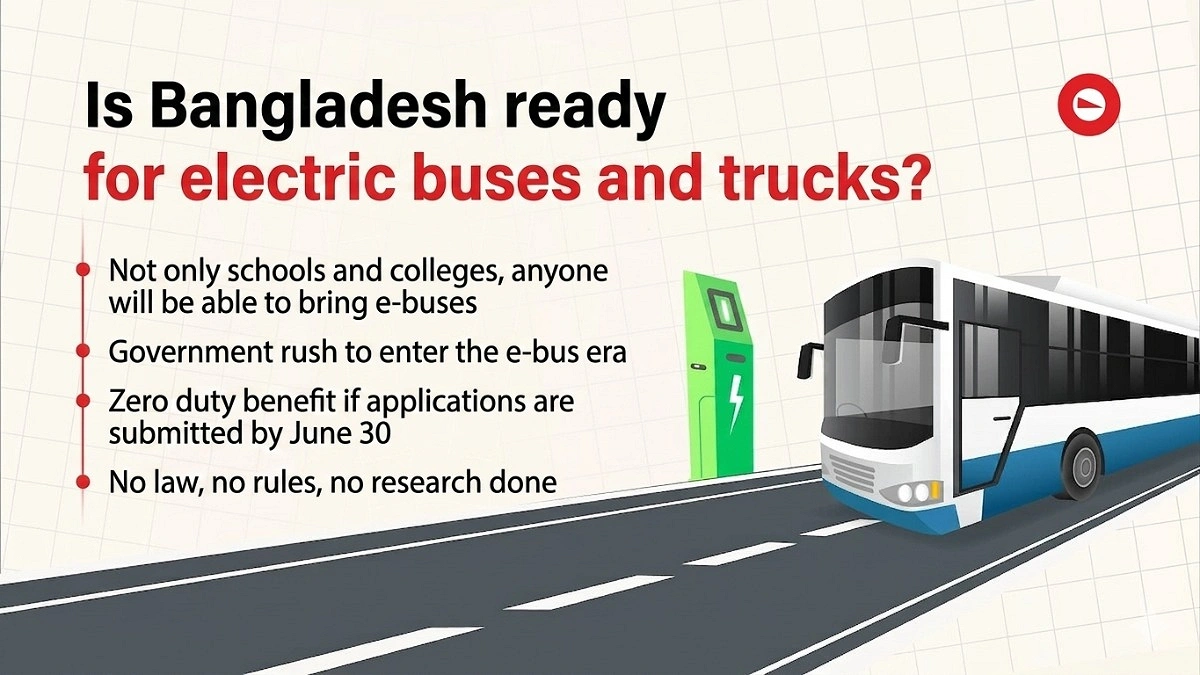
The government is moving quickly to enter the electric bus era. Those who apply by June 30 will receive zero-duty benefits. However, there is no law in place, no regulatory framework, and no supporting research. Infrastructure readiness also remains a major concern.
Questions have also been raised about technical feasibility. For example, even a small electric scooter requires three to four hours of charging and can run only 60 to 70 kilometers. While diesel imports for vehicles may be reduced, electricity generation itself still relies partly on fuel.
Although electric vehicles are being promoted as environment-friendly, concerns remain over battery disposal. With a lifespan of three to five years, experts warn that battery waste could create new forms of environmental pollution.
Electric buses will also run-on electricity, which in turn requires fuel-based generation. Questions remain about charging time for electric bus batteries and whether any proper studies have been conducted on operational feasibility. Critics say major decisions on imports are being taken without sufficient testing or analysis.
Transport expert Dr. Shamsul Haque offered a clear view on the issue. He said, “Entering the era of electric vehicles is a necessity of the time. It is not an option. We must move in that direction.”
On battery-related concerns, the BUET professor responded to questions highlighting the perceived limitations of electric vehicles, including pollution risks from batteries.
He said many of these issues are being resolved one by one with advancing technology. “New technologies are coming. Those raising these concerns are not keeping up with technological developments,” he said. He added that electric vehicles use plate-type solid-state batteries rather than liquid ones. “If they were not environmentally friendly, they would not be allowed in the market,” he said.
The professor further explained that EV batteries are not conventional box-type units and do not contain liquid materials inside. He noted that batteries are replaced through a swapping system, where the old battery is removed and replaced with a new one. He added that the responsibility for importing batteries lies with the importer. “There is nothing here that threatens the environment,” he said.
On infrastructure readiness, Dr. Shamsul Haque said charging systems must be developed nationwide. He explained that EV charging stations are different from CNG or petrol stations and would require customization or retrofitting of existing facilities. He said major infrastructure expansion is not necessarily required, but government incentives are essential, both for vehicle importers and for setting up charging stations.
When asked about manpower readiness, he said the country currently lacks trained personnel. “We have a century-old system. It cannot be changed overnight,” he said. He noted that electric vehicles require specialized maintenance systems beyond charging alone. Regular garages would not be sufficient; specialized workshops and trained engineers would be needed. He also stressed the need to expand parking facilities and gradually transition the large reconditioned vehicle market, ensuring support for stakeholders. “Everything must start in parallel. We need to be forward-looking,” he added.
In its latest Cabinet meeting, the government instructed relevant authorities to submit specific proposals on various issues. It also directed the preparation of plans for importing and installing charging stations for buses and trucks, and for making highways suitable for electric bus operations.
The National Board of Revenue has also been asked to consult with the Ministry of Industries, the Road Transport and Highways Division, and the Power Division, and submit coordinated proposals to the Cabinet for further consideration.
