
JSD, Workers Party Rebuild without Inu, Menon

Graphics: Agamir Somoy
In just a year, two of Bangladesh's best-known leftist parties, the Jatiya Samajtantrik Dal (JSD) and the Workers Party of Bangladesh, 3have undergone a dramatic political shift, moving from the center of power to the political margins. After spending nearly a decade and a half as key allies in the Awami League-led coalition, serving in the Cabinet and maintaining parliamentary representation, both parties are now searching for new organizational strategies to ensure their survival.
Their biggest challenge is not only that their top leaders are either imprisoned or in hiding. They also face the urgent task of building an effective alternative leadership after decades of relying on individual leaders. Political analysts say the crisis goes beyond leadership. It marks a difficult transition from coalition-based politics back to organizational politics.
Following the 2024 mass uprising, JSD President Hasanul Haq Inu was convicted in a crimes against humanity case. Workers Party President Rashed Khan Menon now faces multiple murder cases as well as proceedings before the International Crimes Tribunal. The two parties' general secretaries, Fazle Hossain Badsha and Shirin Akhter, remain in hiding. As a result, their central leadership has become largely ineffective.
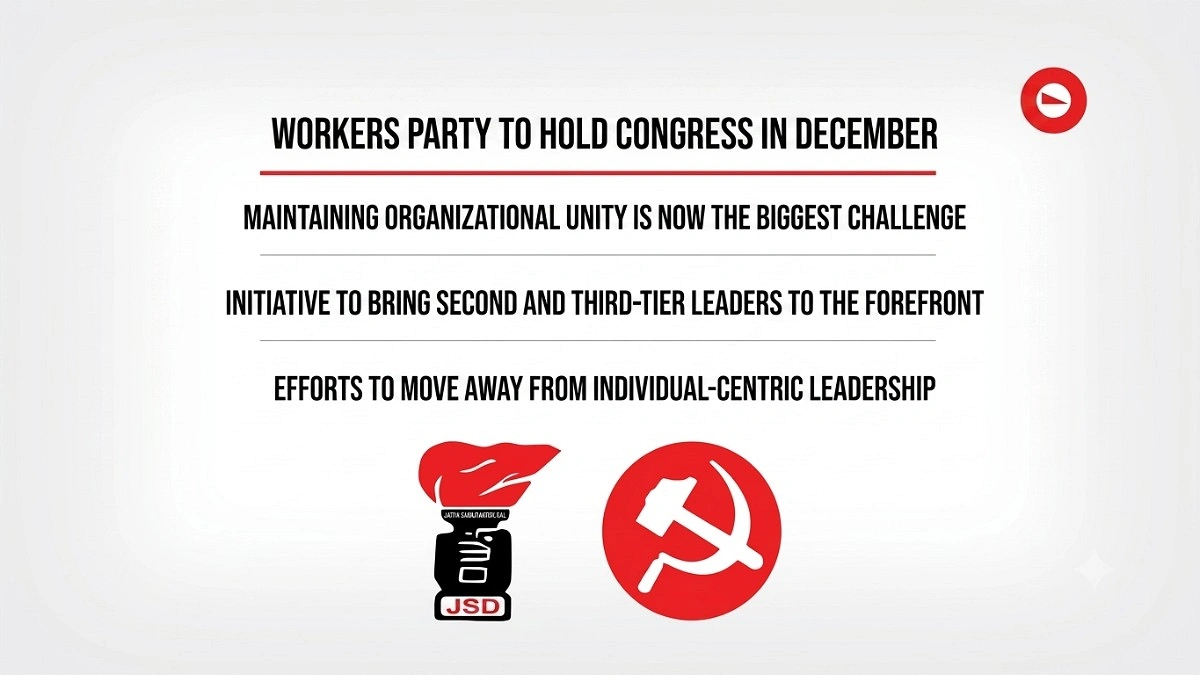
Against that backdrop, both parties have begun promoting second- and third-tier leaders while restructuring their organizations from the central leadership down to the grassroots. They have also started appointing acting leaders, expanding organizational tours, reviving inactive local units, and preparing to elect new leadership through party congresses.
The Limits of Personality-Driven Politics
For years, JSD and the Workers Party have been identified primarily with the leadership of Hasanul Haq Inu and Rashed Khan Menon. Although both parties advocate collective leadership in principle, their top leaders have dominated major political decisions, coalition strategy, and election planning in practice.
Political observers say that reality has now become a major challenge. The failure to cultivate alternative leaders has left both parties vulnerable to organizational paralysis following the absence of their top leadership. Leaders at different levels acknowledge the problem. They say there is little prospect that the senior leaders will return to active politics anytime soon, making it essential to shift from personality-driven leadership to stronger organizational structures.
From Coalition Politics to Organizational Crisis
Since the formation of the 14-party alliance in 2004, much of JSD's and the Workers Party's politics has revolved around their alliance with the Awami League. As members of the Grand Alliance, they secured parliamentary representation in the 2008, 2014, and 2018 elections and also served in government.
Critics argue that the prolonged focus on coalition politics weakened both parties' independent organizational growth and political identity. When power changed hands, those weaknesses became increasingly visible. Following the political transition in 2024, many local units became inactive, numerous leaders and activists went into hiding, and organizational communication deteriorated.
Another Test of Party Unity
JSD's history has largely been one of repeated internal divisions. Since its founding in 1972, the party has experienced a series of ideological and organizational splits. BASAD, ASM Abdur Rab's JSD, Shahjahan Siraj's faction, and Oikya JSD all emerged from successive divisions over the decades.
The Workers Party has followed a similar path. Formed from different strands of the communist movement after Bangladesh's independence, it has also gone through multiple splits before reaching its current form.
As a result, the current crisis is not limited to leadership. It is also a test of party unity. Party leaders fear that a prolonged absence of senior leaders could trigger fresh divisions.
A senior JSD leader said several groups inside and outside the party attempted to create new divisions after the fall of the Awami League government. Some even tried to seize control of the party headquarters, but party leaders and activists prevented those efforts.
Relying on the Grassroots
Leaders of both parties are now focusing on rebuilding their grassroots organizations.
JSD Office Secretary Sazzad Hossain said the party does not depend on any single leader. He noted that grassroots leaders kept the organization functioning during previous crises and said the party would once again rely on that experience.
Mostafa Alamgir Ratan, convener of the Workers Party's media department, said the party has already appointed acting leaders, expanded organizational visits across all 64 districts, and launched restructuring efforts. Acting General Secretary Nur Ahmed Bakul said the party has decided to hold its congress in December, when new leadership will be elected.
Which Path Lies Ahead?
The crisis facing JSD and the Workers Party extends beyond the future of two political organizations. It also represents a critical moment for Bangladesh's leftist politics. While their long-serving leaders remain entangled in legal and political challenges, the next generation has yet to establish a strong national profile. Whether the parties can successfully transition from personality-driven politics to institutional leadership remains the central question.
Dr. Kazi Muhammad Mahbubur Rahman, an associate professor in the Department of Political Science at the University of Dhaka, said the leftist and progressive parties in the 14-party alliance played significant intellectual and political roles during the Liberation War and in the decades that followed. However, he said their public support gradually declined, particularly after the fall of the Ershad regime. According to him, many people came to believe that these parties supported and enabled authoritarian rule after the Awami League returned to power in 2009, causing them to lose much of their public backing.
Rahman said the parties now have little meaningful public engagement and only limited organizational presence. With many senior leaders facing legal challenges, leaders who had long remained outside the top ranks are now trying to rebuild the organizations. He added that overcoming their shrinking support base and staging a political comeback will be extremely difficult.
The current crisis is not simply about a temporary leadership vacuum. It will determine whether JSD and the Workers Party remain personality-driven organizations or successfully rebuild themselves into institutional political parties suited to Bangladesh's new political landscape.
Both parties say they see the crisis as an opportunity to cultivate a new generation of leaders. Political observers, however, argue that the outcome of their organizational rebuilding efforts will determine the future of these two historic leftist parties.
