
Today is National Road Safety Day
Bangladesh ranks second in the world in road deaths

Graphics: Agamir Somoy
The bus had a destination and so did its passengers. Some were returning home while others may have been traveling for work. Suddenly, a head on collision with a truck on the Pabna Natore highway in Baraigram, Natore, brought everything to an abrupt end. Fourteen lives were lost forever and more than 20 people were injured. They were supposed to return to their loved ones, but not everyone made it home. This was the scene early Tuesday morning. As rescuers pulled the dead and injured from the mangled vehicles after the crash, the hopes of families waiting for their loved ones turned into grief one by one.
Such deaths on the roads are not merely statistics. They represent the loss of a family’s breadwinner, a child’s parent or a family’s future. Yet crashes continue to occur. Investigations are announced and promises of safety are made. Then more lives are lost on the roads. In terms of road deaths relative to population, Bangladesh ranks second in the world. In terms of the total number of deaths, it ranks sixth. These figures are from 2021.
Against this backdrop, National Road Safety Day is being observed today, October 22. The day has been observed through government and private sector initiatives since 2017. This year’s theme is “Safe Roads, Prosperous Country: Bangladesh First.” The latest report published by the World Health Organization (WHO) in 2023 clearly illustrates the state of road safety in the country. The Global Status Report on Road Safety presents a concerning picture of road safety in Bangladesh.
Scenes of grief caused by road crashes are an everyday occurrence in the country. In April last year, five members of the same family were killed in a collision between a bus and a microbus in Lohagara, Chattogram. Among them was 18 year old Tasnia Islam Prema. She also died after fighting for her life in the hospital. Another family had an eight year old girl named Aradhya who survived, but a road crash took both her parents.
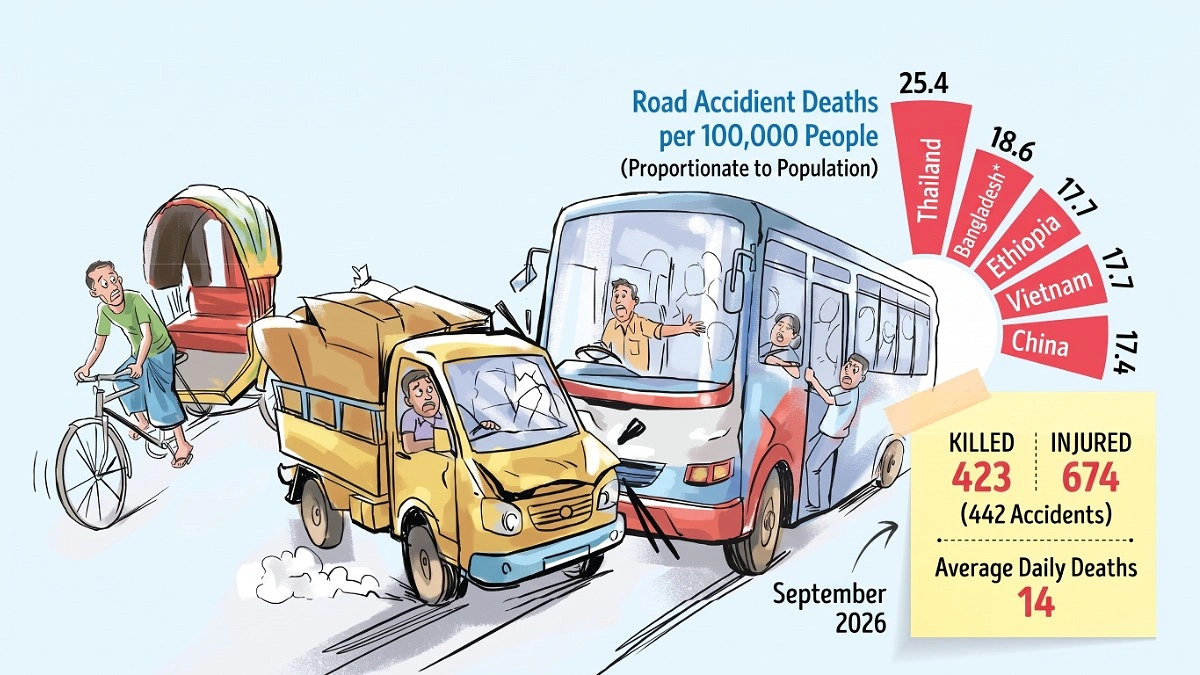
18.6 deaths per 100,000 people, with only Thailand ranking higher than Bangladesh
According to WHO estimates, approximately 31,578 people died in road crashes in Bangladesh in 2021. The death rate was 18.6 per 100,000 people. By this measure, only Thailand ranked above Bangladesh, with 25.4 deaths per 100,000 people. Ethiopia and Vietnam followed Bangladesh, both with a rate of 17.7 per 100,000 people. The rates were 17.4 in China, 17.2 in Nigeria, 15.7 in Brazil, 15.4 in India, 14.2 in the United States and 11.9 in Pakistan.
This comparison relative to population is important. A country with a larger population may have a higher total number of road deaths. However, the death rate per 100,000 people shows the burden of fatalities in relation to population size. By this measure, Bangladesh is one of the most dangerous countries in the world for road users.
However, the WHO estimate of 31,578 deaths is not the number of deaths recorded in Bangladesh’s official statistics. It is an estimate based on various data sources and modeling methods used by the organization. The same report states that official sources in Bangladesh reported 5,084 deaths in 2021. This substantial gap raises questions about data collection and calculation methods used to determine the actual number of road fatalities.
Bangladesh ranks sixth in total road deaths
According to WHO estimates for 2021, Bangladesh ranked sixth among the 10 countries with the highest numbers of road crash fatalities. China ranked first with 248,099 deaths, followed by India with 216,668. The United States ranked third with 47,750 deaths, Nigeria fourth with 36,722 and Brazil fifth with 33,586.
The estimated number of deaths in Bangladesh was 31,578. Pakistan followed with 27,568 deaths, Ethiopia with 21,258, Thailand with 18,218 and Vietnam with 17,229.
In other words, although populous countries such as China and India have higher total numbers of road deaths, Bangladesh’s position is more concerning when fatalities are measured relative to population. Both sets of figures indicate that road safety is a major public health crisis for Bangladesh.
Road deaths continue to rise
Recent domestic statistics also highlight the severity of the situation alongside international estimates. According to the Road Safety Foundation, 7,359 people were killed and 16,476 injured in 7,584 road crashes across the country in 2025. Among those killed were 1,008 children and 962 women. Motorcycle crashes accounted for 2,671 deaths, while 1,564 pedestrians were killed.
The situation showed no significant improvement in September this year. According to data from the Road Safety Foundation, 423 people were killed and 674 injured in 442 road crashes that month. This means an average of 14 people died every day. Among the fatalities were 139 motorcycle riders and 106 pedestrians.
Asked what the government was doing to reduce road crash deaths, State Minister for Road Transport and Bridges Habibur Rashid told Agamir Somoy, “We formed the government only eight months ago. We have already taken several initiatives. The Road Safety Act will be implemented by December 2027. The government has short term and long term plans to reduce road deaths by 50 percent by 2030.”
He said work was underway to ensure safer motor vehicles, improve drivers’ skills, make testing more rigorous, increase transparency at the Bangladesh Road Transport Authority (BRTA) and identify and eliminate dangerous road intersections.
If the government’s plans are implemented, road safety should improve. The main question, however, is how quickly these initiatives will produce tangible results. It will be difficult to achieve the announced targets without regular monitoring of unfit vehicles on the roads, driver qualification checks, speed limit enforcement and safety improvements at crash prone locations.
Crashes are not caused by driver errors alone
Excessive speed, dangerous overtaking, driver inexperience and fatigue, mechanical defects in vehicles, unfit vehicles, flawed road designs and weak law enforcement all contribute to road crash risks. On highways, the movement of slow moving vehicles alongside fast buses and trucks, the lack of safe crossing facilities and reckless driving in populated areas put pedestrians and passengers in smaller vehicles at even greater risk.
Professor Shamsul Hoque, director of the Accident Research Institute at Bangladesh University of Engineering and Technology, said excessive speed, uncontrolled movement of slow moving vehicles on highways, flawed road designs and weak law enforcement were major causes of crashes. In his view, reducing motorcycle crashes requires stronger regulation, appropriate infrastructure and facilities that allow pedestrians to travel safely.
Therefore, the problem cannot be solved simply by blaming drivers, filing cases or conducting awareness campaigns. Authorities must identify deficiencies in road design, speed control, traffic movement and monitoring on roads where similar crashes occur repeatedly. Measures to ensure drivers have valid licenses and proper training, vehicles meet fitness standards and drivers receive adequate rest while working within regulated hours are also essential.
Injambul Haque, general secretary of the Safe Roads Movement, believes that weak traffic management, gaps in law enforcement and the failure to give adequate priority to human safety in road planning are among the main reasons deaths from road crashes continue unabated.
He said, “Even when road crashes occur repeatedly at the same location or crashes of the same type recur, the root causes remain unidentified due to a lack of effective investigations. To stop the growing number of deaths, comprehensive investigations into crashes must be ensured and preventive measures must be taken based on the causes.”
Implementation and accountability are essential
Experts say several measures must be taken together to ensure road safety. These include effective speed control and monitoring on dangerous roads, removing unfit vehicles from service, providing quality training and licensing tests for drivers, establishing separate traffic arrangements for slow moving vehicles on highways and ensuring sidewalks and safe crossing facilities for pedestrians. In addition to identifying crash prone locations and correcting design flaws, authorities must improve rapid rescue operations and emergency medical services following crashes.
It is essential to use data from the police, BRTA and health authorities in a coordinated manner to determine the causes of crashes. Effective planning is impossible without regularly analyzing which roads, vehicle types and circumstances are associated with the highest numbers of deaths and identifying the people most at risk. Corrective measures must be taken based on investigation findings, and the agencies responsible must be held accountable for their work.
The theme of National Road Safety Day presents safe roads as a prerequisite for a prosperous country. However, a theme, a law or a plan alone cannot save lives. Lives are saved through effective implementation. According to WHO estimates, Bangladesh ranks second in the world in road deaths relative to population. Relevant stakeholders view this not merely as a position on an international ranking but also as a major warning about the country’s road management system.
A person who leaves home every day should not have to rely on luck to return safely. Providing that assurance is the real test of road safety.
