World No-Tobacco Day
Tobacco Entangles Rangpur Farmers

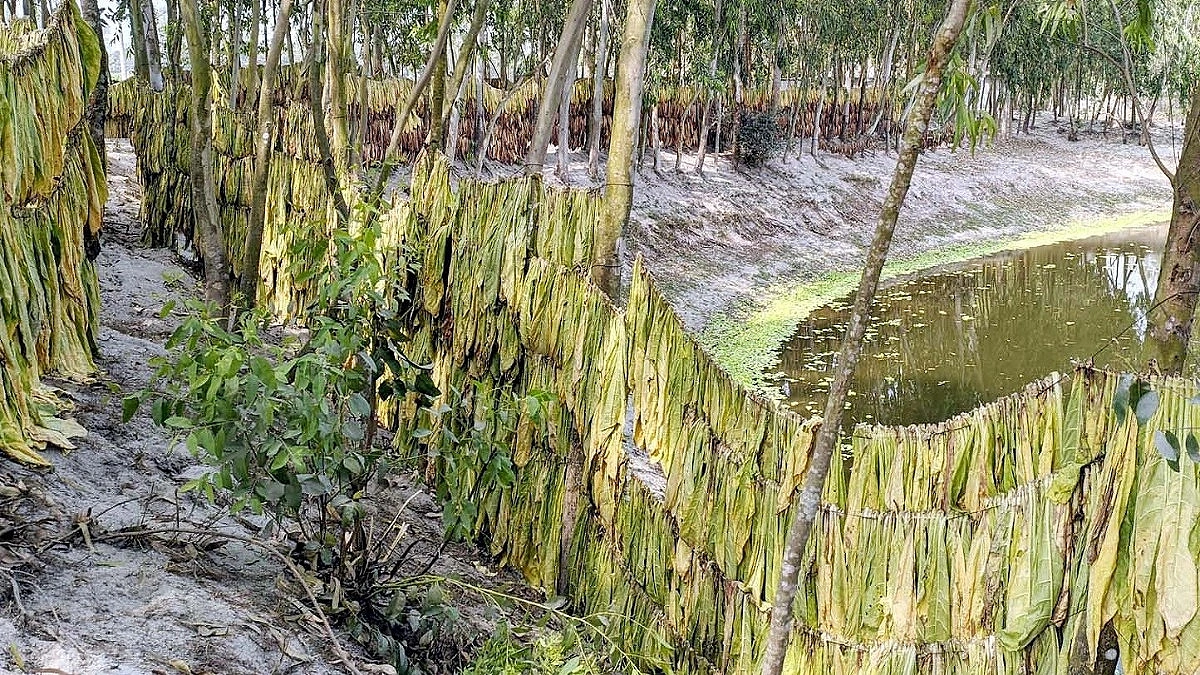
Photo: Agamir Somoy
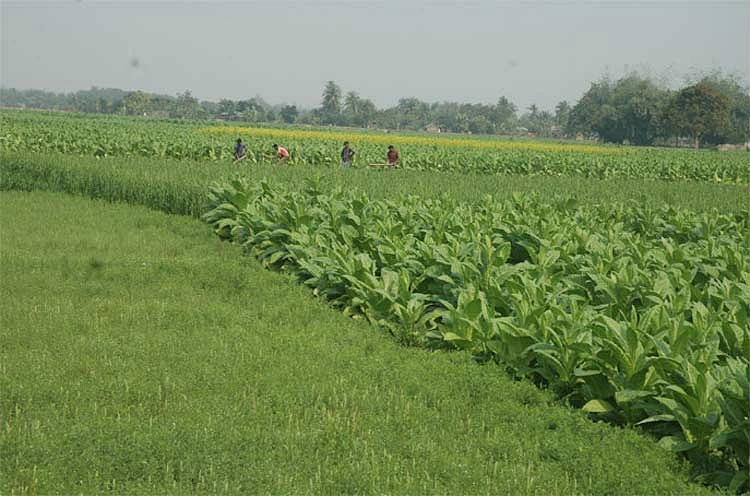
Today is May 31st, World No-Tobacco Day. Although the day is observed globally with various events, this harmful crop continues to haunt farmers in the Rangpur region. Once famous for tobacco, cultivation has not decreased in this area despite various government discouraging measures. While alternative crops like potatoes have been cultivated on over 50,000 hectares of land in Rangpur district this year, tobacco cultivation remains unaffected. The main reasons pulling farmers back to tobacco are complications in obtaining seeds for alternative crops, high production costs, lack of fair prices, and insufficient cold storage or preservation facilities. Additionally, advance loans offered by tobacco companies and their 100% purchase guarantee are further motivating farmers towards this harmful cultivation.
Investigation reveals that tobacco was once the main crop of the Rangpur region. The 'Virginia' variety of tobacco from this area was highly valued by major tobacco-related companies nationwide. Surrounding tobacco, traders in this region built a vast network across the country, where small-scale traders could do business without capital and earn substantial profits. Consequently, various tobacco-related enterprises, including bidi, cigarette, gul, and jarda, emerged in this region. Considering the needs of local farmers, a tobacco research center was established in Burirhat, Rangpur, according to a 1908 survey by the then British government. The institution collected 114 tobacco varieties from home and abroad and developed several new varieties, including two high-yielding ones named 'Surabhi' and 'Sugandhi'.
Later, considering the serious health risks and harmful aspects of tobacco, national and international initiatives were taken to stop its cultivation. As part of this, the Rangpur depot of 'Bangladesh Tobacco Company' (BTC), once a major tobacco buyer, was closed. The traditional tobacco research center was also renamed as the Agricultural Research Center. Since 1985, this institution has been conducting research on cultivating corn, sunflower, mustard, peanuts, and various vegetables as alternatives to tobacco, aiming to make farmers more profitable than with tobacco. Yet, despite all these efforts, tobacco production has not been reduced.
According to the Department of Agriculture, during the current Rabi season, tobacco has been cultivated on paper in Rangpur district on approximately three thousand hectares of land, although the actual amount is much higher. Among this, the highest amount — one thousand hectares — of tobacco cultivation has taken place in Gangachara Upazila alone. Additionally, extensive tobacco cultivation has also been done in Rangpur Sadar, Taraganj, Badarganj, and Kaunia Upazilas. The Department of Agriculture believes that because farmers have been cultivating it since the time of their forefathers, the techniques of tobacco production are at their fingertips. Seeds can be easily preserved at home, and unlike potatoes or other crops, there is no fear of rotting, so no additional cost is required for preservation. Moreover, compared to other crops, tobacco has a guaranteed price and good market availability.
Visiting various areas of Gangachara Upazila to see the real picture, it was observed that although the work of cutting tobacco from the fields is finished, the process of drying tobacco is still ongoing in courtyards or open spaces. Reaching the Mahipur ghat on the way to Kalagachhi, Shankardaha, and Ichli Char in Lakshmitari Union, local boatmen ask in their natural tone, 'Are you going to the tobacco char?' During the dry season, the vast sandy chars of the Teesta river indeed seem to turn into tobacco fields.
Hamid Mia, a tobacco farmer from Kalagachhi char, openly stated that tobacco cultivation is now their only hope for survival. They wait for this season all year round. Sadekul Islam from the same area highlighted the limitations of alternative cultivation, saying, 'Cultivating potatoes as an alternative crop requires a lot of money, which is difficult for small farmers like us to arrange. But if we cultivate tobacco, we can get advance loans from the companies.'
Inquiry reveals that under the supervision of various bidi factories' tobacco purchase and processing centers, farmers in Gangachara, including the Teesta riverine areas, are being encouraged in various ways to cultivate tobacco, as well as being provided with advance capital or loans. As a result, even knowing its harmfulness, trapped in the web of loans and hoping for assured profits, the farmers of Rangpur have been unable to break free from this tobacco circle for generations.