
Hatirjheel at night filled with risks

Graphics: Agamir Somoy
A darkened road. A faint light in the distance. Farther away, a streetlight. Suddenly, a pothole appears ahead. The brakes have to be applied.
Rainwater has collected in the pothole, shimmering in the moonlight. After moving a little farther, the vehicle hits an unmarked speed breaker. There are also potholes and uneven sections beside the speed breaker. Altogether, it feels like a nightmare at night.
This is not a description of a village dirt road or a regional highway. The scene unfolding before the eyes is that of Hatirjheel, one of Dhaka’s popular roads.
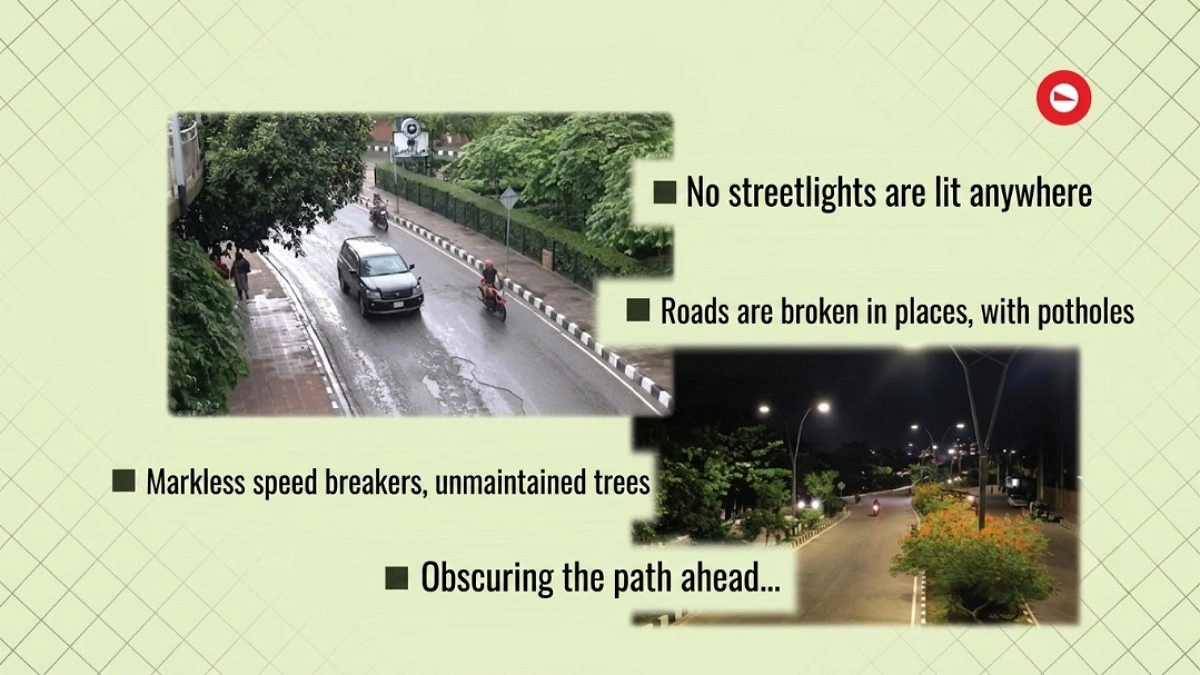
After crossing the Bangladesh Film Development Corporation, the Hatirjheel Road heads toward Gulshan. The road remains busy throughout the day. However, once evening falls, the risks seem to increase. Poor lighting, damaged asphalt and potholes of different sizes seem to test drivers. A moment of carelessness can lead to an accident.
There are relatively fewer potholes at the entrance to Hatirjheel from the Bangladesh Film Development Corporation. But as one moves farther along, the condition of the road gradually deteriorates. It seems there is a pothole every few steps. In some places, asphalt is rising around the bases of lamp posts. Even with caution, driving at night is difficult. Due to inadequate lighting, drivers cannot easily see these holes in the road.
The poor lighting is compounded by trees leaning over the road. When taking a turn, drivers cannot see vehicles approaching from the other side. As a result, a major accident could happen at any time.
New drivers face the most problems. The poor condition of Hatirjheel Road is nothing new. Regular commuters have therefore become somewhat accustomed to it. But for those unfamiliar with the road, it is a source of fear. They do not know where the damaged asphalt or potholes are. Yet a sudden jolt at any time can cause an accident. A vehicle can get stuck in a large pothole. The engine can also be damaged and the vehicle become inoperable after a hard impact.
Rafik Ahmed, a resident of Banasree, was riding a motorcycle. He told Agamir Somoy, “Those of us who travel this road regularly know where it is damaged. Even then, many times we fail to brake because the speed breakers have no markings. So, it is natural for an accident to occur due to a moment of carelessness by those who do not regularly use this road. Besides, whenever it rains, water accumulates in the potholes. It becomes even riskier at that time.”
The Hatirjheel project was opened to the public in 2013 after its construction was completed. The project was undertaken to provide special facilities to residents of Tejgaon, Gulshan, Badda, Rampura, Mouchak, Farmgate, Karwan Bazar and Moghbazar, as well as passengers traveling through the area. Reducing traffic congestion in the capital was also a priority.
The project, which cost Tk 1,971 crore, now appears to be in poor condition after nearly one and a half decades. There is also no regular maintenance.
Urban planner and architect Iqbal Habib led the design of the Hatirjheel project. Agamir Somoy asked him who should take responsibility for the situation and what could be done to resolve it. In response, he said, “The plight of Hatirjheel has been going on for a long time. Although the problems are visible, no initiative to resolve them can be seen. The responsibility lies with the city corporation. RAJUK planned the project to make it people friendly, but there has been no implementation. Therefore, the risks remain.”
Drivers complain that they face the greatest risk when going over the bridges on Hatirjheel Road. There are two bridges along the road. Both have lamp posts. However, the lights do not work. All the lamp posts on the first bridge are out of order. Only one light works on the second bridge. Together, the two bridges have just one functioning light.
As soon as vehicles enter the two bridges, darkness surrounds them. Ornamental trees have been planted on both sides. However, these trees are not properly maintained either. Their branches have grown and bent over the road.
When motorcyclists ride along the side of the road, the branches hit them. In many cases, the trees have obstructed the view of the road ahead of turns. There is already inadequate lighting, and trees are also leaning over the road. When taking a turn, drivers cannot see vehicles approaching from the other side. As a result, a major accident could happen at any time. There is also a risk of death.
Drivers and pedestrians say most of the speed breakers along the road have no visible markings. As a result, drivers cannot tell where the speed breakers are. They do not get enough time to brake in advance. Therefore, if vehicles maintain their speed, they can be involved in accidents.
Infrastructure expert and Bangladesh University of Engineering and Technology professor Moazzem Hossain believes, “During the rainy season, Hatirjheel turns into a danger zone. At the same time, repair initiatives do not work during this period. These should have been fixed several months earlier. And ensuring that there is adequate lighting is a regular responsibility of the city corporation.”
Several attempts were made to contact officials from the relevant department of Dhaka North City Corporation for comment on the matter. However, no response was received.
