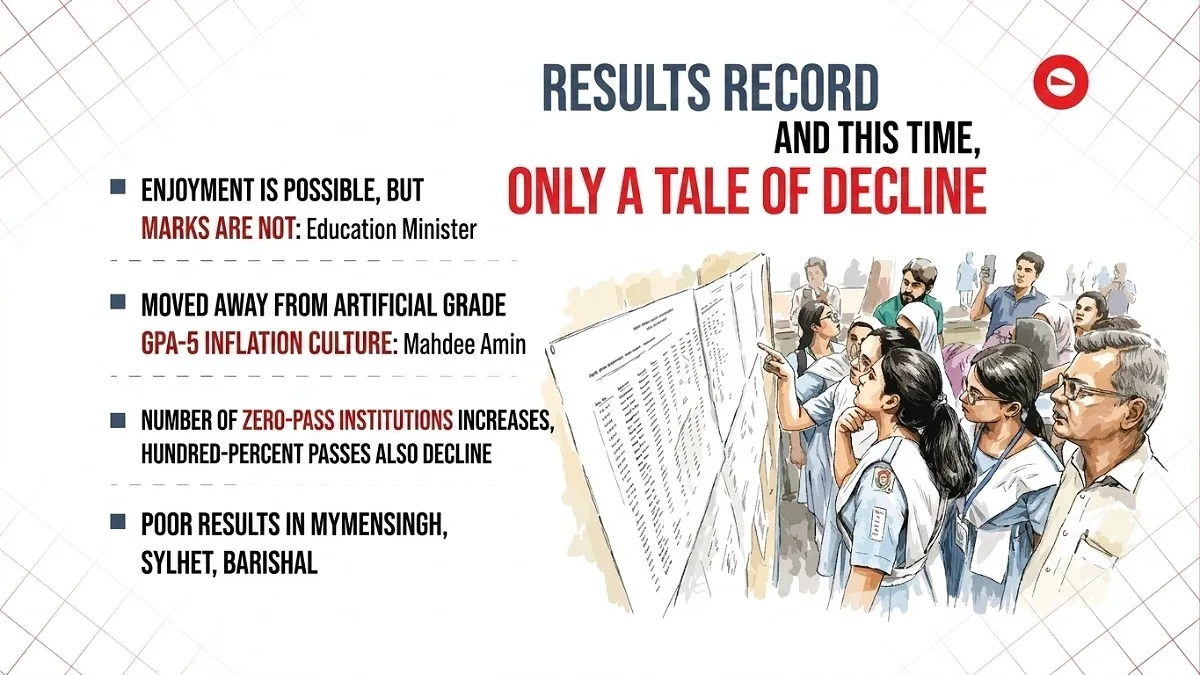
SSC results plunge as generous grading comes to an end
Weak performance in math and English pulls down overall results
New law influences answer script evaluation
CCTV cameras inside centers, body worn cameras outside
Nur Muhammad
শেয়ার করুন:
Graphics: Agamir Somoy
A single set of examination results appears to have suddenly
changed a familiar picture that had remained largely unchanged for nearly two
decades. Pass rates that once hovered around 80 to 90 percent and GPA 5 grades
that stood as the brightest symbol of academic success have both suffered a
sharp decline this year.
Across the 11 education boards, the SSC and equivalent
examination results show not only a lower pass rate but also fewer GPA 5
recipients and fewer institutions recording strong results. At the same time,
the number of institutions where not a single student passed has increased.
Weak performance in English and mathematics has also cast a long shadow over
the overall results.
Overall, the 2026 SSC and equivalent examination results
recorded the lowest pass rate in the past 19 years. According to education
board officials, several factors contributed to the decline, including a move
away from the long-standing practice of giving generous marks, stricter and
more careful evaluation, common question papers, a full syllabus, stronger
monitoring at examination centers, and inadequate student preparation.
On Monday, Professor Dr. Syed Akhtaruzzaman, president of
the Inter Education Board Coordination Committee, presented the overall results
at a press conference at the Secretariat. Earlier, the chairmen of all
education boards handed over copies of the results to Education Minister
Ehsanul Haque Milon. Prime Minister’s Education Adviser Mahdi Amin, Secretary
of the Secondary and Higher Education Division Abdul Khaleque and senior
ministry officials were also present.
A total of 1,829,485 candidates took the examinations under
the 11 education boards this year. Of them, 1,138,877 passed.
Pass rate falls 20.79 percent in three years
The statistics clearly show the depth of the decline. In
2024, the final SSC and equivalent examinations held under the Awami League
government had an average pass rate of 83.04 percent. In 2025, the rate fell to
68.45 percent. This year, it dropped further to 62.25 percent.
That means the average pass rate has fallen by 20.79 percent
in just three years. The decline was 6.20 percent in a single year.
The GPA 5 figures show a similar trend. In 2025, 139,032
students received GPA 5, while this year the number fell to 116,676. The number
of GPA 5 grades declined by 22,356 in one year, a drop of 16.08 percent. Over
three years, the number of GPA 5 grades fell by 65,453.
Institution based results also showed major changes. Last
year, 134 institutions had no students who passed. This year, the number rose
to 312. That means the number of institutions with a zero percent pass rate
increased by 178 in one year.
The change in answer script evaluation has emerged as the
most discussed factor behind the sharp decline in results. According to
education board officials, examiners moved away from the culture of giving
generous marks that had prevailed in previous years and adopted stricter and
more careful evaluation this year.
After taking office, Education Minister Ehsanul Haque Milon
visited various education boards and warned against irregularities. The law was
also amended to stop the practice of awarding excessive marks during answer
script evaluation.
Previously, if a student was dissatisfied with an answer
script, the opportunity was mainly limited to recounting the marks. Under the
new system, a student who challenges an answer script can have the entire
script reevaluated. If an independent committee finds negligence, mistakes or
discrimination by an examiner during the reevaluation, legal and disciplinary
action can be taken against the teacher concerned.
Education board officials believe the provision for
punishment has made examiners more cautious. As a result, instead of
artificially increasing marks, examiners have become much stricter in
evaluating answer scripts.
Professor Syed Akhtaruzzaman, coordinator of the Inter
Education Board and chairman of the Dhaka Education Board, told Agamir Somoy
that greater caution and various standards were followed in evaluating answer
scripts this year. In his words, rather than viewing the results as simply “bad
overall results,” it is more appropriate to say that the evaluation was
accurate. Student preparation, weaknesses in English and mathematics, teacher
quality and the overall educational environment all need to be considered when
analyzing the results.
Asked whether there had been any specific instruction to
make answer script evaluation stricter, Education Minister Ehsanul Haque Milon
said, “The evaluation was accurate; everyone received the results they
deserved.” According to him, there was neither generosity nor strictness toward
anyone in the results. Asked whether examiners had given marks freely this year
as they did in the past, the minister replied, “You can sing with an open
heart, but you cannot give marks with an open heart.”
Prime Minister’s Education Adviser Mahdi Amin claimed that
in previous years, GPA 5 grades and pass rates were deliberately and
artificially inflated. According to him, the system has now been completely
moved away from that culture. The goal now is to ensure that students graduate
with genuine qualifications, skills and creativity.
Weaknesses in English and math pull results down
English and mathematics have emerged as another major reason
behind the decline in the pass rate. While the average pass rate in other
subjects is above 90 percent, the pass rate in these two subjects remained
below 80 percent in most boards.
In the Dhaka Board, more than 97 percent of students passed
Bangla, while the pass rate was 78 percent in English and slightly above 82
percent in mathematics. In the Rajshahi Board, the pass rate was 74.70 percent
in English and 77.17 percent in mathematics. In Dinajpur, the rates were 72.91
percent in English and 71.05 percent in mathematics.
The situation was worse in Mymensingh. There, the pass rate
was 66.64 percent in English and 69.61 percent in mathematics. Students in the
Mymensingh, Sylhet and Barishal boards were comparatively weaker in the two
subjects.
Syed Akhtaruzzaman said students have feared mathematics and
English for decades. That fear has still not been completely overcome.
Worst result in 15 years for Madrasa Board
The biggest blow to the results came in the Madrasa
Education Board. Over the past 15 years, the board’s pass rate had never fallen
below 80 percent. This year, however, it stood at only 55.49 percent.
Institution based results were also concerning. This year,
226 institutions under the Madrasa Board had no students who passed. Last year,
the number was 86. The number of madrasa institutions with a zero percent pass
rate increased by 140 in one year.
Professor Khondkar Mohammad Sadekur Rahman, chairman of the
Madrasa Education Board, told Agamir Somoy that previously most madrasas had
the opportunity to hold examinations at their own centers. This year, for the
first time, students had to sit for examinations at centers other than their
own. He believes the sudden change in the examination environment may have
affected the results.
The subject wise results also clearly show weaknesses among
madrasa students. Pass rates in mathematics and English were comparatively low.
The average pass rate in the two subjects was 69.97 percent, while the English
pass rate was 79.21 percent.
Common questions reduce board based disparity
Another major change in this year’s SSC examinations was the
use of common question papers. After nearly 30 years, all education boards
conducted the examinations using the same question papers. The last time all
boards used the same question papers was in 2006.
Later, board specific question papers were introduced to
prevent question paper leaks. This created differences in results among boards
because of variations in the difficulty of the questions. Many believe that the
use of common question papers this year significantly reduced those
differences.
Among the general education boards, Dhaka recorded the
highest pass rate at 71.63 percent. It was followed by Rajshahi at 63.67
percent, Cumilla at 65.42 percent, Jashore at 66.27 percent, Chattogram at
59.48 percent, Barishal at 60.35 percent, Sylhet at 58.33 percent, Dinajpur at
58.05 percent and Mymensingh at 57.39 percent.
This means there are still differences in results among the
boards, but the gap is not as large as in previous years. Dhaka remained at the
top, while Mymensingh recorded the lowest rate.
CCTV reduces cheating and expulsions
This year’s examinations also introduced a new level of
monitoring. For the first time, CCTV cameras were made mandatory at all
examination centers. The examinations were monitored centrally through these
cameras. Police body worn cameras and a central monitoring cell were also used.
The measures affected the figures for malpractice and
expulsions. In the 2025 SSC examinations, 721 students were expelled. This
year, the number fell to 324. That means the number of expulsions declined by
397 in one year.
Professor Jesmin Taslima Banu, examination controller of the
Dhaka Education Board, told Agamir Somoy that making CCTV cameras mandatory at
all centers played an effective role in stopping cheating and other forms of
misconduct. Teachers serving as examiners and those responsible for examination
centers were also subject to a degree of monitoring. As a result, she said,
everyone received what they deserved, with no one being disadvantaged and no
one receiving an artificially inflated result.
Girls maintain their lead despite overall decline
Despite the sharp decline in the overall results, girls once
again maintained their strong performance. Their pass rate was 8.82 percentage
points higher than that of boys.
In 2025, the pass rate among boys was 65.88 percent,
compared with 71.03 percent among girls. This year, the pass rate among boys
fell to 57.86 percent, while the rate among girls dropped to 66.68 percent.
Although the overall results declined, girls continued to outperform boys.
According to education board officials, a poor result is not
the only explanation. Instead, this year’s results have brought renewed
attention to weaknesses in the education system, the reasons students continue
to struggle with English and mathematics, and gaps in teacher quality and
student preparation.
The next task will be to find answers to these questions and
identify the shortcomings. A decline in marks in an examination result is not
simply a calculation for one year. It has also provided a visible account of
long standing and often unseen weaknesses in the country’s secondary education
system.
Applications for result rechecking begin today
Students who did not receive their desired results or are
dissatisfied with their results can apply for rechecking. Online applications
can be submitted from today through August 17. The application process and
relevant instructions for rechecking will be announced through notices
published on the websites of the education boards.
Syed Akhtaruzzaman said admission to Class 11 will be based
on SSC and equivalent examination results and students’ preferences. He said
admission to Class 11 will be based on SSC and equivalent examination results
and the students’ preferences.
The education minister said admission will follow the old
system. In other words, admission will be based on marks and GPA.