
Houthis' attacks in Saudi Arabia instill fears among Bangladeshi expatriates

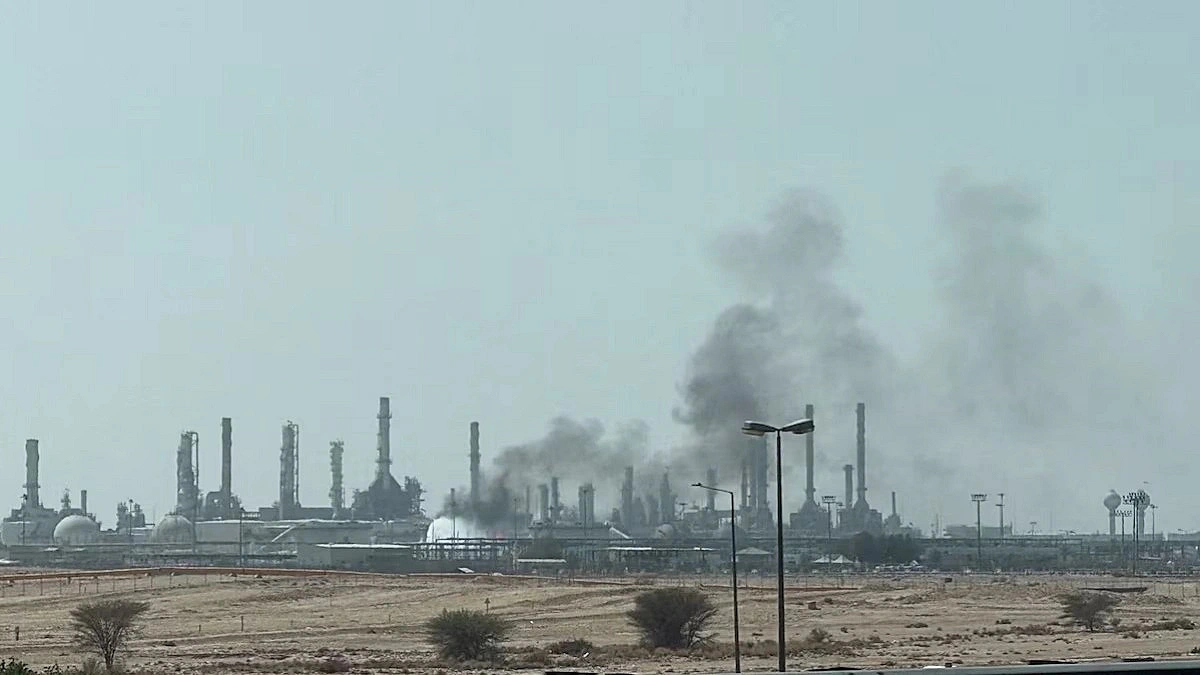
Smoke rises from a fire at an Aramco oil refinery south of Riyadh, Saudi Arabia, following a missile strike. The photo is from October 3. Photo: Reuters
The flames of war in the Middle East have now struck directly at King Khalid International Airport in Riyadh, the capital of Saudi Arabia. Three Saudi nationals were killed and several foreign nationals were injured in missile attacks claimed by the Houthis.
An aircraft operated by Saudi Arabia's state-owned airline, Saudia, was also damaged. The attacks on Saudi airports over two consecutive days have now left six people dead.
The strikes have disrupted air traffic, prompted retaliatory air raids in Yemen and led the European Union to warn of risks to Saudi airspace, adding a new dimension to the conflict. The attacks have raised questions about whether the war that began around Iran is pushing the entire Gulf region into deeper uncertainty and how far its economic and humanitarian consequences could extend to Bangladesh. Several Bangladeshi expatriates living in Saudi Arabia have already expressed concern about their safety.
Citing Saudi Arabia's civil aviation authority, Al Jazeera and the Associated Press (AP) reported that facilities at King Khalid International Airport in Riyadh and an aircraft operated by Saudia were attacked last Thursday, local time. Three Saudi nationals were killed, while several people from different countries were injured. The first strike targeted airport facilities, while the second hit a Saudia aircraft.
Agamir Somoy's correspondent in Saudi Arabia reported that Captain Hamoud bin Ali Al-Kalthami, a pilot with the country's flag carrier, Saudia, was among those killed. Saudia said there were no passengers aboard the damaged aircraft at the time of the attack. Although the strikes caused significant material damage, airport operations later resumed.
In a condolence message, Saudia said Captain Hamoud bin Ali Al-Kalthami's contributions throughout his career with the national airline would be remembered with deep respect and gratitude. The airline also paid tribute to the memories he had left with his colleagues.
The Houthis, an Iran-backed armed group based in Yemen, claimed responsibility for the attacks. The group said it had targeted Riyadh airport with missiles. However, the details of each stage of the attacks, the types of weapons used and the full extent of the damage could not be independently verified.
Geopolitical analysts say the significance of the incident extends beyond the loss of life and damage to infrastructure. An international airport is a critical hub for a country's transportation, trade, tourism and emergency services. An attack on such a facility can quickly extend the effects of a military conflict into people's daily lives and international travel networks.
Following the attack in Riyadh, the Saudi-led coalition launched airstrikes targeting Houthi positions in Yemen. Explosions were reported overnight in the Yemeni capital, Sanaa. A spokesperson for the health ministry under Houthi control claimed that at least six people, including children, were injured in several strikes. These claims could not all be independently verified.
According to an AP report, Houthi attacks have intensified following recent military operations by Saudi Arabia and its allies. This has created a cycle in which one side's attacks are followed by retaliation from the other.
A major concern is whether the conflict will remain confined to Saudi Arabia and Yemen. The wider war involving Iran, military activity across the Gulf and the security of vital maritime trade routes are now interconnected. Any new party entering the conflict directly could make the situation more complicated. At this stage, however, the conflict's future expansion remains uncertain.
Meanwhile, following the attack in Riyadh, the European Union Aviation Safety Agency (EASA) expanded its warnings regarding Saudi airspace. In conflict-related guidance issued on September 30 and subsequently updated, the agency said the geographic reach of Houthi missile and drone attacks had expanded. It also cited evidence of the Houthis' capability to strike targets inside Saudi Arabia, including Riyadh, as well as evidence of retaliatory attacks.
EASA's primary concern is the safety of civilian aircraft. The flight paths of missiles and drones, the operation of air defense systems to intercept them, and falling debris can all pose risks to passenger aircraft. The possibility of misidentification cannot be ruled out either.
The agency has therefore recommended avoiding aircraft operations in specific high-risk areas. For flights in other areas, it has advised operators to exercise caution, conduct regular risk assessments and maintain contingency plans. This is not a declaration that all Saudi airspace is closed; rather, it is a safety advisory concerning flight operations in areas considered dangerous.
The warning is significant because the effects of the war are no longer confined to military installations or border areas. Airports, energy infrastructure and commercial transportation networks are also facing growing risks.
What could be the impact on Bangladesh?
Bangladesh has condemned Houthi attacks on civilian infrastructure in Saudi Arabia, including airports, describing them as violations of international law and threats to regional stability.
In a statement posted on the Ministry of Foreign Affairs' Facebook page on Friday evening, Bangladesh said, “Bangladesh strongly condemns the recent Houthi attacks on civilian infrastructure, including airports, in Saudi Arabia. Such attacks violate international law and threaten the lives of innocent people and regional stability.”
If the conflict in Saudi Arabia continues, Bangladesh could face consequences in several areas, particularly the safety of expatriate workers. A large number of Bangladeshis are employed in Saudi Arabia. An increase in attacks near airports, energy facilities and other civilian infrastructure would raise concerns about their safety. Commuting to work, carrying out daily duties and arranging evacuations in emergencies could also become more difficult.
Moktar Hossain, a native of Ramganj in Lakshmipur who has been working in Riyadh for nearly 12 years, told Agamir Somoy that attacks in Riyadh and surrounding areas had increased in recent days. As a result, he said, not only Bangladeshi workers but also workers from almost every other country living in Saudi Arabia were feeling increasingly insecure. He added that a Bangladeshi citizen had previously been killed in an Iranian attack in Saudi Arabia.
Another expatriate, Faruk, said, “In the past, I never had to worry about these things when leaving home for work. But with the attacks happening as they are now, you never know what might happen. I am constantly afraid. We came here to earn a living, but if we are caught in an accident, our families back home will be left in serious trouble.”
Those concerned say it is therefore important to monitor the situation, follow instructions issued by the Bangladesh Embassy and keep emergency communication arrangements ready.
Another major risk for Bangladesh, according to those familiar with the issue, is instability in international energy markets. An escalation of the conflict in the Middle East could create uncertainty over oil and gas supplies and increase transportation costs, putting upward pressure on international prices.
The situation could become even more complicated if shipping through the Strait of Hormuz or the Red Sea and the Bab el-Mandeb Strait is disrupted.
