Trump says Iran talks begin Monday after halting strikes

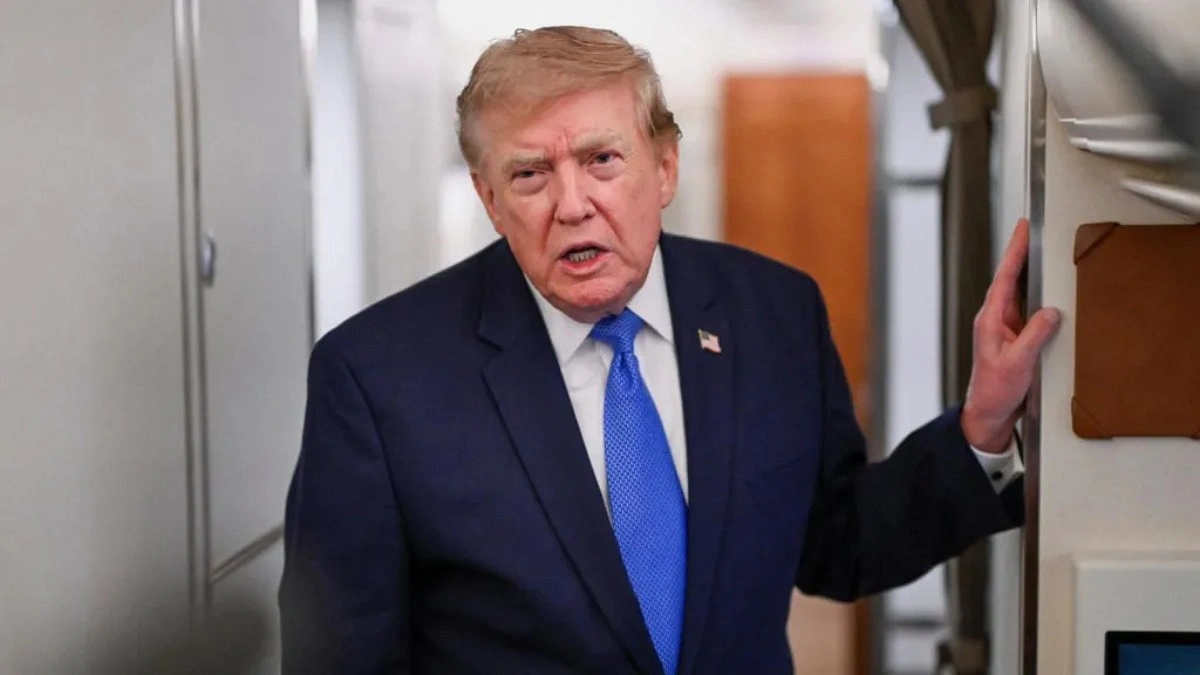
Photo: REUTERS
US President Donald Trump announced on Sunday that a fresh round of negotiations with Tehran would begin on Monday afternoon after he halted what he described as “massive” military strikes against Iran.
While speaking to journalists aboard Air Force One, Trump noted the visibility of the impending military action, saying, “They knew the extent of the attack because they saw it forming”.
He clarified the current status of the engagement by adding, “We’re talking to them in the form of a negotiation. It begins tomorrow afternoon.”
Trump had earlier shared on Truth Social that Iranian officials and Middle Eastern allies requested he “hold off” on the offensive because the “perimeters” of a potential agreement were already established.
Despite his optimism, Iran has not yet officially responded to these specific comments. This follows a pattern where Trump has frequently predicted a negotiated conclusion to the conflict, only for the two nations to resume reciprocal military strikes.
Trump avoided setting a specific timeline for the agreement during his remarks on the presidential aircraft. He explained his flexible stance by saying, “We’ll just see how it is. We’re ready to go anytime we want... I’m not looking to kill people.”
He revealed that Saudi Arabia’s Crown Prince Mohammed Bin Salman, alongside partners in the United Arab Emirates and Qatar, had specifically cautioned him against launching strikes over the weekend.
Trump emphasized the readiness of the US military before the stand-down, asserting, “We were all set to go.” He attributed the shift to the progress of the talks, remarking, “The reason they asked is [that] they think there’s a deal.”
He predicted positive outcomes for both regional and global concerns, saying, “There’s a deal on Hormuz, and there will be a deal on the nuclear.” Following this announcement, global energy markets reacted immediately as oil prices plummeted during Monday morning trading in Asia.
Brent Crude dropped 4.5 percent to settle at $83.98 (£62.26), and US-traded oil fell 4.6 percent to reach $80.74 (£59.85). These fluctuations reflect ongoing trader anxiety regarding the Strait of Hormuz, a critical maritime passage that facilitates the movement of around 20 percent of the world’s crude oil and liquefied natural gas (LNG).
Contradicting Trump’s narrative, Iran’s semi-official Mehr news agency dismissed the claim that Tehran requested a military pause, labeling Trump’s statements as “nothing but a new lie.”
However, Iranian Foreign Minister Abbas Araghchi offered a different tone regarding regional security, saying on Sunday that discussions with Oman concerning the Strait of Hormuz were “on track for finalisation,” according to Iranian media.
Despite the talk of imminent negotiations, Trump has not disclosed the location or the list of participants for the Monday sessions.
Trump characterized the aborted strikes as potentially historic in scale, claiming they would have been “the biggest attack since World War II” and could have destroyed the chances of ending the months-long conflict through diplomacy.
He chose not to clarify whether the targets included Iranian energy infrastructure, an action that international law experts warn might be classified as a war crime.
In response to the tension, Iran’s acting Defense Minister Majid Ibn al-Reza stated that Tehran views every adversary threat as “real and credible,” even those intended as psychological warfare.
He emphasized Iran’s preparedness by asserting, “We will neither be caught off guard nor remain passive.”
This shift represents the latest swing in Trump’s rhetoric, which has ranged from apocalyptic threats to sudden diplomatic overtures. On Saturday, he had warned on social media that the US was “locked and loaded and ready to go against the Islamic Republic of Iran, at levels of Military Terror, Strength, and Power not seen since World War II.”
He later tempered this by suggesting that calling off the attack would serve “for the future benefit of the world and, likewise, the survival of a successful and prosperous Iran.”
Previous escalations saw similar patterns; on 7 April, Trump warned that “a whole civilisation will die tonight” if Iran did not enter peace talks, while also threatening to strike power plants and civilian infrastructure.
That specific intimidation led to high-level, face-to-face discussions in Pakistan headed by Vice-President JD Vance, though those talks failed to produce a final deal.
Meanwhile, the Trump administration has largely ignored data indicating that the ongoing war and its economic repercussions are widely unpopular among the American public, including within the Republican party.
Conservative strategists are reportedly concerned, as polls showing broad dissatisfaction with the war’s management have sparked anxiety ahead of the upcoming November midterms.
Source: BBC (adapted)