
France deploys tear gas as school protests turn violent

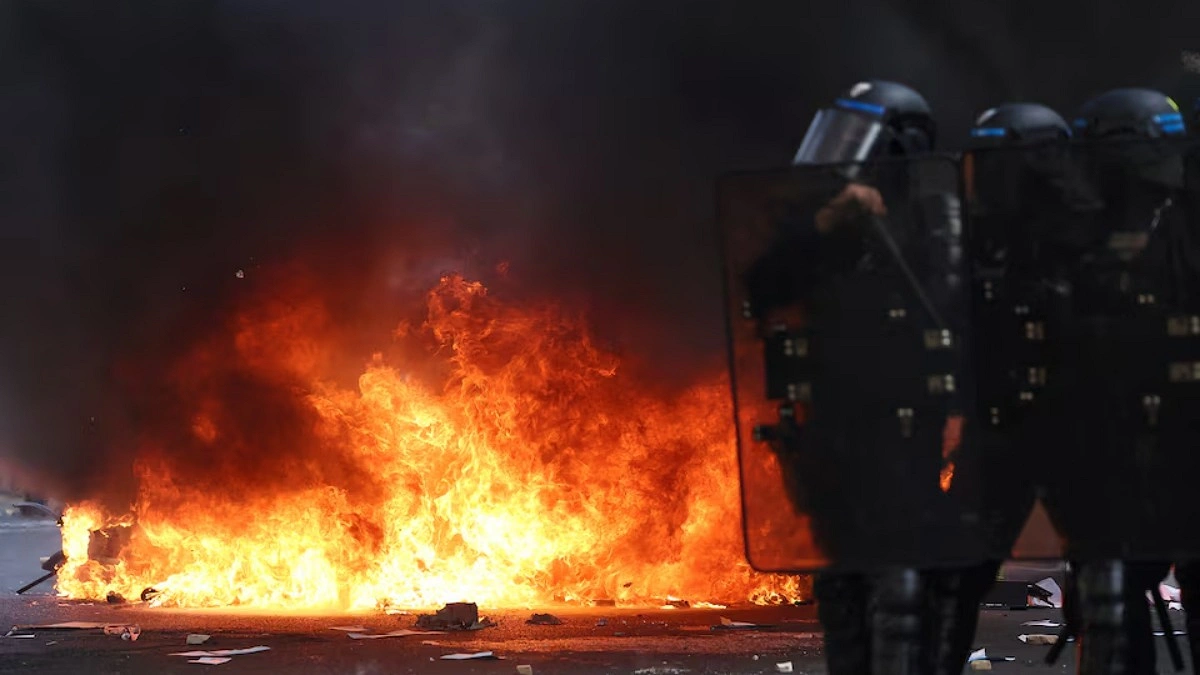
Photo: REUTERS
Teachers, parents, and high school students poured onto the streets across France on Tuesday in demonstrations, marking the largest day of action in nationwide student protests.
Prime Minister Sebastien Lecornu described the unrest as the most violent student demonstrations that the country has witnessed in decades. On the fringes of marches across Paris, Strasbourg, Rennes, Toulouse, and other cities, security forces deployed tear gas and water cannons to disperse the groups.
While organizers reported that 4,50,000 people joined the rallies, the Interior Ministry estimated that over 2,50,000 demonstrators gathered across dozens of cities.
The ongoing protests reflect escalating public anger across France, where support for far-right and far-left populist parties has surged ahead of next spring’s presidential election. A teenager suffered a severe injury on Monday, losing a hand during the demonstrations.
Meanwhile, weak economic growth has placed heavy pressure on the government to rein in public debt, and ministers have struggled to handle basic governance tasks like passing a budget ever since allies of President Emmanuel Macron lost their parliamentary majority in a 2024 vote.
Lecornu informed lawmakers that clashes have injured at least 215 teenagers and 85 school staff members, labeling the toll as “the heaviest toll in decades paid by the school system”. His office disclosed that the violence has injured more than 700 police officers.
Broadcaster BFM reported that Macron convened an emergency meeting on Tuesday with Lecornu and key senior ministers.
From the United States, President Donald Trump weighed in on Truth Social, claiming the unrest demonstrated “out of control” migration and posting, “This isn’t about schools, this is about Islam wanting to take over a once great Country.”
However, the actual demands of the students do not involve religion or immigration policy, focusing instead on understaffing and a critical lack of funding. Marine Le Pen’s far-right National Rally party has also refrained from linking the demonstrations to French migration policies, while Lecornu’s office offered no response when asked for comment.
Across various cities, demonstrators expressed their anger through direct action; parents in Toulouse locked arms at the front of a march through the city center, while protesters in Marseille and Nantes brandished handmade placards carrying slogans like “The state has killed national education”.
In Paris, security officials reported that clashes erupted when roughly 300 individuals, mostly masked or hooded, confronted security personnel, though authorities noted the broader rally proceeded without major incident elsewhere despite damage to several storefronts.
The Interior Ministry said law enforcement officers arrested 488 individuals and recorded injuries to 48 security personnel on Tuesday.
The student movement originally ignited in September within the economically disadvantaged suburbs of Paris before rapidly spreading across the nation. Demonstrating students are demanding immediate fixes for severe basic maintenance failures in their schools, ranging from persistent water leaks to widespread rat infestations.
Highlighting the disconnect, Hugo Vetzel, a recent high school graduate in Strasbourg, remarked, “There is such a gap between the elites and us.” The High School Students Union announced that blockade actions or closures affected over half of all high schools across France for the day, prompting some local education authorities to shift instruction to online classes.
Various civil rights groups, students, and parent associations have condemned government authorities for deploying disproportionate force against minors. Conversely, government officials assert that external agitators hijacked the protest movement, causing it to descend into urban violence in several regions.
On Monday, the Justice Ministry disclosed that prosecutors are pursuing cases against more than 1,800 people for unspecified offenses, including 1,483 minors.
Omar Slaouti, a high school teacher in the northwestern Paris suburb of Argenteuil, criticized the administration’s tactics, saying, “They want to divide the young people into good and bad protesters. If there were no trash cans on fire, the government would not have stepped back and become aware of the issues at stake.”
In response to the growing chaos, Lecornu directed his cabinet ministers to address the core demands raised by the students. These priorities include establishing reliable arrangements to replace absent teachers, re-evaluating the traditional 8 am to 6 pm school schedule, expanding lunch break durations, and funding urgent building repairs for aging school infrastructure.
Lecornu set a firm deadline, instructing ministers to submit their initial reform proposals by the end of October. Nevertheless, parents remain skeptical; speaking outside the Helene Boucher school in Paris, parent Emilie Lhomme dismissed the official promises, adding, “That’s all fine and dandy, but that’s not what’s going to change the daily lives of our children.”
Securing the financial resources required for educational improvements presents a daunting challenge for France, as ministers struggle to shrink an expanding budget deficit amidst elevated borrowing costs, sluggish economic growth, and persistent investor anxieties over government spending.
Benchmark 10-year French bond yields spiked to a 24-year high exceeding 5 percent last week. This dramatic rise in borrowing expenses has begun destabilizing the wider euro zone, triggering new anxieties among policymakers as the euro currency continues to weaken.
Despite the market strain, Finance Minister Roland Lescure asserted on Tuesday that the situation does not require intervention from the European Central Bank.
Meanwhile, far-right populist Marine Le Pen, who currently leads the presidential polling ahead of next spring’s election, outlined plans to drastically cut public spending in an effort to establish fiscal credibility amidst the worsening bond market crisis.
Official data from the PISA 2025 assessment reveals that French education spending has consistently lagged behind inflation, leaving French students trailing behind their international peers across OECD countries in overall academic performance.
Source: Reuters (adapted)
