
Workers across Spain stage first general strike in 14 years as anger rages over housing

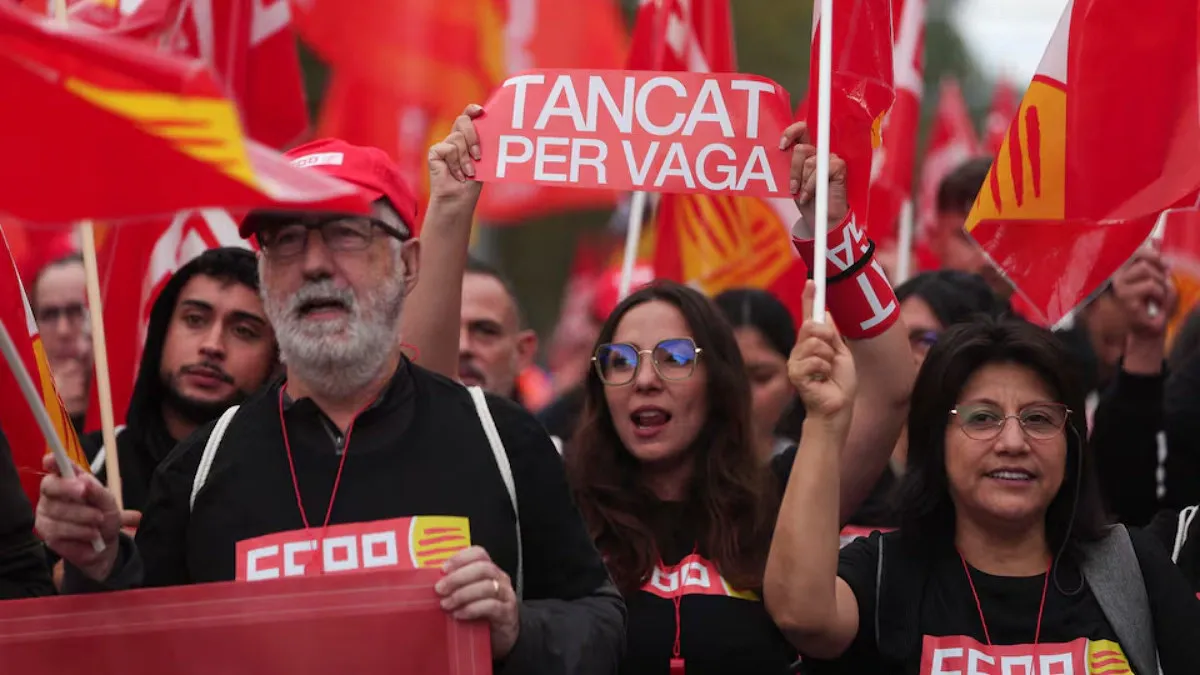
A protestor holds a sign that reads 'closed due to strike' as people protest during a 24-hour nationwide general strike, held to demand wages that allow access to decent housing, in Barcelona, Spain, November 11, 2026. REUTERS.
Spanish workers went on a general strike on Wednesday, enduring stormy weather to set up picket lines in a mass protest against the country's housing affordability crisis less than three weeks before a snap general election.
It is the first general strike in 14 years to be jointly backed by Spain's two largest unions, UGT and CCOO, as well as other labour organisations and tenants' associations angry about rising rents and evictions.
Prime Minister Pedro Sanchez hopes to harness voter resentment over housing in the November 29 election to shift the political narrative away from a series of corruption cases involving his inner circle and a deadly train crash last month. So far, his Socialist Party still trails in opinion polls.
Unions said participation in the strike was uneven across Spain, with the strongest support in coastal regions including the Cantabrian coast, Catalonia, Andalusia and parts of the Mediterranean, where housing pressures have been particularly acute.
Spain has a deficit of about 750,000 homes, which is set to grow to more than a million by 2028, according to the central bank.
With fewer people able to afford a home, renting has increased sharply, putting pressure on that market. The average rental price of €1,176 ($1,315) is equivalent to about 98.7% of a young person's average monthly salary in Spain, according to the Youth Council of Spain.
"I’m 36 years old and I still can’t move out on my own," said Madrid resident Jesus Gonzalez, 36, who works in a hospital IT department. "Rents just keep going up, house prices just keep going up, and it’s simply impossible."
EARLY TURNOUT STRONGEST AT PORTS, AUTO PLANTS
Angela de Miguel, vice president of Spain's main business lobby CEOE, said the strike was counterproductive because small businesses were also affected by the housing crisis, since shortages of homes made recruitment more challenging.
Speaking on state broadcaster TVE, she said the solution was to build more homes and to lower taxes in construction and the home-buying process, which she said had helped increase the final price of buying a new home by 40% in the past decade.
Plans for massive protest marches in the afternoon were threatened by two storms, dubbed Charles and Bruna, that led weather agency AEMET to issue alerts for 14 regions over strong winds, rough seas and heavy rains.
According to UGT and CCOO, early participation in the strike reached 90% at ports and in the automotive sector, with "total stoppages" reported at factories including Volkswagen's in Navarre and SEAT's in Barcelona.
The unions also put early turnout at 85% in the meat industry, 82% in waste collection and 75% in the energy sector. They said participation was lower in healthcare and social services, at 38%, and at 35% in the postal service.
They pointed to a 10% drop in electricity demand as an indication of disruption across energy-intensive industries, saying much of the petrochemical, steel-processing, food-processing and transport sectors had halted activity apart from operations covered by minimum service requirements.
Tensions flared at the start of the strike at Madrid's Mercamadrid wholesale market, where about 1,000 protesters gathered. CCOO's Madrid branch said on X that police fired pepper spray at pickets and arrested one of them, with 13 people requiring medical attention.
A police spokesperson confirmed the arrest but not the use of pepper spray, although he said it was used to disperse a separate picket line in the Carabanchel district.
Dozens of protesters attempted to prevent buses leaving Madrid's municipal bus depot early on Wednesday, waving flags and chanting slogans such as "while you work, they are stealing from you" and "you're either with the capitalists or the working class."
In the southern region of Andalusia, television station Canal Sur Television joined the protest by going black during the transmission of a morning news bulletin.
ELECTION GAMBLE
The strike follows weeks of demonstrations and encampments provoked by the eviction and subsequent death of an 87-year-old woman in Madrid.
Those protests, along with parliament's rejection last month of government decrees aimed at curbing evictions and limiting rent pressures, prompted Sanchez to call the snap election.
The government has largely blamed the right-wing opposition running many regions and municipalities for rising rents and insufficient housing supply.
But union leaders and many of the protesters have said they also hold the central government responsible for the housing crisis, as well as for Spain's second fatal train crash this year.
