
A territory where no one will live!
Not the border, but the map of life is changing
- Fear grows over Israel’s ‘uninhabitable zone’ in Southern Lebanon
- Talks on withdrawal in Rome, while controlled explosions continue on the ground; Israel claims 24 villages have been destroyed, 68,000 homes damaged or made uninhabitable

Collected Photo
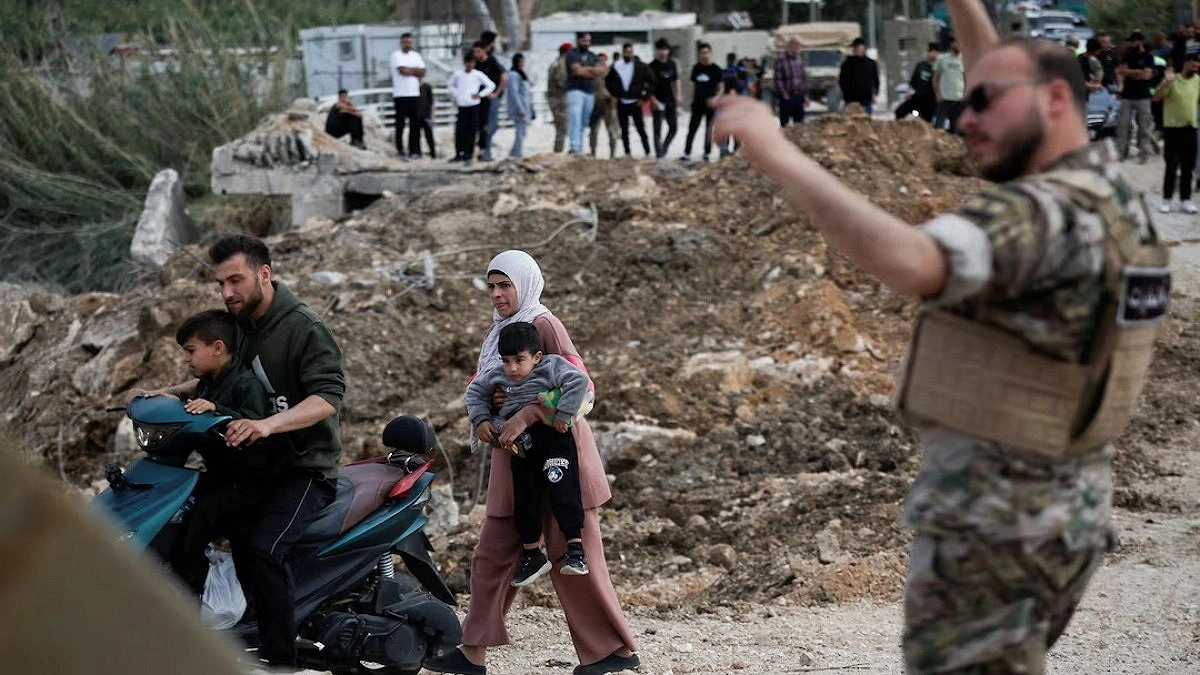
While Lebanese and Israeli representatives are looking for ways to resolve the border dispute and find a path toward the withdrawal of Israeli forces from southern Lebanon in Rome, the picture on the ground is exactly the opposite. Homes, farmland, roads and public infrastructure are collapsing one after another in explosions. For many residents of southern Lebanon, the question is no longer only when Israel will withdraw, but whether anything will remain for them to return to at all.
According to an analysis published by Arab News on Tuesday, a security zone four to 10 kilometers deep has been created inside Israel’s declared ‘Yellow Line.’ Although the area lies within Lebanese territory, access for civilians there is almost completely blocked. According to Lebanon, the area under Israeli control has increased from about 590 square kilometers after the ceasefire to 650 square kilometers.
‘A zone where people cannot live’
Ahmad Baydoun, a researcher at Delft University of Technology in the Netherlands and an open source investigator, told Arab News on August 4 that regardless of the legal position or the wording of any agreement on withdrawal, the reality on the ground is that a territory has been created where people cannot live. In his words, even if the shelling stops, this destruction will not return to its previous state on its own.
Kim Ghattas, a Financial Times columnist and author of Black Wave, recently said during a discussion with Ian Bremmer of GZERO Media that in southern Lebanon, it is not only airstrikes or artillery fire, but explosives are being deliberately planted to completely blow up entire villages. According to her, although the justification is the destruction of Hezbollah’s infrastructure, the result is a buffer zone that has become uninhabitable.
Israeli Defense Minister Israel Katz recently claimed that the military had destroyed 24 villages in southern Lebanon because they were being used as Hezbollah bases. However, Lebanese residents and human rights analysts are questioning whether wiping out entire villages, farmland and civilian infrastructure in the name of destroying military installations goes beyond the limits of necessary and proportionate military action.
Buying images to find their villages
Many displaced families are now purchasing commercial satellite images to see what remains of their villages. Tarek Mazrani, head of an organization representing residents of border areas, told Arab News that they can now learn what remains in their villages only through images. He alleged that this is not ordinary wartime damage, but rather an attempt to erase villages, history and people’s ties to their land.
Government agencies also have no opportunity to fully assess the damage. To enter areas under Israeli control, advance permission must be sought through a US, Lebanese and Israeli coordination mechanism, including names, photographs and vehicle information. Apart from UNIFIL patrols and limited humanitarian convoys, regular access is almost nonexistent.
68,000 homes destroyed or made uninhabitable
According to preliminary Lebanese estimates, around 68,000 residential units have been completely destroyed or rendered uninhabitable. Some villages have effectively disappeared beneath the rubble. During the broader phase of the war, more than 1.2 million people were displaced. Although many have returned, homes, shops, schools, health centers, water systems and electricity infrastructure remain damaged.
UNIFIL spokesperson Candice Ardiel said at a United Nations briefing in Geneva on July 8 that although violence has decreased, violations of United Nations Security Council Resolution 1701 are being documented every day. She said many people who returned found their homes, hospitals, schools and basic infrastructure destroyed, while some villages near the border remain inaccessible for return.
UNIFIL has also made clear that Israel’s declared ‘Yellow Line’ is not a United Nations recognized border. The only relevant dividing line recognized by the United Nations is the ‘Blue Line.’ Israeli presence north of it constitutes a violation of Resolution 1701.
Long term damage to farmland
The economy of southern Lebanon’s border areas is largely agriculture based. But olive groves, tobacco fields, orchards and farmland have been damaged by explosions, fires, bulldozers and chemical contamination. Lebanese officials fear that some land could remain unsuitable for cultivation for a long time.
Even if residents return, economic recovery has not begun. Small businesses cannot reopen, farmers cannot access their land, and many families who have exhausted their savings while displaced are now surviving on money sent by relatives abroad or by selling personal assets. A study by the Arab Center for Research and Policy Studies titled The Suspended Return says that physically returning does not mean returning to normal life.
Israel’s argument: the Hezbollah threat
Israel claims that Hezbollah has spent years building tunnels, weapons depots and military infrastructure in southern Lebanon to launch attacks against Israeli territory. At the end of July, the Israeli military said it had destroyed a major tunnel network in the Beaufort Ridge area. Israeli sources claim that about 700 tons of explosives were used to destroy Hezbollah’s command and attack infrastructure.
Israel has also said that its security cannot be guaranteed until Hezbollah is disarmed. The framework agreement signed on June 26 under US mediation calls for the disarmament of Hezbollah, a phased Israeli withdrawal and the deployment of the Lebanese army. However, Hezbollah is not a signatory to the agreement and has refused to give up its weapons.
Hopes for ‘pilot zones,’ but reality is difficult
Under US mediation, ‘pilot zones’ have been launched in several areas, including Zawtar al Gharbiyeh. According to the plan, Lebanese forces will take control after Israeli troops withdraw and residents will return. But the first test has shown that the houses are uninhabitable, Israeli troops remain nearby and there is no money for reconstruction.
Mahasen Faqih and her husband, who returned to Zawtar al Gharbiyeh, have taken shelter in a shop because they cannot live in their destroyed home. Mahasen told the Associated Press that there is ‘not even one percent’ sense of security there. So far, only a handful of families have returned to the area.
Talks in Rome, explosions on the ground
A new round of US mediated talks was scheduled to begin in Rome on August 4. The talks include the border dispute, Israeli withdrawal, Hezbollah’s weapons and the expansion of ‘pilot zones.’ But just before the meeting, Israeli forces carried out extensive explosions in an area near Beaufort Castle. Tremors resembling an earthquake were felt as far away as Deir Mimas and Nabatieh.
Lebanese President Joseph Aoun and other leaders have alleged that the destruction is contrary to the spirit of the ceasefire and the environment for negotiations. They fear that although there may be commitments on withdrawal in the talks, Israel is creating a reality on the ground that could later be established as a permanent security zone.
Temporary security zone or permanent depopulated area?
Israel says its operations are aimed at eliminating Hezbollah’s military threat. Lebanon says that erasing entire villages and preventing civilians from returning creates a risk of permanently altering the arrangement of the land and population, going beyond the limits of self defense. UNIFIL has also stated that Israeli presence north of the Blue Line is not internationally recognized.
Amid this conflict, displaced civilians are paying the highest price. They now face three uncertainties: when Israel will withdraw, where the money for reconstruction will come from, and whether it will actually be possible to live there even if they return.
The talks in Rome may involve negotiations over border lines, the stages of withdrawal and the accounting of weapons. But a more fundamental question remains amid the rubble of southern Lebanon: Can a territory from which people have been removed and where their homes, land and livelihood infrastructure have been destroyed really be called a ‘security zone,’ or is it simply another name for creating a permanent depopulated area?
