Suspected Ukrainian sea drone strike hits Russian navy ship in Libya

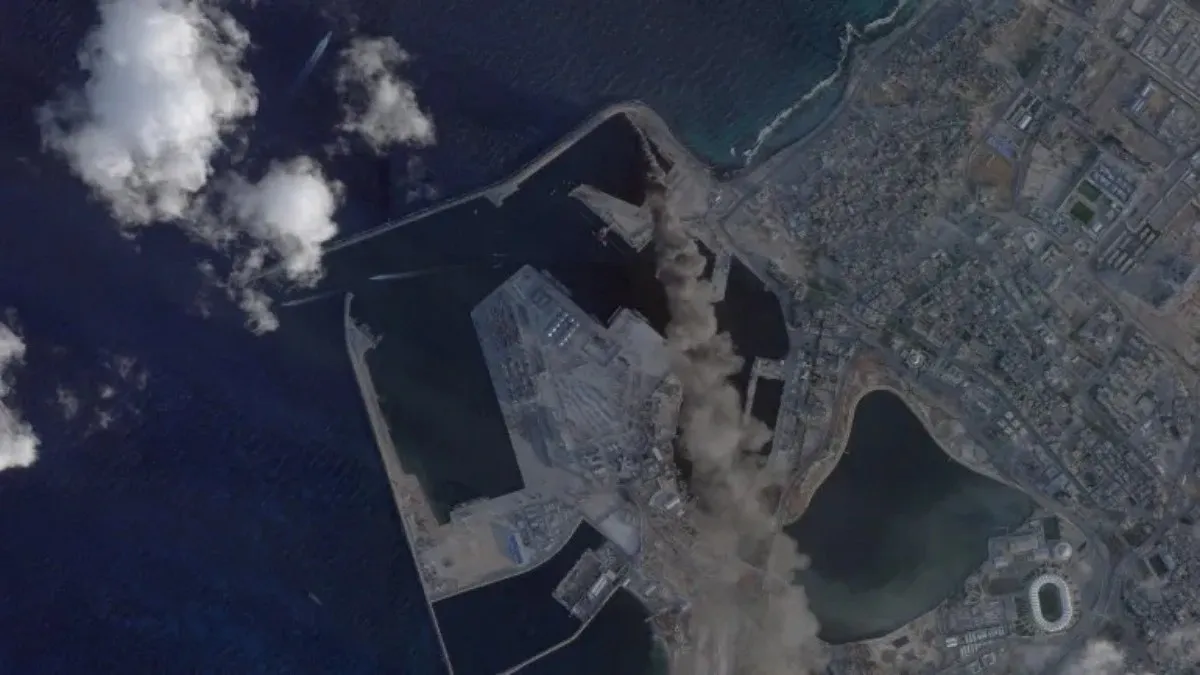
Photo: REUTERS
A suspected sea drone attack struck a Russian Navy vessel docked at the civil sea port of Benghazi in eastern Libya at dawn, triggering a massive explosion and a brief fire.
The North African nation’s eastern-based administration confirmed the incident, while local sources said on Sunday the strike killed an unspecified number of Libyan and Russian nationals. The vessel had moored near a naval base while carrying a cargo of weapons, ammunition, and military drones.
Locals reported seeing three drones target the warship during the early morning raid.
Satellite imagery provider Vantor identified the targeted vessel as the Merkury, a Russian Navy corvette or small warship. Satellite photos revealed that the warship had largely capsized and sunk into the harbor waters, leaving only its bow visible above the surface.
Thick smoke continued to rise from the ship’s damaged superstructure, while extensive debris lay scattered along the pier. Prior to the attack, the Benghazi-based government said the warship had docked at the civil port to refuel and take on supplies under a bilateral cooperation agreement between Russia and Libya’s eastern government.
The Associated Press (AP) news agency cited unnamed sources late Sunday reporting that forces launched several Ukrainian sea drones against the vessel from a military base operated by Ukrainian personnel in western Libya.
In a separate incident on Sunday evening, another sea drone hit a Malta-flagged commercial ship off the Benghazi coast. The Health Ministry of the Benghazi-based administration reported that rescue teams successfully saved all crew members “who were injured when a merchant vessel was targeted this evening by explosives-laden sea drones off the coast of Benghazi” and provided medical treatment.
Moreover, the Almasar satellite television channel reported that Libyan naval and air forces intercepted and destroyed at least 12 other sea drones off the coast of the Mediterranean city.
Following the assault, the Benghazi-based administration initiated a joint investigation alongside Russia to “uncover the circumstances of the attack, its source, and the party behind it.” Authorities confirmed that emergency crews brought the fire under control and secured the port site. However, the eastern government strongly condemned the strike as a violation of Libya’s national sovereignty and a threat to international maritime safety.
Emphasizing neutrality, the government declared, “The Libyan government will not allow Libyan ports, territory or territorial waters to be turned into an arena for settling scores or exporting international conflicts,” while affirming that Libya is “not a party to the Russian-Ukrainian war.”
This Mediterranean naval strike highlights the expanding global footprint of Russia’s war against Ukraine, which began with Moscow’s full-scale invasion in February 2022. Since the invasion started, Ukrainian forces have consistently deployed naval drones and missiles to assault Russian warships and naval installations across the Black Sea.
However, recent actions demonstrate that the conflict is spreading beyond the Black Sea region. On Saturday, a drone struck a Russian cargo ship navigating the eastern Baltic Sea near Finnish waters, an attack that Finland’s border guard attributed directly to Ukraine.
Previous maritime incidents also link Ukrainian military actions to Russian shipping in distant international waters. In March, a Russian liquefied natural gas (LNG) carrier sank off the coast of Libya following an offshore attack that Russian President Vladimir Putin explicitly blamed on Ukraine.
In December of last year, Ukrainian authorities publicly acknowledged using aerial drones to strike a Russian-linked oil tanker operating in the Mediterranean Sea.
Analyzing the attack, Tallha Abdulrazaq, a Middle East security and defense expert, told Al Jazeera that Ukrainian intelligence services almost certainly orchestrated the strike inside the Libyan port.
Abdulrazaq highlighted earlier intelligence reports, saying, “There was a lot of reporting on the tail end of last year about there being a deal between the Ukrainian intelligence services and the Tripolitan government to establish a Ukrainian military and intelligence presence there.” He explained the reciprocal nature of the arrangement, adding, “In exchange, the Tripoli government would get Ukrainian military expertise.”
Abdulrazaq further characterized the strike in Benghazi as a direct “spillover” of Russia’s war on Ukraine. He noted that the assault represents the “latest example of what [Ukrainian] President [Volodymyr] Zelenskyy has long described as ‘Ukrainian long-range sanctions against Russia’.”
The political situation in Libya complicates these ongoing military developments. Libya has suffered deep fragmentation since a NATO-backed armed uprising ousted and killed longtime leader Muammar Gaddafi in 2011.
Two rival authorities govern the divided country: a United Nations-recognized administration based in Tripoli in the west, and a separate rival administration seated in Benghazi in the east.
As a result, Libya, an oil-rich nation, remains a focal point and battleground for a long-standing geopolitical rivalry between Russia and Western powers.
Seeking diplomatic recourse, Prime Minister Osama Hammad of the eastern-based Libyan government announced that his administration submitted a formal request to both the UN General Assembly and the UN Security Council for an international investigation into the attacks.
On Sunday, Hammad demanded an inquiry into “suspicions that the boats had been launched from western Libya… and for verification of the presence of Ukrainian experts in the country, as well as formal explanations from Kyiv about their activities.”
At the same time, the United Nations Support Mission in Libya (UNSMIL) called for an independent investigation into the drone strikes. Warning against foreign military entanglements, UNSMIL posted on X early Monday, saying, “Libya cannot afford, and must not become a battleground for foreign conflicts.”
Source: Al Jazeera (adapted)